Scott
The Terra Nova put in at Lyttelton, to find flags at half-mast.
"Yes, Scott is dead, the adventure is at an end," wrote Gran, "and the future lies ahead." [1]
Amundsen was on a lecture tour in Madison, Wisconsin when he heard the news. "In a spirit of absolute dejection," wrote the New York Times, "travel-stained and woebegone, [the] discoverer of the south pole paced his apartment at the Blackstone Hotel this afternoon, and with an intensity of emotion, which he unsuccessfully endeavored to conceal, paid tribute to Capt. Scott and his brave associates who perished with him in the Antarctic.
"'Horrible, horrible!' exclaimed Capt. Amundsen, as he walked back and forth .... 'I cannot read that last message of Scott's without emotion. I never met him, personally, but I know he was a brave man. That is the way he died, like a brave man.'
"'And to think,' added the Captain in a hushed tone, 'that while those brave men were dying out there in the waste of ice, I was lecturing in warmth and comfort in Australia.'"
Asked about his Arctic ambitions, he replied, guarded as ever, "'I do not seek the pole. I may not even reach it. I do not care whether I do. These stories that I am actually to seek the pole are untrue. I am going up into that vicinity only on a scientific expedition, chiefly to study air and ocean currents. If I am close to the pole and conditions are favorable I will go there, not otherwise.'" [2]
Notes:
[1] Tryggve Gran, diary, 12 February, 1913, quoted in The Norwegian With Scott : Tryggve Gran's Antarctic Diary 1910-1913 ([Greenwich] : National Maritime Museum, 1984), p.237.
[2] New York Times, 11 February, 1913.
Showing posts with label Terra Nova. Show all posts
Showing posts with label Terra Nova. Show all posts
February 12, 2013

February 10, 2013
Monday, 10 February 1913
Scott
 The Wellington Evening Post, 10 February, 1913. [1]
The Terra Nova arrived at Oamaru, New Zealand. Because of press contracts, she had to remain at sea for 24 hours after a cable had been sent to England.
"And so at 2.30 a.m. on February 10," Cherry wrote later, "we crept like a phantom ship into the little harbour of Oamaru on the east coast of New Zealand. With what mixed feelings we smelt the old familiar woods and grassy slopes, and saw the shadowy outlines of human homes. With untiring persistence the little lighthouse blinked out the message, 'What ship's that?' 'What ship's that?' They were obviously puzzled and disturbed at getting no answer. A boat was lowered and Pennell and Atkinson were rowed ashore and landed. The seamen had strict orders to answer no questions. After a little the boat returned, and Crean announced: "We was chased, sorr, but they got nothing out of us." [2]
Notes:
[1] Papers Past.
[2] Apsley Cherry-Garrard, The Worst Journey in the World, ch.19.
 The Wellington Evening Post, 10 February, 1913. [1]
The Terra Nova arrived at Oamaru, New Zealand. Because of press contracts, she had to remain at sea for 24 hours after a cable had been sent to England.
"And so at 2.30 a.m. on February 10," Cherry wrote later, "we crept like a phantom ship into the little harbour of Oamaru on the east coast of New Zealand. With what mixed feelings we smelt the old familiar woods and grassy slopes, and saw the shadowy outlines of human homes. With untiring persistence the little lighthouse blinked out the message, 'What ship's that?' 'What ship's that?' They were obviously puzzled and disturbed at getting no answer. A boat was lowered and Pennell and Atkinson were rowed ashore and landed. The seamen had strict orders to answer no questions. After a little the boat returned, and Crean announced: "We was chased, sorr, but they got nothing out of us." [2]
Notes:
[1] Papers Past.
[2] Apsley Cherry-Garrard, The Worst Journey in the World, ch.19.
January 19, 2013
Sunday, 19 January 1913
Scott
 A panorama of the interior of the hut at Cape Evans, January 2000. It remains much as it was when abandoned in January 1913. Photo by Kuno Lechner. [1]
"January 19," Cherry wrote in his diary. "On board the Terra Nova. After 28 hours' loading we left the old hut for good and all at 4 p.m. this afternoon. It has been a bit of a rush and little sleep last night. It is quite wonderful now to be travelling a day's journey in an hour: we went to Cape Royds in about that time and took off geological and zoological specimens. I should like to sit up and sketch all these views, which would have meant long travelling without the ship, but I feel very tired. The mail is almost too good for words. Now, with the latest waltz on the gramophone, beer for dinner and apples and fresh vegetables to eat, life is more bearable than it has been for many a long weary week and month. I leave Cape Evans with no regret: I never want to see the place again. The pleasant memories are all swallowed up in the bad ones." [2]
Notes:
[1] Wikipedia.
[2] Apsley Cherry-Garrard, diary, 19 January, 1913, quoted in The Worst Journey in the World, ch.19.
 A panorama of the interior of the hut at Cape Evans, January 2000. It remains much as it was when abandoned in January 1913. Photo by Kuno Lechner. [1]
"January 19," Cherry wrote in his diary. "On board the Terra Nova. After 28 hours' loading we left the old hut for good and all at 4 p.m. this afternoon. It has been a bit of a rush and little sleep last night. It is quite wonderful now to be travelling a day's journey in an hour: we went to Cape Royds in about that time and took off geological and zoological specimens. I should like to sit up and sketch all these views, which would have meant long travelling without the ship, but I feel very tired. The mail is almost too good for words. Now, with the latest waltz on the gramophone, beer for dinner and apples and fresh vegetables to eat, life is more bearable than it has been for many a long weary week and month. I leave Cape Evans with no regret: I never want to see the place again. The pleasant memories are all swallowed up in the bad ones." [2]
Notes:
[1] Wikipedia.
[2] Apsley Cherry-Garrard, diary, 19 January, 1913, quoted in The Worst Journey in the World, ch.19.
January 18, 2013
Saturday, 18 January 1913
Scott
"Terra Nova in sight," Gran wrote in his diary. "Hurrah! Hurrah! Great jubilation. Hurrah!" [1]
The ship, scrubbed and squared in preparation for celebration, and under now-Commander Evans, approached Cape Evans. "'Are you all well,' through a megaphone from the bridge. 'The Polar Party died on their return from the Pole: we have their records.' A pause and then a boat." [2]
Notes:
[1] Tryggve Gran, diary, 18 January, 1913, quoted in The Norwegian With Scott : Tryggve Gran's Antarctic Diary 1910-1913 (National Maritime Museum, 1984), p.232.
[2] Apsley Cherry-Garrard, The Worst Journey in the World, ch.19.
"Terra Nova in sight," Gran wrote in his diary. "Hurrah! Hurrah! Great jubilation. Hurrah!" [1]
The ship, scrubbed and squared in preparation for celebration, and under now-Commander Evans, approached Cape Evans. "'Are you all well,' through a megaphone from the bridge. 'The Polar Party died on their return from the Pole: we have their records.' A pause and then a boat." [2]
Notes:
[1] Tryggve Gran, diary, 18 January, 1913, quoted in The Norwegian With Scott : Tryggve Gran's Antarctic Diary 1910-1913 (National Maritime Museum, 1984), p.232.
[2] Apsley Cherry-Garrard, The Worst Journey in the World, ch.19.
April 1, 2012
Monday, 1 April 1912
Scott
Atkinson and Keohane arrived back at Hut Point.
The Terra Nova arrived in New Zealand. The last news of Scott had come back from the Barrier with Lt. Evans, on 4th January. Evans himself was on board, sent home to recuperate. Also on the ship were Simpson, Taylor, Ponting, Day, Meares, Forde, Clissold, and Anton.
Amundsen
Among the letters of thanks that Amundsen wrote (his first was to Don Pedro Christophersen), was one to Nansen. "Again and again I have tried to find expression for the thanks I so much want to send you, but in vain. World cannot express it. With your name, you have gone surety for my actions. With your authority you have shamed all the gossiping people into silence. In my heart of hearts I have felt that you wanted to help me, and often, often, it has helped me forwards, when things became difficult."
"Unfortunately my letter does not only bring good news -- I have been compelled to send Johansen ashore. From the start his behaviour on board has been anything but pleasant. during the winter, he refused to obey orders on one occasion, and on that account I was compelled to exclude him from participation in the Southern party. That naturally made things worse. On our arrival here, he got drunk and began to pick quarrels with his shipmates, and obstruct them in their work. To have peace on board, I have therefore been compelled to send him ashore." [1]
Amundsen gave Johansen money for his passage home, and he left Hobart on a cargo boat, arriving in Norway in the middle of June. Amundsen, unable to forgive Johansen's actions in the winter, cabled the president of the Norwegian Geographical Society that Johansen was being sent home because he had committed mutiny, and that he was to be excluded from official celebrations.
Notes:
[1] Roald Amundsen, letter to Fridtjof Nansen, [date not given], quoted by Roland Huntford in Scott and Amundsen (New York : Putnam, 1980, c1979), p.551.
Atkinson and Keohane arrived back at Hut Point.
The Terra Nova arrived in New Zealand. The last news of Scott had come back from the Barrier with Lt. Evans, on 4th January. Evans himself was on board, sent home to recuperate. Also on the ship were Simpson, Taylor, Ponting, Day, Meares, Forde, Clissold, and Anton.
Amundsen
Among the letters of thanks that Amundsen wrote (his first was to Don Pedro Christophersen), was one to Nansen. "Again and again I have tried to find expression for the thanks I so much want to send you, but in vain. World cannot express it. With your name, you have gone surety for my actions. With your authority you have shamed all the gossiping people into silence. In my heart of hearts I have felt that you wanted to help me, and often, often, it has helped me forwards, when things became difficult."
"Unfortunately my letter does not only bring good news -- I have been compelled to send Johansen ashore. From the start his behaviour on board has been anything but pleasant. during the winter, he refused to obey orders on one occasion, and on that account I was compelled to exclude him from participation in the Southern party. That naturally made things worse. On our arrival here, he got drunk and began to pick quarrels with his shipmates, and obstruct them in their work. To have peace on board, I have therefore been compelled to send him ashore." [1]
Amundsen gave Johansen money for his passage home, and he left Hobart on a cargo boat, arriving in Norway in the middle of June. Amundsen, unable to forgive Johansen's actions in the winter, cabled the president of the Norwegian Geographical Society that Johansen was being sent home because he had committed mutiny, and that he was to be excluded from official celebrations.
Notes:
[1] Roald Amundsen, letter to Fridtjof Nansen, [date not given], quoted by Roland Huntford in Scott and Amundsen (New York : Putnam, 1980, c1979), p.551.
February 29, 2012
Thursday, 29 February 1912
Scott
The Terra Nova left Cape Evans with the convalescent Lt. Evans and a number of the scientists on board, and made for Evans Cove to collect Campbell's Northern Party. Ice and bad weather kept them too far out, despite repeated attempts, and rather than have the ship be iced in, Pennell turned and headed for New Zealand on 7th March.
Despite a few upsets, and the dogs once running away with the half-loaded sledge, Cherry having flung himself on it but unable to stop them, he wrote in his diary, "If anybody had told me we could reach Bluff Depôt, nearly ninety miles, in four days, I would not have believed it. We have had a good clear day with much mirage. Dogs a bit tired." [1]
The six men of the Northern Party had been confined to their tents by a thirteen-day blizzard, hungry and anxious to sight the Terra Nova, by now some weeks later than expected. Around this time, an increasingly-worried Levick wrote, "Should the ship not appear by the 6th March, there will be small chance of her reaching us owing to the pack freezing in, and we shall conclude that she has gone down or been injured somehow, as of course she would never dream of leaving us here for the winter with only four weeks' provisions." [2]
Notes:
[1] Apsley Cherry-Garrard, in The Worst Journey in the World, ch.XIII.
[2] George Murray Levick, diary? [date not given], quoted by Katherine Lambert in The Longest Winter (Washington DC : Smithsonian Books, c2004), p.122.
The Terra Nova left Cape Evans with the convalescent Lt. Evans and a number of the scientists on board, and made for Evans Cove to collect Campbell's Northern Party. Ice and bad weather kept them too far out, despite repeated attempts, and rather than have the ship be iced in, Pennell turned and headed for New Zealand on 7th March.
Despite a few upsets, and the dogs once running away with the half-loaded sledge, Cherry having flung himself on it but unable to stop them, he wrote in his diary, "If anybody had told me we could reach Bluff Depôt, nearly ninety miles, in four days, I would not have believed it. We have had a good clear day with much mirage. Dogs a bit tired." [1]
The six men of the Northern Party had been confined to their tents by a thirteen-day blizzard, hungry and anxious to sight the Terra Nova, by now some weeks later than expected. Around this time, an increasingly-worried Levick wrote, "Should the ship not appear by the 6th March, there will be small chance of her reaching us owing to the pack freezing in, and we shall conclude that she has gone down or been injured somehow, as of course she would never dream of leaving us here for the winter with only four weeks' provisions." [2]
Notes:
[1] Apsley Cherry-Garrard, in The Worst Journey in the World, ch.XIII.
[2] George Murray Levick, diary? [date not given], quoted by Katherine Lambert in The Longest Winter (Washington DC : Smithsonian Books, c2004), p.122.
February 15, 2012
Thursday, 15 February 1912
Scott
"Again we are running short of provision," wrote Scott. "We don't know our distance from the depot, but imagine about 20 miles. Heavy march -- did 13 3/4 (geo.). We are pulling for food and not very strong evidently. In the afternoon it was overcast; land blotted out for a considerable interval. We have reduced food, also sleep; feeling rather done. Trust 1 1/2 days or 2 at most will see us at depot." [1]
Oates noted equally tersely, "Evans is quite worn out with the work and how he is going to do the 400 odd miles we have still to do I don't know." [2]
The Terra Nova left to collect Debenham's Second Western Party at Granite Harbour on the western side of McMurdo Sound, and four days later headed north for Terra Nova Bay.
Notes:
[1] R.F. Scott, diary, 15 February, 1912, quoted in Scott's Last Expedition, v.1.
[2] L.E.G. Oates, diary, 15 February, 1912, quoted by Sue Limb and Patrick Cordingly in Captain Oates, Soldier and Explorer (London : Batsford, 1982), p.158.
"Again we are running short of provision," wrote Scott. "We don't know our distance from the depot, but imagine about 20 miles. Heavy march -- did 13 3/4 (geo.). We are pulling for food and not very strong evidently. In the afternoon it was overcast; land blotted out for a considerable interval. We have reduced food, also sleep; feeling rather done. Trust 1 1/2 days or 2 at most will see us at depot." [1]
Oates noted equally tersely, "Evans is quite worn out with the work and how he is going to do the 400 odd miles we have still to do I don't know." [2]
The Terra Nova left to collect Debenham's Second Western Party at Granite Harbour on the western side of McMurdo Sound, and four days later headed north for Terra Nova Bay.
Notes:
[1] R.F. Scott, diary, 15 February, 1912, quoted in Scott's Last Expedition, v.1.
[2] L.E.G. Oates, diary, 15 February, 1912, quoted by Sue Limb and Patrick Cordingly in Captain Oates, Soldier and Explorer (London : Batsford, 1982), p.158.
February 5, 2012
Monday, 5 February 1912
Scott
P.O. Evans was deteriorating rapidly. Bitterly disappointed over the loss of the Pole -- it would have meant financial security to him, promotion and the chance to open a little pub in a comfortable retirement -- he was now becoming listless and apathetic. [1]
Scott was not especially sympathetic towards invalids, and expected his men to bear their suffering with English stoicism. "Our faces are much cut up by all the winds we have had, mine least of all; the others tell me they feel their noses more going with than against the wind. Evans' nose is almost as bad as his fingers. He is a good deal crocked up," he noted, adding in a remarked edited out of the published journals, "and very stupid about himself." [2]
The Terra Nova arrived at Cape Evans. Simpson decided to change his plans and go home, handing over his work to Wright; Meares had already intended to take the ship back.
Debenham's Second Western Geological Party began trekking south, after waiting for the Terra Nova for twenty days.
Notes:
[1] Roland Huntford, in Scott and Amundsen (New York : Putnam, 1980, c1979), p.522, citing interviews with Tryggve Gran.
[2] R.F. Scott, diary, 5 February, 1912, quoted by Roland Huntford in Race for the South Pole : the expedition diaries of Scott and Amundsen (London : Continuum, c2010), p.271.
P.O. Evans was deteriorating rapidly. Bitterly disappointed over the loss of the Pole -- it would have meant financial security to him, promotion and the chance to open a little pub in a comfortable retirement -- he was now becoming listless and apathetic. [1]
Scott was not especially sympathetic towards invalids, and expected his men to bear their suffering with English stoicism. "Our faces are much cut up by all the winds we have had, mine least of all; the others tell me they feel their noses more going with than against the wind. Evans' nose is almost as bad as his fingers. He is a good deal crocked up," he noted, adding in a remarked edited out of the published journals, "and very stupid about himself." [2]
The Terra Nova arrived at Cape Evans. Simpson decided to change his plans and go home, handing over his work to Wright; Meares had already intended to take the ship back.
Debenham's Second Western Geological Party began trekking south, after waiting for the Terra Nova for twenty days.
Notes:
[1] Roland Huntford, in Scott and Amundsen (New York : Putnam, 1980, c1979), p.522, citing interviews with Tryggve Gran.
[2] R.F. Scott, diary, 5 February, 1912, quoted by Roland Huntford in Race for the South Pole : the expedition diaries of Scott and Amundsen (London : Continuum, c2010), p.271.
January 15, 2012
Monday, 15 January 1912
Scott
"My pemmican," Oates wrote in his diary, "must have disagreed with me at breakfast, for coming along I felt very depressed and homesick." [1]
At lunch they made their last depot at 89° 37' S, and pressed on.They had seen no trace of Amundsen, having taken it for granted that the Norwegians would follow the known route up the Beardmore. "It ought to be a certain thing now," wrote Scott, "and the only appalling possibility the sight of the Norwegian flag forestalling ours." [2]
Atkinson's returning party arrived at One Ton in the evening. At the depots all along the way, they had been finding "rather despondent" notes from Meares, reporting thick weather and short rations. He had killed one dog along the way, and taken a portion of biscuit and butter from the units in order to make it to the next depots. "The dogs had the ponies on which to feed," Cherry wrote later, "to make up the deficiency of man-food we went one biscuit a day short when going up the Beardmore: but the dogs went back slower than was estimated and his provisions were insufficient. It was evident that the dog-teams would arrive too late and be too done to take out the food which had still to be sledged to One Ton for the three parties returning from the plateau." [3]
"Judge therefore our joy when we reached One Ton ... to find three of the five XS rations which were necessary for the three parties. A man-hauling party consisting of Day, Nelson, Hooper and Clissold had brought out this food; they left a note saying the crevasses near Corner Camp were bad and open. Day and Hooper had reached Cape Evans from the Barrier on December 21: they started out again on this depôt-laying trip on December 26."
The Terra Nova was unable to collect the Second Western Geological Party because of ice.
Amundsen
Since they were now into a routine of a 15- to 20-mile run then eight hours' camp regardless of the time of day, they arrived at 82° 30' S at 1:30 in the morning, after 5 1/2 hours' "splendid skiing". [4] The temperatures of around -10° (-23 C) were so comparatively warm for the conditions that Amundsen found it "baking hot" in the tent.
Notes:
[1] L.E.G. Oates, diary, 15 January, 1912, quoted by by Sue Limb and Patrick Cordingly in Captain Oates, Soldier and Explorer (London : Batsford, 1982), p.157.
[2] R.F. Scott, diary, 15 January, 1912, quoted in Scott's Last Expedition, v.1.
[3] Apsley Cherry-Garrard, in The Worst Journey in the World, ch.XII.
[4] Roald Amundsen, diary, quoted by Roland Huntford in Race for the South Pole : the expedition diaries of Scott and Amundsen (London : Continuum, c2010), p.244.
"My pemmican," Oates wrote in his diary, "must have disagreed with me at breakfast, for coming along I felt very depressed and homesick." [1]
At lunch they made their last depot at 89° 37' S, and pressed on.They had seen no trace of Amundsen, having taken it for granted that the Norwegians would follow the known route up the Beardmore. "It ought to be a certain thing now," wrote Scott, "and the only appalling possibility the sight of the Norwegian flag forestalling ours." [2]
Atkinson's returning party arrived at One Ton in the evening. At the depots all along the way, they had been finding "rather despondent" notes from Meares, reporting thick weather and short rations. He had killed one dog along the way, and taken a portion of biscuit and butter from the units in order to make it to the next depots. "The dogs had the ponies on which to feed," Cherry wrote later, "to make up the deficiency of man-food we went one biscuit a day short when going up the Beardmore: but the dogs went back slower than was estimated and his provisions were insufficient. It was evident that the dog-teams would arrive too late and be too done to take out the food which had still to be sledged to One Ton for the three parties returning from the plateau." [3]
"Judge therefore our joy when we reached One Ton ... to find three of the five XS rations which were necessary for the three parties. A man-hauling party consisting of Day, Nelson, Hooper and Clissold had brought out this food; they left a note saying the crevasses near Corner Camp were bad and open. Day and Hooper had reached Cape Evans from the Barrier on December 21: they started out again on this depôt-laying trip on December 26."
The Terra Nova was unable to collect the Second Western Geological Party because of ice.
Amundsen
Since they were now into a routine of a 15- to 20-mile run then eight hours' camp regardless of the time of day, they arrived at 82° 30' S at 1:30 in the morning, after 5 1/2 hours' "splendid skiing". [4] The temperatures of around -10° (-23 C) were so comparatively warm for the conditions that Amundsen found it "baking hot" in the tent.
Notes:
[1] L.E.G. Oates, diary, 15 January, 1912, quoted by by Sue Limb and Patrick Cordingly in Captain Oates, Soldier and Explorer (London : Batsford, 1982), p.157.
[2] R.F. Scott, diary, 15 January, 1912, quoted in Scott's Last Expedition, v.1.
[3] Apsley Cherry-Garrard, in The Worst Journey in the World, ch.XII.
[4] Roald Amundsen, diary, quoted by Roland Huntford in Race for the South Pole : the expedition diaries of Scott and Amundsen (London : Continuum, c2010), p.244.
January 3, 2012
Wednesday, 3 January 1912
Scott
"Last night I decided to reorganise," wrote Scott, "and this morning told off Teddy Evans, Lashly, and Crean to return. They are disappointed, but take it well." [1]
"'You've got a bad cold, Crean,' said Scott. But Crean saw through him. 'I understand a half-sung song, sir.'" [2]
Scott also told Lt. Evans privately that he wanted Bowers to go on with Scott's own team. Evans recalled, "He asked me to spare Bowers from mine if I thought I could make the return journey of 750 miles short-handed; this, of course, I consented to do, and so little Bowers left us to join the Polar Party. Captain Scott said he felt I was the only person capable of piloting the last supporting party back without a sledge meter. I felt very sorry for him having to break the news to us, although I had foreseen it." [3]
"I never thought for a moment that he [Lt. Evans] would be in the final party," Bowers wrote, "but he had buoyed himself up with the idea of going till the last minute.... Poor Teddy -- I am sure it was for his wife's sake he wanted to go. He gave me a little silk flag she had given him to fly at the pole." [4]
"Bowers is to come into our tent," Scott continued, "and we proceed as a five man unit to-morrow. We have 5 1/2 units of food -- practically over a month's allowance for five people -- it ought to see us through."
"I am one of the five to go on to the Pole," Wilson wrote to his wife. "It seems too good to be true that this long journey to the Pole should be realizing itself -- we ought to be there in less than a fortnight now..... Our five are all very nice together and we shall be a happy party." [5]
"The Captain said he was satisfied we were all in good condition," wrote Lashly, "fit to do the journey, but only so many could go on, so it was his wish Mr. Evans, Crean and myself should return. He was quite aware we should have a very stiff job, but we told him we did not mind that, providing he thought they could reach the Pole with the assistance we had been able to give them. The first time I have heard we were having mules coming down to assist us next year. I was offering to remain at Hut Point, to be there if any help was needed, but the Captain said it was his and also Capt. Oates' wish if the mules arrived I was to take charge of and look after them until their return; but if they did not arrive there was no reason why I should not come to Hut Point and wait their return. We had a long talk with the owner [Scott] in our tent about things in general and he seemed pretty confident of success. He seemed a bit afraid of us getting hung up, but as he said we had a splendid navigator [Lt. Evans], who he was sure he could trust to pull us through. He also thanked us all heartily for the way we had assisted in the Journey and he should be sorry when we parted. We are of course taking the mail, but what a time before we get back to send it. We are nearly as far as Shackleton was on his Journey. I shall not write more to-night, it is too cold." [6]
Oates' last letter home was dated "The Plateau, 3rd Jan '12. Dear Mother, I have been selected to go on to the Pole with Scott as you will have seen by the papers. I am of course delighted but I am sorry I shall not be home for another year as we shall miss the ship. We shall get to the Pole alright. We are now within 50 miles of Shackleton's farthest South.
"It is pretty cold up here (9500 feet) and the work has been very heavy but it is easier now as we can ski. The last supporting party takes this home. I am now lying writing this in my bag, we had -20° last night. I am very fit indeed and have lost condition less than anyone else almost. I hope the alterations at Gestingthorpe have been carried out I mean the archway between Violet's room & my room and my gear is in the room opposite the bath room, it shd be nice in there as I can have a fire at night better than in my old one. My clothes I left in the ship for returning to Lyttleton [sic] in will be in a fearful state from damp I am afraid so I have enclosed a list of things I should like sent out for me if you will, also I enclose a note for Brujum it is about the filly. Can you please also ask Col. Boucher to send me 1/2 doz books so that I can start working for my Major's exam on the way home. These things should be addressed to the Terra Nova at Lyttleton. What a lot we shall have to talk about when I get back. God bless you & keep you well until I come home.... 4th Waiting in the tent for hoosh. We get plenty of food & as soon as we start back we have plenty in the depots. Please give my love to Violet Lilian & Eric, & mention me to Algy. I am afraid the letter I wrote you from the hut was full of grumbles but I was very anxious about setting off with those ponies." [7] He enclosed the list of clothing he wanted sent out, adding at the end tobacco, cigarettes, and a big box of caramel creams.
"My feet are giving me a bit of trouble," he confessed in his diary. "They've been continually wet since leaving Hut Point. And now walking along this hard ice [on the Beardmore] has made rather hay of them." [8]
Back at Cape Adare, the Terra Nova put in at Robertson Bay to collect the Northern Party. "I sighted her," Levick noted at 8:30 a.m., " and hoisted a flag to alert the five men in the hut." Heavy pack meant that time was short, and many of Levick's specimens had to be left behind, to his great disappointment. Campbell, however, wrote, "We were not sorry to leave that gelid desolate spot, our place of abode for so many dreary months." [9] Pennell's orders were to drop off the Northern Party at Evans Coves, and to collect from the same place Debenham's Second Western Party, around January 8th.

The ship also carried a new set of dogs and seven mules. Oates had earlier persuaded Scott that mules would be a better form of transport on the Barrier than ponies, specifically trained Indian Transport mules.
Amundsen
Since the weather was fine and the going good, Amundsen abandoned his timetable and drove twenty miles, stopped for a five-hour rest, and continued on. After the first ten miles, they picked up their line of cairns.
Notes:
[1] R.F. Scott, diary, 3 January, 1912, quoted in Scott's Last Expedition, v.1.
[2] Tryggve Gran, Kampen om Sydpolen, p.158, quoted by Roland Huntford in Scott and Amundsen (New York : Putnam, 1980, c1979), p.472.
[3] E.R.G.R. Evans, South with Scott (London : Collins, 1947), p.210, quoted by David Crane in Scott of the Antarctic (New York : Knopf, c2005), p.482.
[4] H.R. Bowers, quoted by David Crane in Scott of the Antarctic (New York : Knopf, c2005), p.480.
[5] E.A. Wilson, letter to Oriana Wilson, 3 January, 1912, quoted by David Crane in Scott of the Antarctic (New York : Knopf, c2005), p.483.
[6] William Lashly, diary, 3 January, 1912, quoted by Apsley Cherry-Garrard in The Worst Journey in the World, ch.XII.
[7] L.E.G. Oates, letter, 3 January 1912, reproduced by Sue Limb and Patrick Cordingly in Captain Oates, Soldier and Explorer (London : Batsford, 1982), p.153-155. Violet and Lilian were Oates' sisters; Oates and the unmarried Violet lived with their mother in the family home at Gestingthorpe Hall, near Sudbury in Essex.
[8] L.E.G. Oates, diary, quoted by Roland Huntford in Scott and Amundsen (New York : Putnam, 1980, c1979), p.474.
[9] Both quoted by Katherine Lambert in The Longest Winter (Washington DC : Smithsonian Books, c2004), p.105-106.
[10] R.F. Scott, Scott's last expedition, v.2 (GoogleBooks edition), facing p.216. Note that the header on this e-book states that it is volumes 1 and 2, but is in fact only volume 2, which contains the various accounts of the Winter Journey, the Northern Party and Western Journeys, the second winter at Cape Evans, and scientific reports.
"Last night I decided to reorganise," wrote Scott, "and this morning told off Teddy Evans, Lashly, and Crean to return. They are disappointed, but take it well." [1]
"'You've got a bad cold, Crean,' said Scott. But Crean saw through him. 'I understand a half-sung song, sir.'" [2]
Scott also told Lt. Evans privately that he wanted Bowers to go on with Scott's own team. Evans recalled, "He asked me to spare Bowers from mine if I thought I could make the return journey of 750 miles short-handed; this, of course, I consented to do, and so little Bowers left us to join the Polar Party. Captain Scott said he felt I was the only person capable of piloting the last supporting party back without a sledge meter. I felt very sorry for him having to break the news to us, although I had foreseen it." [3]
"I never thought for a moment that he [Lt. Evans] would be in the final party," Bowers wrote, "but he had buoyed himself up with the idea of going till the last minute.... Poor Teddy -- I am sure it was for his wife's sake he wanted to go. He gave me a little silk flag she had given him to fly at the pole." [4]
"Bowers is to come into our tent," Scott continued, "and we proceed as a five man unit to-morrow. We have 5 1/2 units of food -- practically over a month's allowance for five people -- it ought to see us through."
"I am one of the five to go on to the Pole," Wilson wrote to his wife. "It seems too good to be true that this long journey to the Pole should be realizing itself -- we ought to be there in less than a fortnight now..... Our five are all very nice together and we shall be a happy party." [5]
"The Captain said he was satisfied we were all in good condition," wrote Lashly, "fit to do the journey, but only so many could go on, so it was his wish Mr. Evans, Crean and myself should return. He was quite aware we should have a very stiff job, but we told him we did not mind that, providing he thought they could reach the Pole with the assistance we had been able to give them. The first time I have heard we were having mules coming down to assist us next year. I was offering to remain at Hut Point, to be there if any help was needed, but the Captain said it was his and also Capt. Oates' wish if the mules arrived I was to take charge of and look after them until their return; but if they did not arrive there was no reason why I should not come to Hut Point and wait their return. We had a long talk with the owner [Scott] in our tent about things in general and he seemed pretty confident of success. He seemed a bit afraid of us getting hung up, but as he said we had a splendid navigator [Lt. Evans], who he was sure he could trust to pull us through. He also thanked us all heartily for the way we had assisted in the Journey and he should be sorry when we parted. We are of course taking the mail, but what a time before we get back to send it. We are nearly as far as Shackleton was on his Journey. I shall not write more to-night, it is too cold." [6]
Oates' last letter home was dated "The Plateau, 3rd Jan '12. Dear Mother, I have been selected to go on to the Pole with Scott as you will have seen by the papers. I am of course delighted but I am sorry I shall not be home for another year as we shall miss the ship. We shall get to the Pole alright. We are now within 50 miles of Shackleton's farthest South.
"It is pretty cold up here (9500 feet) and the work has been very heavy but it is easier now as we can ski. The last supporting party takes this home. I am now lying writing this in my bag, we had -20° last night. I am very fit indeed and have lost condition less than anyone else almost. I hope the alterations at Gestingthorpe have been carried out I mean the archway between Violet's room & my room and my gear is in the room opposite the bath room, it shd be nice in there as I can have a fire at night better than in my old one. My clothes I left in the ship for returning to Lyttleton [sic] in will be in a fearful state from damp I am afraid so I have enclosed a list of things I should like sent out for me if you will, also I enclose a note for Brujum it is about the filly. Can you please also ask Col. Boucher to send me 1/2 doz books so that I can start working for my Major's exam on the way home. These things should be addressed to the Terra Nova at Lyttleton. What a lot we shall have to talk about when I get back. God bless you & keep you well until I come home.... 4th Waiting in the tent for hoosh. We get plenty of food & as soon as we start back we have plenty in the depots. Please give my love to Violet Lilian & Eric, & mention me to Algy. I am afraid the letter I wrote you from the hut was full of grumbles but I was very anxious about setting off with those ponies." [7] He enclosed the list of clothing he wanted sent out, adding at the end tobacco, cigarettes, and a big box of caramel creams.
"My feet are giving me a bit of trouble," he confessed in his diary. "They've been continually wet since leaving Hut Point. And now walking along this hard ice [on the Beardmore] has made rather hay of them." [8]
Back at Cape Adare, the Terra Nova put in at Robertson Bay to collect the Northern Party. "I sighted her," Levick noted at 8:30 a.m., " and hoisted a flag to alert the five men in the hut." Heavy pack meant that time was short, and many of Levick's specimens had to be left behind, to his great disappointment. Campbell, however, wrote, "We were not sorry to leave that gelid desolate spot, our place of abode for so many dreary months." [9] Pennell's orders were to drop off the Northern Party at Evans Coves, and to collect from the same place Debenham's Second Western Party, around January 8th.

Gran with his mule Lal Khan at Cape Evans, date unknown. [10]
The ship also carried a new set of dogs and seven mules. Oates had earlier persuaded Scott that mules would be a better form of transport on the Barrier than ponies, specifically trained Indian Transport mules.
Amundsen
Since the weather was fine and the going good, Amundsen abandoned his timetable and drove twenty miles, stopped for a five-hour rest, and continued on. After the first ten miles, they picked up their line of cairns.
Notes:
[1] R.F. Scott, diary, 3 January, 1912, quoted in Scott's Last Expedition, v.1.
[2] Tryggve Gran, Kampen om Sydpolen, p.158, quoted by Roland Huntford in Scott and Amundsen (New York : Putnam, 1980, c1979), p.472.
[3] E.R.G.R. Evans, South with Scott (London : Collins, 1947), p.210, quoted by David Crane in Scott of the Antarctic (New York : Knopf, c2005), p.482.
[4] H.R. Bowers, quoted by David Crane in Scott of the Antarctic (New York : Knopf, c2005), p.480.
[5] E.A. Wilson, letter to Oriana Wilson, 3 January, 1912, quoted by David Crane in Scott of the Antarctic (New York : Knopf, c2005), p.483.
[6] William Lashly, diary, 3 January, 1912, quoted by Apsley Cherry-Garrard in The Worst Journey in the World, ch.XII.
[7] L.E.G. Oates, letter, 3 January 1912, reproduced by Sue Limb and Patrick Cordingly in Captain Oates, Soldier and Explorer (London : Batsford, 1982), p.153-155. Violet and Lilian were Oates' sisters; Oates and the unmarried Violet lived with their mother in the family home at Gestingthorpe Hall, near Sudbury in Essex.
[8] L.E.G. Oates, diary, quoted by Roland Huntford in Scott and Amundsen (New York : Putnam, 1980, c1979), p.474.
[9] Both quoted by Katherine Lambert in The Longest Winter (Washington DC : Smithsonian Books, c2004), p.105-106.
[10] R.F. Scott, Scott's last expedition, v.2 (GoogleBooks edition), facing p.216. Note that the header on this e-book states that it is volumes 1 and 2, but is in fact only volume 2, which contains the various accounts of the Winter Journey, the Northern Party and Western Journeys, the second winter at Cape Evans, and scientific reports.
March 31, 2011
Friday, 31 March 1911
Scott
The Terra Nova arrived back in Lyttelton, after a difficult voyage north in which, beset by stormy weather, the bilge pumps clogged up yet again.
The Terra Nova arrived back in Lyttelton, after a difficult voyage north in which, beset by stormy weather, the bilge pumps clogged up yet again.
February 16, 2011
Thursday, 16 February 1911
Scott
After marching a little less than seven miles, the depot party made camp. They had wanted to reach 80° -- it was 79° 28 1/2'. Scott thought that three of the five ponies could go on, but the temperature had dropped to -21° with a stiff breeze, and some of the men were showing signs of frostbite.
Oates wanted to put down Gran's pony, which was worn out, and continue on south with the four remaining ponies, but Scott refused. "He had, as he himself put it, felt quite sick on account of the animal's sufferings," Gran wrote later. "Even thought Oates was of course a highly disciplined officer, he felt obliged on this occasion to press his views on his chief: 'Sir, I'm afraid you'll come to regret not taking my advice.' 'Regret it or not,' replied Scott, 'I have taken my decision as a Christian gentleman.'" [1]
At Cape Adare, the Northern Party watched the Terra Nova put out to sea. They would not see it again for nearly a year.
Notes:
[1] Tryggve Gran, note added later to diary entry of 16 February, 1911, in The Norwegian with Scott ([Greenwich] : National Maritime Museum, 1984), p.59.
After marching a little less than seven miles, the depot party made camp. They had wanted to reach 80° -- it was 79° 28 1/2'. Scott thought that three of the five ponies could go on, but the temperature had dropped to -21° with a stiff breeze, and some of the men were showing signs of frostbite.
Oates wanted to put down Gran's pony, which was worn out, and continue on south with the four remaining ponies, but Scott refused. "He had, as he himself put it, felt quite sick on account of the animal's sufferings," Gran wrote later. "Even thought Oates was of course a highly disciplined officer, he felt obliged on this occasion to press his views on his chief: 'Sir, I'm afraid you'll come to regret not taking my advice.' 'Regret it or not,' replied Scott, 'I have taken my decision as a Christian gentleman.'" [1]
At Cape Adare, the Northern Party watched the Terra Nova put out to sea. They would not see it again for nearly a year.
Notes:
[1] Tryggve Gran, note added later to diary entry of 16 February, 1911, in The Norwegian with Scott ([Greenwich] : National Maritime Museum, 1984), p.59.
February 13, 2011
Monday, 13 February 1911
Scott
By now, Scott, realising that they were not going to get as far south as he had hoped, had decided to send back the weakest ponies, in order to get as many of them back alive as possible. Oates wanted to press on with at least some of the ponies, then slaughter and depot them for dog food on the coming Polar journey, but Scott was against this idea. P.O. Evans, Keohane, and Forde were sent back with Blossom, Blucher, and Jimmy Pigg, the three weakest ponies.
"During the day," Gran wrote, "a new plan has been worked out. When our goal is reached, Scott, Wilson, Meares and Cherry will return with the dogs on foot, while Bowers, Oates and I will lead the horses back. That is the plan now." [1]
 Huts at Cape Adare, photographed 21 February 2011 by Bruce McKinlay. The two structures on the right are those from Borchgrevink's Southern Cross Expedition of 1898-1900, and the one on the left was put up by the Northern Party in 1911. [2]
The Terra Nova with Campbell's Northern Party put in at Cape Adare, and began to unload their stores and prefabricated hut. Campbell was to survey the area and make magnetic observations. Levick was zoologist, photographer, stores officer, and doctor. Priestley was geologist, meteorologist, and microbiologist. Abbott was carpenter, Dickason the cook, and Browning assisted both Priestley with his meteorological work and Dickason in the galley.
Amundsen
 Tent camp with sledges, probably from the first depot-laying trip. The depot (marked with flags) stands near the tent. [2]
The Norwegians reached their goal of 80° S, built their depot, and turned for home. Amundsen was determined to not repeat the mistakes of Scott's and Shackleton's previous journeys, and on the way out had placed bamboo stakes with numbered black flags every eight miles to mark the route.
On the return journey, as these flags proved to be too far apart, they filled the gaps with frozen stockfish from the dogs' rations, stuck in the snow, alternating with boards from a broken-up packing case, every quarter-mile.
"It was much easier to travel down here than up North during the Gjøa expedition," Hanssen noted. [3]
Notes:
[1] Tryggve Gran, diary, 12 February, 1911, in The Norwegian with Scott ([Greenwich] : National Maritime Museum, 1984), p.57.
[2] Bruce McKinlay. Licensed under Creative Commons.
[3] Roald Amundsen Bildearkiv, Nasjonalbiblioteket.
[3] Helmer Hanssen, Gjennem Isbaksen, p.83, quoted by Roland Huntford in Scott and Amundsen (New York : Putnam, 1980, c1979), p.347.
By now, Scott, realising that they were not going to get as far south as he had hoped, had decided to send back the weakest ponies, in order to get as many of them back alive as possible. Oates wanted to press on with at least some of the ponies, then slaughter and depot them for dog food on the coming Polar journey, but Scott was against this idea. P.O. Evans, Keohane, and Forde were sent back with Blossom, Blucher, and Jimmy Pigg, the three weakest ponies.
"During the day," Gran wrote, "a new plan has been worked out. When our goal is reached, Scott, Wilson, Meares and Cherry will return with the dogs on foot, while Bowers, Oates and I will lead the horses back. That is the plan now." [1]
 Huts at Cape Adare, photographed 21 February 2011 by Bruce McKinlay. The two structures on the right are those from Borchgrevink's Southern Cross Expedition of 1898-1900, and the one on the left was put up by the Northern Party in 1911. [2]
The Terra Nova with Campbell's Northern Party put in at Cape Adare, and began to unload their stores and prefabricated hut. Campbell was to survey the area and make magnetic observations. Levick was zoologist, photographer, stores officer, and doctor. Priestley was geologist, meteorologist, and microbiologist. Abbott was carpenter, Dickason the cook, and Browning assisted both Priestley with his meteorological work and Dickason in the galley.
Amundsen
 Tent camp with sledges, probably from the first depot-laying trip. The depot (marked with flags) stands near the tent. [2]
The Norwegians reached their goal of 80° S, built their depot, and turned for home. Amundsen was determined to not repeat the mistakes of Scott's and Shackleton's previous journeys, and on the way out had placed bamboo stakes with numbered black flags every eight miles to mark the route.
On the return journey, as these flags proved to be too far apart, they filled the gaps with frozen stockfish from the dogs' rations, stuck in the snow, alternating with boards from a broken-up packing case, every quarter-mile.
"It was much easier to travel down here than up North during the Gjøa expedition," Hanssen noted. [3]
Notes:
[1] Tryggve Gran, diary, 12 February, 1911, in The Norwegian with Scott ([Greenwich] : National Maritime Museum, 1984), p.57.
[2] Bruce McKinlay. Licensed under Creative Commons.
[3] Roald Amundsen Bildearkiv, Nasjonalbiblioteket.
[3] Helmer Hanssen, Gjennem Isbaksen, p.83, quoted by Roland Huntford in Scott and Amundsen (New York : Putnam, 1980, c1979), p.347.
February 8, 2011
Wednesday, 8 February 1911
Scott
 "Laying a depot. H. & P’s biscuits. Feb. 8th 1911", photographed by Ponting. [1]
After bad weather had kept them at Corner Camp from 4th to 7th February, the depot-laying party moved on. "The ponies were much shaken by the blizzard," Scott wrote in his diary. "One supposes they did not sleep -- all look listless and two or three are visibly thinner than before. But the worst case by far is Forde's little pony; he was reduced to a weight little exceeding 400 lbs. on his sledge and caved in altogether on the second part of the march. The load was reduced to 200 lbs., and finally Forde pulled this in, leading the pony. The poor thing is a miserable scarecrow and never ought to have been brought.... The dogs are in fine form -- the blizzard has only been a pleasant rest for them." [1]
Campbell and the Terra Nova arrived off Cape Evans with the news of Amundsen. He landed the two ponies he'd taken for the exploration of King Edward VII Land, as South Victoria Land was mountainous and unsuitable for ponies. They had to be swum ashore through the icy water.
In order to get the news to Scott as quickly as possible, Campbell took the ship up McMurdo Sound to Hut Point, before it headed off to put the now-renamed Northern Party ashore at, as it turned out, Cape Adare, where they would winter.
Notes:
[1] Scott Polar Research Institute.
[2] R.F. Scott, diary, 8 February, 1911, quoted in Scott's Last Expedition, v.1.
 "Laying a depot. H. & P’s biscuits. Feb. 8th 1911", photographed by Ponting. [1]
After bad weather had kept them at Corner Camp from 4th to 7th February, the depot-laying party moved on. "The ponies were much shaken by the blizzard," Scott wrote in his diary. "One supposes they did not sleep -- all look listless and two or three are visibly thinner than before. But the worst case by far is Forde's little pony; he was reduced to a weight little exceeding 400 lbs. on his sledge and caved in altogether on the second part of the march. The load was reduced to 200 lbs., and finally Forde pulled this in, leading the pony. The poor thing is a miserable scarecrow and never ought to have been brought.... The dogs are in fine form -- the blizzard has only been a pleasant rest for them." [1]
Campbell and the Terra Nova arrived off Cape Evans with the news of Amundsen. He landed the two ponies he'd taken for the exploration of King Edward VII Land, as South Victoria Land was mountainous and unsuitable for ponies. They had to be swum ashore through the icy water.
In order to get the news to Scott as quickly as possible, Campbell took the ship up McMurdo Sound to Hut Point, before it headed off to put the now-renamed Northern Party ashore at, as it turned out, Cape Adare, where they would winter.
Notes:
[1] Scott Polar Research Institute.
[2] R.F. Scott, diary, 8 February, 1911, quoted in Scott's Last Expedition, v.1.
February 5, 2011
Sunday, 5 February 1911
Scott
A blizzard kept the depot party in camp. The dogs could curl up and sleep in the snow, but the ponies suffered terribly. The wind, Cherry wrote later, "is raging chaos. It is blowing a full gale: the air is full of falling snow, and the wind drives this along and adds to it the loose snow which is lying on the surface of the Barrier. Fight your way a few steps away from the tent, and it will be gone. Lose your sense of direction and there is nothing to guide you back." [1]
Campbell directed the Terra Nova back to McMurdo Sound with the news of Amundsen, amongst "heavy arguments in wardroom about the rights and wrongs of Amundsen's party and the chances of our being able to beat them. Their experience and number of dogs seem to leave us very little." [2]
"Well!," Priestley wrote in his diary that night, "we have left the Norwegians and our thoughts are full, too full of them at present. The impression they have left me with is that of a set of men of distinctive personality, and evidently inured to hardship, good goers and pleasant and good-humoured. All these qualities combine to make them very dangerous rivals, but even did one not want to, one cannot help liking them individually in spite of the rivalry." [3]
Amundsen
The day after the Terra Nova's visit, wrote Amundsen, "our hut was baptised and given the name 'Framheim' ["Home of Fram"]. The idea was Prestrud's. We had the ship's party, or as they are called, the pirates, for a house warming." [4] They had to visit in shifts, four to lunch and six to supper, as they could not all leave the ship at the same time.
Notes:
[1] Apsley Cherry-Garrard, The Worst Journey in the World, ch.5.
[2] Wilfred Bruce, diary, 5 February, 1911, quoted by Roland Huntford in Scott and Amundsen (New York : Putnam, 1980, c1979), p.360.
[3] Raymond Priestley, diary, [5 February, 1911], quoted by David Crane in Scott of the Antarctic (New York : Knopf, c2005), p.425.
[4] Roald Amundsen, diary, [date not given], quoted by Roland Huntford in The Amundsen Photographs (London : Hodder & Stoughton, c1987), p.85.
A blizzard kept the depot party in camp. The dogs could curl up and sleep in the snow, but the ponies suffered terribly. The wind, Cherry wrote later, "is raging chaos. It is blowing a full gale: the air is full of falling snow, and the wind drives this along and adds to it the loose snow which is lying on the surface of the Barrier. Fight your way a few steps away from the tent, and it will be gone. Lose your sense of direction and there is nothing to guide you back." [1]
Campbell directed the Terra Nova back to McMurdo Sound with the news of Amundsen, amongst "heavy arguments in wardroom about the rights and wrongs of Amundsen's party and the chances of our being able to beat them. Their experience and number of dogs seem to leave us very little." [2]
"Well!," Priestley wrote in his diary that night, "we have left the Norwegians and our thoughts are full, too full of them at present. The impression they have left me with is that of a set of men of distinctive personality, and evidently inured to hardship, good goers and pleasant and good-humoured. All these qualities combine to make them very dangerous rivals, but even did one not want to, one cannot help liking them individually in spite of the rivalry." [3]
Amundsen
The day after the Terra Nova's visit, wrote Amundsen, "our hut was baptised and given the name 'Framheim' ["Home of Fram"]. The idea was Prestrud's. We had the ship's party, or as they are called, the pirates, for a house warming." [4] They had to visit in shifts, four to lunch and six to supper, as they could not all leave the ship at the same time.
Notes:
[1] Apsley Cherry-Garrard, The Worst Journey in the World, ch.5.
[2] Wilfred Bruce, diary, 5 February, 1911, quoted by Roland Huntford in Scott and Amundsen (New York : Putnam, 1980, c1979), p.360.
[3] Raymond Priestley, diary, [5 February, 1911], quoted by David Crane in Scott of the Antarctic (New York : Knopf, c2005), p.425.
[4] Roald Amundsen, diary, [date not given], quoted by Roland Huntford in The Amundsen Photographs (London : Hodder & Stoughton, c1987), p.85.
February 4, 2011
Saturday, 4 February 1911
 The Fram, from the Terra Nova. [1]
 Fram with the Terra Nova in the distance. [2]
A few hours before midnight, the Terra Nova put into the Bay of Whales.
Scott had always doubted the existence of this Bay, and Priestley was cheered to find that they had now "wonderfully upheld" Shackleton's observations. [3]
"[It was] satisfactory to find ... everybody backing up the Shackleton expedition," Priestley went on, "and I turned in ... feeling quite cheerful and believing that there would be a good chance of ... finding a home on the Barrier here -- our last hope of surveying King Edward's Land. However, Man proposes but God disposes and I was waked at one o'clock by Lillie with the astounding news that we had sighted a ship at anchor to the sea ice in the Bay. All was confusion on board for a few minutes, everybody rushing up on deck with cameras and clothes. It was no false alarm, there she was within a few hundred yards of us and what is more, those of us who had read Nansen's books recognized the Fram."
"An eruption of Erebus would fall flat after that," Bruce remarked. [4] "Curses loud & deep were heard everywhere, and we ran close by her & made fast to the floe ahead without them knowing." [5]
This astonishment is not particularly surprising, for although the British knew that Amundsen was in the Antarctic, they had no idea where, indeed, had assumed either Graham Land or the Weddell Sea.
The Norwegians were perhaps rather more alarmed than astonished.
"We had long expected her [the Terra Nova]," Gjertsen wrote in his diary, "to come into the bay when she went Eastwards with the party [for] King Edward's Land. Our watchman ... saw two men go ashore, put on skis, and, with reasonably good speed for foreigners, rush off up towards the barrier, following the dogs' tracks. 'Well,' thought the watchman, 'if they have any nefarious intentions, (one of our constant subjects of discussion was how the Englishmen would take our challenge) the dogs will manage that job, and get them to turn round all right. It'll be worse if they sneak up to Fram, where I'm alone on watch. Best to be ready for all eventualities.' After this profound monologue, he dashed into the charthouse, carefully loaded 9 bullets into our old Farman gun (which when at peace we used for hunting seals), dug out an old English grammar, and looked up, on page 11, 'How are you this morning' and similar expressions. Thus armed to the teeth, both physically and mentally, he crept out on watch again. He might have been waiting 1/2 an hour, partly occupied in checking sight and trigger, partly swotting items of grammar, when suddenly a shock went through him. The Englishmen were coming down again, with a course straight for Fram.... He looked carefully: No, they had no weapons; if so, it must be a revolver in a pocket -- Suddenly he remembered a verse from his childhood, 'Be brave when danger threatens, etc.' and immediately became very brave. He put down the gun and the grammar just under his coat, so that both could be retrieved in a hurry, raised himself and calmly awaited the Englishmen's movements." [6]
 Terra Nova to the left, and Fram. [7]
At six in the morning, Gjertsen continued, Amundsen and the others "came galloping down. Never before had it gone so swimmingly, and once down on the flat ice, they formed a line and there was a veritable race to reach the ship. The Englishmen [were] absolutely flabbergasted. No, they had never dreamt that dogs could run in that way before a sledge, and already they felt contempt for their dear ponies. Suddenly they were gripped by wild excitement, cheered, and waved their caps. Our drivers returned their greetings and cracked their whips." [8]
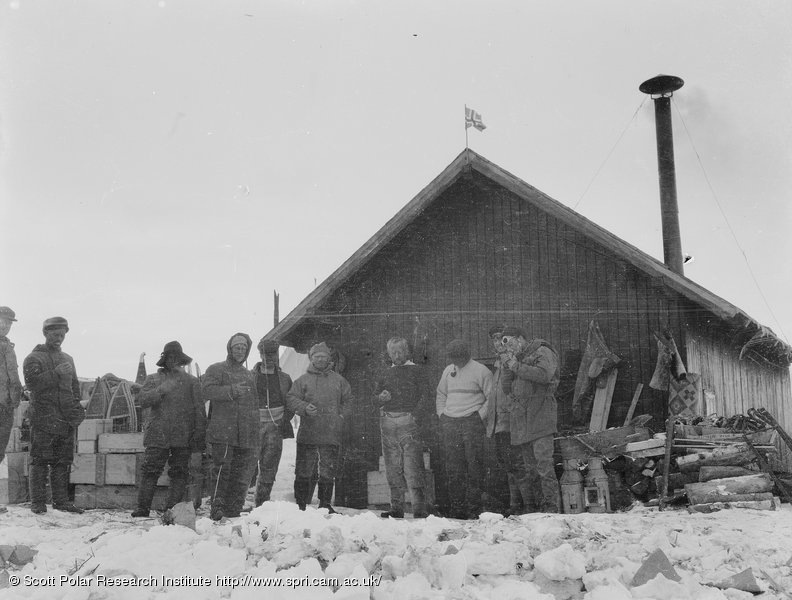 Campbell and his party at Framheim. At center, without a hat, is Amundsen, with Johansen at his right. Hassel is fourth from the left, with a fair beard. The man in the white jumper is probably Campbell. [9]
Campbell (who spoke Norwegian), Pennell, and Levick, the eastern party's surgeon, were invited to breakfast in the new hut, where Lindstrøm served them all hotcakes, and then they were given a tour of the Fram. "[Everyone] broke out in eulogies over how nice and comfortably we lived," Gjertsen said. "When they saw that every man had his own cabin, and everyone had a large common saloon, their eyes grew wide with astonishment. No, they had seen nothing like this before." Upon hearing how the officers' mess on the Terra Nova lay directly underneath the ponies, "one of Fram's crew was immediately seized by the deepest sympathy, and gave his melancholy informant ... a tot of aquavit to strengthen himself. The Englishman was wild with enthusiasm. Yes, it was 'a wonderful ship'."
Nilsen, after being shown over the Terra Nova in return, noted laconically, "I must confess it did not look very inviting." [10]
Johansen was not impressed either. "They should go to New Zealand immediately," he wrote in his diary. "They had a hard journey. Had been leaking and the bulwark was knocked in. But they were in good spirits and extremely courteous to us, though they nevertheless had not expected to meet us here. Something they repeatedly assured us." [11]
Amundsen told the British to land and make their base wherever they wanted, but, as Priestley put it, "we cannot according to etiquette trench on their country for winter quarters." [12] Campbell was deeply disappointed, having regarded the exploration of King Edward Land as "the thing of the whole expedition, " its only truly original work. [13] When Amundsen asked casually about the motor sledges, Campbell told him that one was "already on terra firma." He was referring, of course, to the one at the bottom of McMurdo Sound, but further information was neither asked for nor given. [14]
"It appears that ... Capt. Amundsen ... is going to have a run for the Pole so it will prove a very exciting affair," Dickason, one of the British seamen, wrote in his diary. "He has dogs for sledge work and all his men are good on ski." [15]
Notes:
[1] Alexander Turnbull Library, National Library of New Zealand. The catalogue record of this photograph identifies it as "The ship Terra Nova arriving at the Bay of Whales in 1910, to find the Norwegian expedition.... Photographed from 'Fram', the ship of Amundsen, by an unidentified photographer". It is clearly, however, the smoke-stackless, not to mention stocky and straight-sided, Fram.
[2] Roald Amundsen Bildearkiv, Nasjonalbiblioteket.
[3] Raymond Priestley, diary, [date not given], quoted by Roland Huntford in Scott and Amundsen (New York : Putnam, 1980, c1979), p.342.
[4] Wilfred Bruce, letter to Kathleen Scott, 27 February, 1911, quoted by Roland Huntford in Scott and Amundsen (New York : Putnam, 1980, c1979), p.342.
[5] Wilfred Bruce, letter to Kathleen Scott, 27 February, 1911, quoted by David Crane in Scott of the Antarctic (New York : Knopf, c2005), p.424.
[6] Lt. H.F. Gjertsen, diary, 4 February, 1911, quoted by Roland Huntford in Scott and Amundsen (New York : Putnam, 1980, c1979), p.341. The watchman was Beck, according to Gjertsen's account in ch.16 of The South Pole.
[7] Roald Amundsen Bildearkiv, Nasjonalbiblioteket.
[8] Lt. H.F. Gjertsen, diary, 4 February, 1911, quoted by Roland Huntford in Scott and Amundsen (New York : Putnam, 1980, c1979), p.341.
[9] Scott Polar Research Institute. The SPRI labels this photograph as being taken by Debenham, but he was in Victoria Land with Taylor, Wright, and P.O. Evans from January to March 1911; Levick probably took it, as he was quite interested in photography and had had lessons from Ponting.
[10] Thorvald Nilsen, diary, 4 February, 1911, quoted by Roland Huntford in Scott and Amundsen (New York : Putnam, 1980, c1979), p.344.
[11] Hjalmar Johansen, diary, 4 February 1911, published as Dagbok fra Sydpolen (Skien : Vågemot Miniforlag, 2007), p.6.
[12] Raymond Priestley, diary, 4 February, 1911, quoted by Roland Huntford in Scott and Amundsen (New York : Putnam, 1980, c1979), p.344.
[13] Victor Campbell [?], 27 February, 1911, quoted by David Crane in Scott of the Antarctic (New York : Knopf, c2005), p.424.
[14] Katherine Lambert, in The Longest Winter (Washington DC : Smithsonian, 2004, originally Hell with a Capital H, Pimlico, 2002) is the only writer yet found to state that the Norwegians did in fact find out that one of Scott's sledges had been lost: "Unfortunately, a member of the Eastern Party had let slip the fact that one of these machines was even then reposing on the floor of McMurdo Sound, a fact noted by Nilsen in his diary -- 'at 200 fathoms on the ice they had lost their best automobile.' Amundsen must have been profoundly relieved to hear this snippet of news" (p.53). Lambert does not give a citation for this or any of the diary quotes in this chapter.
[15] Harry Dickason, diary, 4 February 1911, quoted by Roland Huntford in Race for the South Pole : the expedition diaries of Scott and Amundsen (London : Continuum, c2010), p.18.
January 28, 2011
Saturday, 28 January 1911
Scott
 "Sledge-hauling on the Great Ice Barrier" by E.A. Wilson, 1903. [1]
The depot-laying party reached the Barrier.
"Those first days of sledging were wonderful!" wrote Cherry in retrospect. "What memories they must have brought to Scott and Wilson when to us, who had never seen them before, these much-discussed landmarks were almost like old friends." [2]
"I expect we were all a little excited, for to walk upon the Barrier for the first time was indeed an adventure: what kind of surface was it, and how about these beastly crevasses of which we had read so much? Scott was ahead, and so far as we could see there was nothing but the same level of ice all round -- when suddenly he was above us, walking up the sloping and quite invisible drift. A minute after and our ponies and sledges were up and over the tide crack, and beneath us soft and yielding snow, very different from the hard wind-swept surface of the frozen sea, which we had just left."
The Terra Nova left for the western shore of McMurdo Sound to land Taylor's geological party.
Notes:
[1] Source unknown.
[2] Apsley Cherry-Garrard, The Worst Journey in the World, ch.5.
 "Sledge-hauling on the Great Ice Barrier" by E.A. Wilson, 1903. [1]
The depot-laying party reached the Barrier.
"Those first days of sledging were wonderful!" wrote Cherry in retrospect. "What memories they must have brought to Scott and Wilson when to us, who had never seen them before, these much-discussed landmarks were almost like old friends." [2]
"I expect we were all a little excited, for to walk upon the Barrier for the first time was indeed an adventure: what kind of surface was it, and how about these beastly crevasses of which we had read so much? Scott was ahead, and so far as we could see there was nothing but the same level of ice all round -- when suddenly he was above us, walking up the sloping and quite invisible drift. A minute after and our ponies and sledges were up and over the tide crack, and beneath us soft and yielding snow, very different from the hard wind-swept surface of the frozen sea, which we had just left."
The Terra Nova left for the western shore of McMurdo Sound to land Taylor's geological party.
Notes:
[1] Source unknown.
[2] Apsley Cherry-Garrard, The Worst Journey in the World, ch.5.
January 8, 2011
Sunday, 8 January 1911
Scott
 "Men pulling a motor-sledge from the 'Terra Nova' on 8 January 1911. Taken by Herbert George Ponting in 1911, during the British Antarctic ('Terra Nova') Expedition (1910-1913)." [1]
The third of the motor sledges was lost when it fell through the thawing sea ice as it was being unloaded. "We realised that the ice was getting very rotten," Priestley wrote in his diary, but no-one wanted to disobey Scott's orders to hurry. The sledge had been lowered onto the ice when Williamson went through to his knees, "[the] car suddenly dipped, the ice gave way beneath her after end and she fell with all her weight vertically on the rope. The rope began cutting through the thin ice, and we were never able to hold her steady for a moment. Man after man was forced to leave the rope through his hands, and when only five of us were left she took charge at a gallop and is now resting on the bottom at a depth of 120 fathoms." Priestley himself, having gone back to the ship for a life-line and Day's goggles, fell through and was swept under by a strong current, bursting up again through the rotten ice "like a cork out of a champagne bottle." [2] "Day, here are your goggles," he said calmly. [3]
"A day of disaster," Scott wrote in his journal. [4]
Notes:
[1] National Library of New Zealand.
[2] Raymond Priestley, diary, 8 January, 1911, quoted by David Crane in Scott of the Antarctic (New York : Knopf, c2005), p.404.
[3] Apsley Cherry-Garrard, The Worst Journey in the World, ch.4.
[4] R.F. Scott, diary, 8 January, 1911, quoted in Scott's Last Expedition, v.1.
"Men pulling a motor-sledge from the 'Terra Nova' on 8 January 1911. Taken by Herbert George Ponting in 1911, during the British Antarctic ('Terra Nova') Expedition (1910-1913)." [1]The third of the motor sledges was lost when it fell through the thawing sea ice as it was being unloaded. "We realised that the ice was getting very rotten," Priestley wrote in his diary, but no-one wanted to disobey Scott's orders to hurry. The sledge had been lowered onto the ice when Williamson went through to his knees, "[the] car suddenly dipped, the ice gave way beneath her after end and she fell with all her weight vertically on the rope. The rope began cutting through the thin ice, and we were never able to hold her steady for a moment. Man after man was forced to leave the rope through his hands, and when only five of us were left she took charge at a gallop and is now resting on the bottom at a depth of 120 fathoms." Priestley himself, having gone back to the ship for a life-line and Day's goggles, fell through and was swept under by a strong current, bursting up again through the rotten ice "like a cork out of a champagne bottle." [2] "Day, here are your goggles," he said calmly. [3]
"A day of disaster," Scott wrote in his journal. [4]
Notes:
[1] National Library of New Zealand.
[2] Raymond Priestley, diary, 8 January, 1911, quoted by David Crane in Scott of the Antarctic (New York : Knopf, c2005), p.404.
[3] Apsley Cherry-Garrard, The Worst Journey in the World, ch.4.
[4] R.F. Scott, diary, 8 January, 1911, quoted in Scott's Last Expedition, v.1.
January 7, 2011
Saturday, 7 January 1911
 "View of ice, with the ship 'Terra Nova' in the distance, taken 7 January 1911 by Herbert George Ponting during the British Antarctic Expedition." [1]
Work continued unloading the Terra Nova. Two parties of officers made ten journeys apiece, with loads of 250 to 300 lbs. per man, 25 miles over the ice to the site of the hut. The ponies, fractious and restive after their long confinement aboard ship, two or three times got away from their handlers, once with a loaded sledge. "Oates is splendid with them," wrote Scott, "I do not know what we should do without him." [2]
The dogs, too, were restless, and a team got away from Meares, so unexpectedly that one of the dogs lost its footing and was dragged for nearly half a mile.
The ice was becoming sludgy, and in some places the ponies' feet went through. Ponting, too, got a ducking, out on his own with a small sledge loaded with his cameras and cinematograph, but luckily for him and his equipment both, the weak area he had inadvertently stepped into was small enough that he managed to pull himself out.
Work on the hut continued apace, and the framework was being covered with its double-layer of insulation. "I am wondering," Scott added to himself, "how we shall stable the ponies in the winter."
Sources:
[1] National Library of New Zealand.
[2] R.F. Scott, diary, 7 January, 1911, quoted in Scott's Last Expedition, v.1.
January 3, 2011
Tuesday, 3 January 1911
Scott
 Cape Crozier precipices, photographed by Ponting on 3 January, 1911. [1]
"6 P.M. -- No good!! Alas! Cape Crozier with all its attractions is denied us," lamented Scott. [2] They had come to the Great Barrier five miles east of the Cape, but heavy swells prevented their landing a boat, and there was no access to the beach for unloading their equipment. "It would have taken weeks to land the ordinary stores, and heaven knows how we could have got the ponies and the motor sledges ashore." [3]
Cherry wrote later, "We could see the great pressure waves which had proved such an obstacle to travellers from the Discovery to the Emperor penguin rookery. The Knoll was clear, but the summit of Mount Terror was in the clouds. As for the Barrier we seemed to have known it all our lives, it was so exactly like what we had imagined it to be, and seen in the pictures and photographs." [4]
Amundsen
 Fram in the ice-pack, 1910. [5]
The Fram entered the pack ice at 175° 35'E longitude.
"The ice through which we have gone lies in streams with broad, open leads in between [with] a few eroded icebergs," Amundsen wrote in his diary. "An occasional seal has been seen here and there. In those cases, we stop and take it.... It had been a red letter day for all of us. For dinner we had steak -- the finest and tenderest meat.... The dogs have done just as well. For dinner they had each their huge piece of meat, about 2 kilos, together with a large piece of skin with blubber. To begin with, they did not really grasp the change from stockfish to fresh seal meat -- but it did not take them long.... I estimate that the ... heaviest seal we caught weighs about 500 kilos. Not many of those fellows will be needed to feed the dogs during the winter." [6]
Notes:
[1] Scott Polar Research Institute.
[2] R.F. Scott, diary, 3 January, 1911, quoted in Scott's Last Expedition, v.1.
[3] R.F. Scott, diary [date not given], quoted by David Crane in Scott of the Antarctic (New York : Knopf, c2005), p.401-402.
[4] Apsley Cherry-Garrard, The Worst Journey in the World, ch.4.
[5] Roald Amundsen Bildearkiv, Nasjonalbiblioteket.
[6] Roald Amundsen, diary, 3 January, 1911, quoted by Roland Huntford in The Amundsen Photographs (London : Hodder & Stoughton, c1987), p.72.
 Cape Crozier precipices, photographed by Ponting on 3 January, 1911. [1]
"6 P.M. -- No good!! Alas! Cape Crozier with all its attractions is denied us," lamented Scott. [2] They had come to the Great Barrier five miles east of the Cape, but heavy swells prevented their landing a boat, and there was no access to the beach for unloading their equipment. "It would have taken weeks to land the ordinary stores, and heaven knows how we could have got the ponies and the motor sledges ashore." [3]
Cherry wrote later, "We could see the great pressure waves which had proved such an obstacle to travellers from the Discovery to the Emperor penguin rookery. The Knoll was clear, but the summit of Mount Terror was in the clouds. As for the Barrier we seemed to have known it all our lives, it was so exactly like what we had imagined it to be, and seen in the pictures and photographs." [4]
Amundsen
 Fram in the ice-pack, 1910. [5]
The Fram entered the pack ice at 175° 35'E longitude.
"The ice through which we have gone lies in streams with broad, open leads in between [with] a few eroded icebergs," Amundsen wrote in his diary. "An occasional seal has been seen here and there. In those cases, we stop and take it.... It had been a red letter day for all of us. For dinner we had steak -- the finest and tenderest meat.... The dogs have done just as well. For dinner they had each their huge piece of meat, about 2 kilos, together with a large piece of skin with blubber. To begin with, they did not really grasp the change from stockfish to fresh seal meat -- but it did not take them long.... I estimate that the ... heaviest seal we caught weighs about 500 kilos. Not many of those fellows will be needed to feed the dogs during the winter." [6]
Notes:
[1] Scott Polar Research Institute.
[2] R.F. Scott, diary, 3 January, 1911, quoted in Scott's Last Expedition, v.1.
[3] R.F. Scott, diary [date not given], quoted by David Crane in Scott of the Antarctic (New York : Knopf, c2005), p.401-402.
[4] Apsley Cherry-Garrard, The Worst Journey in the World, ch.4.
[5] Roald Amundsen Bildearkiv, Nasjonalbiblioteket.
[6] Roald Amundsen, diary, 3 January, 1911, quoted by Roland Huntford in The Amundsen Photographs (London : Hodder & Stoughton, c1987), p.72.
Subscribe to:
Posts (Atom)


