Scott
Here at 87°32'S, Lt. Evans, Crean, and Lashly turned back for Cape Evans. They were less than 150 miles from the Pole. "Teddy Evans is terribly disappointed but has taken it very well and behaved like a man. Poor old Crean wept and even Lashly was affected," Scott wrote. "I was glad to find their sledge is a mere nothing to them, and thus, no doubt, they will make a quick journey back." [1] Wilson was "very sorry for Teddy Evans as he has spent 2 1/2 years in working for a place on this polar journey." [2]
Oates told Evans, "I'm afraid, Teddy, you won't have much of a 'slope' going back, but old Christopher [Oates' pony] is waiting to be eaten on the Barrier when you get there." [3]
Evans carried a number of messages from Scott, to Kathleen, to the press -- "I am remaining in the Antarctic for another winter in order to continue and complete my work" -- and a verbal one to Meares, changing the orders for the dogs, for the fourth time. He wanted Meares to come out with the dogs and meet them between 82° and 83° S some time in the middle of February, in order to hurry the Polar party back in time to catch the ship.
The three men followed the Polar party for a few miles, stopped, gave three cheers, and turned for home.
Bowers found it difficult to keep up with the team, sinking sometimes to his knees in the snow. "It is a long slog with a well-loaded sledge," he wrote, "and more tiring for me than the others, as I have no ski. However, as long as I can do my share all day and keep fit it does not matter much one way or the other." [4]
"At present everything seems to be going with extraordinary smoothness, and one can scarcely believe that obstacles will not present themselves to make our task more difficult." [5]
Lashly wrote that evening, "We travelled a long time so as to make the best of it while the weather was suitable, as we have to keep up a good pace on the food allowance. It wont do [sic] to lay up much. One thing since we left Mt. Darwin, we have had weather we could travel in, although we have not seen the sun much of late. We did 13 miles as near as we can guess by the cairns we have passed. We have not got a sledge meter so shall have to go by guess all the way home." Cherry added here later, "Owing to the loss of a sledge meter on the Beardmore Glacier one of the three parties had to return without one. A sledge meter gives the navigator his dead reckoning, indicating the miles travelled, like the log of a ship. To be deprived of it in a wilderness of snow without landmarks adds enormously to the difficulties and anxieties of a sledge party." [6]
Back at Hut Point, Meares and Dimitri arrived with the dogs.
Amundsen
The Norwegians reached the Butcher's Shop and their depot of dog carcasses.
It was Helmer Hanssen, Amundsen wrote gratefully, "who, with his sharp eyes, discovered [the depot]. Had that not been the case, I don't quite know what would have happened. The place was completely unrecognisable -- just as if we had never seen it before." Their earlier visit had been in fog. "No, to travel blind in these surroundings is fairly dangerous. I thought I recognized the land yesterday, but subsequently it proved to be absolutely wrong." [7]
He also realised that he had "overestimated the heights of the mountains a lot in the misty atmosphere on the southwards journey." He decided, correctly as it turned out, that they were only twelve to thirteen thousand feet, not eighteen to twenty thousand as he had written to King Haakon, and which earlier Bjaaland "had found so damned difficult to believe." [8]
Stopping only long enough to feed the dogs and load the sledges with the meat from the depot, they "shot off, pell mell, down the slopes, the one worse than the other," as Bjaaland put it. The sledges were braked with ropes wound around the runners. They dropped 3,000 feet from the Butcher's Shop to the upper terrace of the Axel Heiberg Glacier in an hour and a half, having done 23 miles for the day. "[We] have our tent in a warm and cosy place where the sun is in the process of melting us," Amundsen wrote. "The dogs are resting contentedly in the sunshine having devoured a huge portion of dog meat plus pemmican.... Well, we are down from the Plateau again, and we are all extremely glad. We have been comfortable there, but we long for the 'Barrier', which is an old friend. Once down there, we count ourselves as good as home. We have got food there all over the place." [9]
They had been 45 days on the Polar Plateau.
Notes:
[1] R.F. Scott, diary, 4 January, 1912, quoted in Scott's Last Expedition, v.1.
[2] E.A. Wilson, diary, 4 January, 1912, quoted by Roland Huntford in Scott and Amundsen (New York : Putnam, 1980, c1979), p.475.
[3] E.R.G.R. Evans, South With Scott, p.207, quoted by Roland Huntford in Scott and Amundsen (New York : Putnam, 1980, c1979), p.475.
[4] H.R. Bowers, diary, 4 January, 1912, quoted by Apsley Cherry-Garrard in The Worst Journey in the World, ch.XVII.
[5] R.F. Scott, diary, 4 January, 1912, quoted in Scott's Last Expedition, v.1.
[6] William Lashly, diary, 4 January, 1912, quoted by Apsley Cherry-Garrard in The Worst Journey in the World, ch.XII.
[7] Roald Amundsen, diary, 5 January, 1912, quoted by Roland Huntford in Race for the South Pole : the expedition diaries of Scott and Amundsen (London : Continuum, c2010), p.224.
[8] Olav Bjaaland, diary, 5 January, 1912, quoted by Roland Huntford in Race for the South Pole : the expedition diaries of Scott and Amundsen (London : Continuum, c2010), p.225.
[9] Roald Amundsen, diary, 5 January 1912, quoted by Roland Huntford in Scott and Amundsen (New York : Putnam, 1980, c1979), p.503-504.
Showing posts with label Meares. Show all posts
Showing posts with label Meares. Show all posts
January 4, 2012

December 11, 2011
Monday, 11 December 1911
Scott
 The Beardmore Glacier, discovered by Shackleton on his Nimrod expedition in 1908. This aerial photograph was taken in 1956. [1]
"[Lt. Evans's team] started quite well," wrote Scott, "but got into difficulties, did just the wrong thing by straining again and again, and so, tiring themselves, went from bad to worse. Their ski shoes, too, are out of trim. Just as I thought we were in for making a great score, this difficulty overtakes us -- it is dreadfully trying. The snow around us to-night is terribly soft, one sinks to the knee at every step; it would be impossible to drag sledges on foot and very difficult for dogs. Ski are the thing, and here are my tiresome fellow-countrymen too prejudiced to have prepared themselves for the event." [2]
Wright, with Atkinson and Lashly on Lt. Evans's team, wrote somewhat testily in his diary, "Scott came back to wonder why we were behind the other teams. I was in front with Evans and had found one could do better by pulling at an angle of about 15° to the side and thus get a grip on the surface without my ski sliding back. Scott then said to Birdie, 'See that's the way to do it,' to which Birdie unthinkingly replied, 'Yes, but look at the loss of pull due to the angle.' I felt like reminding Birdie that the cosine at 15° would not lose more than 1 per cent effort of the straight pull.... However I kept my peace, for conditions were then at their worst and any argument ... should be avoided." [3]

In the afternoon, Meares and Dimitri finally turned for home with the dog teams. "They have done splendidly," Cherry wrote in his diary. "It looks as if Amundsen may have hit off the right thing." [5]
"The dogs should get back quite easily," Scott added, "there is food all along the line." There were in fact only two depots between the foot of the Beardmore and 80° (to Amundsen's seven), the Mid-Barrier depot and One Ton, 120 miles apart.
The dogs were supposed to have turned back two days earlier. In order to provide Meares with two days' more food, everyone else in the party gave up one biscuit daily, almost five percent of an already-low ration. [6]
Amundsen
At 89° 15', they started now to go downhill, sinking gently from the summit.
"[The] same fine terrain and going," Amundsen wrote in his diary. [7] In sunshine and clear skies, the men had done seventeen miles instead of their stipulated fifteen.
"The Pole is in sight," Bjaaland wrote. "Hope and pray to my God that the weather may continue fine. I whipped the dogs on to keep level with Helmer Hanssen's." [8]
With the goal fast approaching, nerves were tight. Hassel found Amundsen "distant and cantankerous", writing in his diary, "One would think the man has a screw loose. He has many times in the last few days actually initiated quarrels, an extraordinary stand to take for a Governor and leader for whom peace and good camaraderie should be the main target." [9]
In King Edward VII Land, Prestrud's Eastern Party had their first day of real sunshine. "At our midday rest we found ourselves abreast of the bay, where, on the outward journey, we had laid down our depot of seals' flesh. I had intended to turn aside to the depot and replenish our supply of meat as a precaution, but Johansen suggested leaving out this detour and going straight on. We might thereby run the risk of having to go on short rations; but Johansen thought it a greater risk to cross the treacherous ground about the bay, and, after some deliberation, I saw he was right. It was better to go on while we were about it." [10]
Notes:
[1] Wikipedia.
[2] R.F. Scott, diary, 11 December, 1911, quoted in Scott's Last Expedition : the Journals, v.1.
[3] Charles Wright, diary, 11 December, 1911, quoted by David Crane in Scott of the Antarctic (New York : Knopf, c2005), p.472.
[4] Henry Fountain, "Antarctic Odyssey, Through the Eyes of a Polar Pioneer", New York Times, October 17, 2011.
[5] Apsley Cherry-Garrard, diary, 11 December 1911, quoted by Roland Huntford in Scott and Amundsen (New York : Putnam, 1980, c1979), p.465.
[6] R.F. Scott, diary, 11 December, 1911, quoted in Scott's Last Expedition : the Journals, v.1.
[7] Roald Amundsen, diary, 12 December ,1911, quoted by Roland Huntford in Scott and Amundsen (New York : Putnam, 1980, c1979), p.484.
[8] Olav Bjaaland, diary, 12 December, 1911, quoted by Roland Huntford in Scott and Amundsen (New York : Putnam, 1980, c1979), p.484.
[9] Sverre Hassel, diary, [12 December, 1911], quoted by Tor Bomann-Larsen in Roald Amundsen (Stroud, Gloucestershire : Sutton, c2006, c1995), p.108.
[10] Kristian Prestrud, "The Eastern Sledge Journey", in Roald Amundsen's The South Pole, ch.15. Note that the date is given as 12th December; see Hinks' note on dates in "The Observations of Amundsen and Scott at the South Pole" (The Geographical Journal, April 1944, p.169).
 The Beardmore Glacier, discovered by Shackleton on his Nimrod expedition in 1908. This aerial photograph was taken in 1956. [1]
"[Lt. Evans's team] started quite well," wrote Scott, "but got into difficulties, did just the wrong thing by straining again and again, and so, tiring themselves, went from bad to worse. Their ski shoes, too, are out of trim. Just as I thought we were in for making a great score, this difficulty overtakes us -- it is dreadfully trying. The snow around us to-night is terribly soft, one sinks to the knee at every step; it would be impossible to drag sledges on foot and very difficult for dogs. Ski are the thing, and here are my tiresome fellow-countrymen too prejudiced to have prepared themselves for the event." [2]
Wright, with Atkinson and Lashly on Lt. Evans's team, wrote somewhat testily in his diary, "Scott came back to wonder why we were behind the other teams. I was in front with Evans and had found one could do better by pulling at an angle of about 15° to the side and thus get a grip on the surface without my ski sliding back. Scott then said to Birdie, 'See that's the way to do it,' to which Birdie unthinkingly replied, 'Yes, but look at the loss of pull due to the angle.' I felt like reminding Birdie that the cosine at 15° would not lose more than 1 per cent effort of the straight pull.... However I kept my peace, for conditions were then at their worst and any argument ... should be avoided." [3]

The camp at Lower Glacier Depot, 11th December, 1911, photographed by Scott. [4]
In the afternoon, Meares and Dimitri finally turned for home with the dog teams. "They have done splendidly," Cherry wrote in his diary. "It looks as if Amundsen may have hit off the right thing." [5]
"The dogs should get back quite easily," Scott added, "there is food all along the line." There were in fact only two depots between the foot of the Beardmore and 80° (to Amundsen's seven), the Mid-Barrier depot and One Ton, 120 miles apart.
The dogs were supposed to have turned back two days earlier. In order to provide Meares with two days' more food, everyone else in the party gave up one biscuit daily, almost five percent of an already-low ration. [6]
Amundsen
At 89° 15', they started now to go downhill, sinking gently from the summit.
"[The] same fine terrain and going," Amundsen wrote in his diary. [7] In sunshine and clear skies, the men had done seventeen miles instead of their stipulated fifteen.
"The Pole is in sight," Bjaaland wrote. "Hope and pray to my God that the weather may continue fine. I whipped the dogs on to keep level with Helmer Hanssen's." [8]
With the goal fast approaching, nerves were tight. Hassel found Amundsen "distant and cantankerous", writing in his diary, "One would think the man has a screw loose. He has many times in the last few days actually initiated quarrels, an extraordinary stand to take for a Governor and leader for whom peace and good camaraderie should be the main target." [9]
In King Edward VII Land, Prestrud's Eastern Party had their first day of real sunshine. "At our midday rest we found ourselves abreast of the bay, where, on the outward journey, we had laid down our depot of seals' flesh. I had intended to turn aside to the depot and replenish our supply of meat as a precaution, but Johansen suggested leaving out this detour and going straight on. We might thereby run the risk of having to go on short rations; but Johansen thought it a greater risk to cross the treacherous ground about the bay, and, after some deliberation, I saw he was right. It was better to go on while we were about it." [10]
Notes:
[1] Wikipedia.
[2] R.F. Scott, diary, 11 December, 1911, quoted in Scott's Last Expedition : the Journals, v.1.
[3] Charles Wright, diary, 11 December, 1911, quoted by David Crane in Scott of the Antarctic (New York : Knopf, c2005), p.472.
[4] Henry Fountain, "Antarctic Odyssey, Through the Eyes of a Polar Pioneer", New York Times, October 17, 2011.
[5] Apsley Cherry-Garrard, diary, 11 December 1911, quoted by Roland Huntford in Scott and Amundsen (New York : Putnam, 1980, c1979), p.465.
[6] R.F. Scott, diary, 11 December, 1911, quoted in Scott's Last Expedition : the Journals, v.1.
[7] Roald Amundsen, diary, 12 December ,1911, quoted by Roland Huntford in Scott and Amundsen (New York : Putnam, 1980, c1979), p.484.
[8] Olav Bjaaland, diary, 12 December, 1911, quoted by Roland Huntford in Scott and Amundsen (New York : Putnam, 1980, c1979), p.484.
[9] Sverre Hassel, diary, [12 December, 1911], quoted by Tor Bomann-Larsen in Roald Amundsen (Stroud, Gloucestershire : Sutton, c2006, c1995), p.108.
[10] Kristian Prestrud, "The Eastern Sledge Journey", in Roald Amundsen's The South Pole, ch.15. Note that the date is given as 12th December; see Hinks' note on dates in "The Observations of Amundsen and Scott at the South Pole" (The Geographical Journal, April 1944, p.169).
December 7, 2011
Thursday, 7 December 1911
Scott
"The storm continues and the situation is now serious," wrote Scott. "One small feed remains for the ponies after to-day, so that we must either march to-morrow or sacrifice the animals. That is not the worst; with the help of the dogs we could get on, without doubt. The serious part is that we have this morning started our Summit rations, that is to say, the food calculated from the Glacier depot has been begun. Resignation to misfortune is the only attitude, but not an easy one to adopt. It seems undeserved where plans were well laid and so nearly crowned with a first success. I cannot see that any plan would be altered if it were to do again, the margin for bad weather was ample according to all experience, and this stormy December -- our finest month -- is a thing that the most cautious organiser might not have been prepared to encounter. It is very evil to lie here in a wet sleeping-bag and think of the pity of it, whilst with no break in the overcast sky things go steadily from bad to worse (T. 32°)." [1]
Teddy Evans, a trifle petulantly, wrote in his diary, "I think it would be fairer to shoot [the ponies] now, for what is a possible twelve miles to help?... Why, our party have never been out of harness for nearly 400 miles, so why should not the other eight men buckle to and do some dragging instead of saving work in halfpenny numbers?" [2]
With little else to do, Cherry's thoughts turned towards food. "Henceforward our full ration will be 16 oz. biscuit, 12 oz. pemmican, 2 oz. butter, 0.57 oz. cocoa, 3.0 oz. sugar and 0.86 oz. tea. This is the Summit ration, total 34.43 oz., with a little onion powder and salt. I am all for this: Seaman Evans and others are much regretting the loss of chocolate, raisins and cereals. For the first week up the glacier we are to go one biscuit short to provision Meares on the way back. The motors depôted too much and Meares has been brought on far farther than his orders were originally bringing him. Originally he was to be back at Hut Point on December 10. The dogs, however, are getting all the horse that is good for them, and are very fit. He has to average 24 miles a day going back. Michael is well out of this: we are now eating him. He was in excellent condition and tastes very good, though tough." [3]
Amundsen
 Sledges, dogs, and men, having passed Shackleton's southernmost latitude, 7th December, 1911. [4]
"One of our big days," Amundsen began his diary.
"'His Grace'" the sun emerged and they found the observed latitude, 88° 16', agreed with the dead reckoning to within a mile: "a brilliant victory, after 1 1/2 deg. [ninety miles] in thick fog and snow drift ... so now we are ready to take the pole in any kind of weather on offer." [5]
Amundsen, going ahead as forerunner, "suddenly heard a stout, hearty cheer behind. I turned round. In the light breeze from the South, the brave, well-known colours waved from the first sledge, we have passed and put behind us [Shackleton's] record. It was a splendid sight. The sun had just broken through in all its glory and illuminated in a lovely manner the beautiful little flag .... My goggles clouded over again, but this time it was not the South wind's fault." [6]
"As my dogs were horribly worn, I was 1 mile behind," wrote Bjaaland, "and when I reached 88° 23' the Norwegian flag was flying, and I seemed to walk on springs. I congratulated the Captain, he was in a brilliant humour, you can be sure. Extra chocolate in honour of the occasion. Tomorrow rest day. The sun is shining." [7]
 Prestrud at the top of Scott's Nunatak, probably 7th December, 1911. [8]
In the Alexandra Mountains, Prestrud's party dug themselves out after a four-day blizzard. "After six hours' hard work," he wrote later, "we got the tent set up a few yards to windward of its first position; the place where it had stood was now a well about seven feet deep. Unfortunately there was no chance of immortalizing this scene of excavation. It would have been amusing enough to have it on the plate; but drifting snow is a serious obstacle to an amateur photographer -- besides which, my camera was on Stubberud's sledge, buried at least four feet down." [9]
Afterwards, they dashed off at last to the peaks they had sighted days earlier, which he named Scott's Nunataks -- "after Captain Scott, who first saw them" in 1902.
Notes:
[1] R.F. Scott, diary, 7 December, 1911, quoted in Scott's Last Expedition : the Journals, v.1.
[2] E.R.G.R. Evans, diary, [date not given], quoted by David Crane in Scott of the Antarctic (New York : Knopf, c2005), p.469.
[3] Apsley Cherry-Garrard, The Worst Journey in the World, ch.IX.
[4] Roald Amundsen Bildearkiv, Nasjonalbiblioteket.
[5] Roald Amundsen, diary, 8 December, 1911, quoted by Roland Huntford in Scott and Amundsen (New York : Putnam, 1980, c1979), p.484.
[6] Roald Amundsen, diary, 8 December, 1911, quoted by Roland Huntford in Scott and Amundsen (New York : Putnam, 1980, c1979), p.459.
[7] Olav Bjaaland, diary, 8 December, 1911, quoted by Roland Huntford in Race for the South Pole : the expedition diaries of Scott and Amundsen (London : Continuum, c2010), p.170.
[8] Roald Amundsen Bildearkiv, Nasjonalbiblioteket.
[9] Kristian Prestrud, "The Eastern Sledge Journey", in Roald Amundsen's The South Pole, ch.15. Note that the date is given as 8th December; see Hinks' note on dates in "The Observations of Amundsen and Scott at the South Pole" (The Geographical Journal, April 1944, p.169).
"The storm continues and the situation is now serious," wrote Scott. "One small feed remains for the ponies after to-day, so that we must either march to-morrow or sacrifice the animals. That is not the worst; with the help of the dogs we could get on, without doubt. The serious part is that we have this morning started our Summit rations, that is to say, the food calculated from the Glacier depot has been begun. Resignation to misfortune is the only attitude, but not an easy one to adopt. It seems undeserved where plans were well laid and so nearly crowned with a first success. I cannot see that any plan would be altered if it were to do again, the margin for bad weather was ample according to all experience, and this stormy December -- our finest month -- is a thing that the most cautious organiser might not have been prepared to encounter. It is very evil to lie here in a wet sleeping-bag and think of the pity of it, whilst with no break in the overcast sky things go steadily from bad to worse (T. 32°)." [1]
Teddy Evans, a trifle petulantly, wrote in his diary, "I think it would be fairer to shoot [the ponies] now, for what is a possible twelve miles to help?... Why, our party have never been out of harness for nearly 400 miles, so why should not the other eight men buckle to and do some dragging instead of saving work in halfpenny numbers?" [2]
With little else to do, Cherry's thoughts turned towards food. "Henceforward our full ration will be 16 oz. biscuit, 12 oz. pemmican, 2 oz. butter, 0.57 oz. cocoa, 3.0 oz. sugar and 0.86 oz. tea. This is the Summit ration, total 34.43 oz., with a little onion powder and salt. I am all for this: Seaman Evans and others are much regretting the loss of chocolate, raisins and cereals. For the first week up the glacier we are to go one biscuit short to provision Meares on the way back. The motors depôted too much and Meares has been brought on far farther than his orders were originally bringing him. Originally he was to be back at Hut Point on December 10. The dogs, however, are getting all the horse that is good for them, and are very fit. He has to average 24 miles a day going back. Michael is well out of this: we are now eating him. He was in excellent condition and tastes very good, though tough." [3]
Amundsen
 Sledges, dogs, and men, having passed Shackleton's southernmost latitude, 7th December, 1911. [4]
"One of our big days," Amundsen began his diary.
"'His Grace'" the sun emerged and they found the observed latitude, 88° 16', agreed with the dead reckoning to within a mile: "a brilliant victory, after 1 1/2 deg. [ninety miles] in thick fog and snow drift ... so now we are ready to take the pole in any kind of weather on offer." [5]
Amundsen, going ahead as forerunner, "suddenly heard a stout, hearty cheer behind. I turned round. In the light breeze from the South, the brave, well-known colours waved from the first sledge, we have passed and put behind us [Shackleton's] record. It was a splendid sight. The sun had just broken through in all its glory and illuminated in a lovely manner the beautiful little flag .... My goggles clouded over again, but this time it was not the South wind's fault." [6]
"As my dogs were horribly worn, I was 1 mile behind," wrote Bjaaland, "and when I reached 88° 23' the Norwegian flag was flying, and I seemed to walk on springs. I congratulated the Captain, he was in a brilliant humour, you can be sure. Extra chocolate in honour of the occasion. Tomorrow rest day. The sun is shining." [7]
 Prestrud at the top of Scott's Nunatak, probably 7th December, 1911. [8]
In the Alexandra Mountains, Prestrud's party dug themselves out after a four-day blizzard. "After six hours' hard work," he wrote later, "we got the tent set up a few yards to windward of its first position; the place where it had stood was now a well about seven feet deep. Unfortunately there was no chance of immortalizing this scene of excavation. It would have been amusing enough to have it on the plate; but drifting snow is a serious obstacle to an amateur photographer -- besides which, my camera was on Stubberud's sledge, buried at least four feet down." [9]
Afterwards, they dashed off at last to the peaks they had sighted days earlier, which he named Scott's Nunataks -- "after Captain Scott, who first saw them" in 1902.
Notes:
[1] R.F. Scott, diary, 7 December, 1911, quoted in Scott's Last Expedition : the Journals, v.1.
[2] E.R.G.R. Evans, diary, [date not given], quoted by David Crane in Scott of the Antarctic (New York : Knopf, c2005), p.469.
[3] Apsley Cherry-Garrard, The Worst Journey in the World, ch.IX.
[4] Roald Amundsen Bildearkiv, Nasjonalbiblioteket.
[5] Roald Amundsen, diary, 8 December, 1911, quoted by Roland Huntford in Scott and Amundsen (New York : Putnam, 1980, c1979), p.484.
[6] Roald Amundsen, diary, 8 December, 1911, quoted by Roland Huntford in Scott and Amundsen (New York : Putnam, 1980, c1979), p.459.
[7] Olav Bjaaland, diary, 8 December, 1911, quoted by Roland Huntford in Race for the South Pole : the expedition diaries of Scott and Amundsen (London : Continuum, c2010), p.170.
[8] Roald Amundsen Bildearkiv, Nasjonalbiblioteket.
[9] Kristian Prestrud, "The Eastern Sledge Journey", in Roald Amundsen's The South Pole, ch.15. Note that the date is given as 8th December; see Hinks' note on dates in "The Observations of Amundsen and Scott at the South Pole" (The Geographical Journal, April 1944, p.169).
November 24, 2011
Friday, 24 November 1911
Scott
The first of the planned return parties, Day and Hooper, turned back, from Camp 20 at 81° 15'. The original intention had been that they return from 80° 30', but Scott had decided that the unit stay together a few days longer to form a light advance party to make a track.
Day and Hooper took with them a letter from Scott to Simpson, in command back at Cape Evans, changing the orders for Meares and the dogs. "My Dear Simpson. This goes with Day and Hooper now returning. We are making fair progress and the ponies doing fairly well. I hope we shall get through to the glacier without difficulty, but to make sure I am carrying the dog-teams farther than I intended at first -- the teams may be late returning, unfit for further work or non-existent..." [1] With them, they took two of the dogs, including Stareek, who had unaccountably gone on strike. "'Stareek' is a splendid leader and the most intelligent of the dogs," Bowers had written almost three weeks earlier, "and that I think is his undoing. The fact seems to be that he has come to the conclusion that he does not know where he is and that we are still heading away from home, so he has chucked his hand in." [2]
In the evening, the first of the ponies was shot, Atkinson's Jehu, "the crockiest of the crocks" as Cherry put it. This was "a good few miles further South than the lat. where Shackleton shot his first pony," Wilson noted in his diary. [3]
Amundsen
"Bloody horrible lying still," Bjaaland wrote. [4]
Notes:
[1] Quoted by Apsley Cherry-Garrard in a footnote in The Worst Journey in the World, ch.IX.
[2] H.R. Bowers, diary letter to his sister May, 2 November, 1911, quoted by Roland Huntford in Scott and Amundsen (New York : Putnam, 1980, c1979), p.427.
[3] E.A. Wilson, diary, [date not given], quoted by Roland Huntford in Scott and Amundsen (New York : Putnam, 1980, c1979), p.427.
[4] Olav Bjaaland, diary, 25 November, 1911, quoted by Roland Huntford in Race for the South Pole : the expedition diaries of Scott and Amundsen (London : Continuum, c2010), p.144.
The first of the planned return parties, Day and Hooper, turned back, from Camp 20 at 81° 15'. The original intention had been that they return from 80° 30', but Scott had decided that the unit stay together a few days longer to form a light advance party to make a track.
Day and Hooper took with them a letter from Scott to Simpson, in command back at Cape Evans, changing the orders for Meares and the dogs. "My Dear Simpson. This goes with Day and Hooper now returning. We are making fair progress and the ponies doing fairly well. I hope we shall get through to the glacier without difficulty, but to make sure I am carrying the dog-teams farther than I intended at first -- the teams may be late returning, unfit for further work or non-existent..." [1] With them, they took two of the dogs, including Stareek, who had unaccountably gone on strike. "'Stareek' is a splendid leader and the most intelligent of the dogs," Bowers had written almost three weeks earlier, "and that I think is his undoing. The fact seems to be that he has come to the conclusion that he does not know where he is and that we are still heading away from home, so he has chucked his hand in." [2]
In the evening, the first of the ponies was shot, Atkinson's Jehu, "the crockiest of the crocks" as Cherry put it. This was "a good few miles further South than the lat. where Shackleton shot his first pony," Wilson noted in his diary. [3]
Amundsen
"Bloody horrible lying still," Bjaaland wrote. [4]
Notes:
[1] Quoted by Apsley Cherry-Garrard in a footnote in The Worst Journey in the World, ch.IX.
[2] H.R. Bowers, diary letter to his sister May, 2 November, 1911, quoted by Roland Huntford in Scott and Amundsen (New York : Putnam, 1980, c1979), p.427.
[3] E.A. Wilson, diary, [date not given], quoted by Roland Huntford in Scott and Amundsen (New York : Putnam, 1980, c1979), p.427.
[4] Olav Bjaaland, diary, 25 November, 1911, quoted by Roland Huntford in Race for the South Pole : the expedition diaries of Scott and Amundsen (London : Continuum, c2010), p.144.
November 7, 2011
Tuesday, 7 November 1911
Scott
In the teeth of a blizzard, Meares arrived with his dog sledge to find the polar party tent-bound. He had been told to join Scott at 80° 30' S., just beyond One Ton Depot. Irritated at Meares' unexpected arrival, Scott wrote in his diary, "[he has] played too much for safety in catching us so soon, but it is satisfactory to find the dogs will pull the loads and can be driven to face such a wind as we have had. It shows that they ought to be able to help us a good deal." [1]
"We men are snug and comfortable enough, but it is very evil to lie here and know that the weather is steadily sapping the strength of the beasts on which so much depends. It requires much philosophy to be cheerful on such occasions."
Oates took advantage of Meares' arrival to have a whinge with his friend. "We both damn the motors. 3 motors at £1,000 each, 19 ponies at £5 each. 32 dogs at 30/- each. If Scott fails to get to the Pole he jolly well deserves it." [2]
Amundsen
Forty-five dogs were now left, pulling four sledges. Helmer Hanssen went first, because he was the best driver; being also the best navigator, he had the special non-magnetic sledge with its gimbelled compass. Behind him came Hassel, then Wisting, and Bjaaland at the end because he was the worst driver. Amundsen, on skis, roamed the line as needed, sometimes going ahead as forerunner. They marked the route as they went with a cairn at every third mile built of nine large snow blocks. Each cairn was visible from the next, and contained a record with its position, the distance from the last depot, and the bearing of the previous cairn. The interval between each cairn was deliberately selected to give the dogs a rest every hour.
"We are going like greyhounds over the endless flat snow plain," wrote Amundsen. [3]
"It'll be Dad himself who first sees the mountains!" Bjaaland teased, one evening not long after leaving 82°. "Why do you think that?" asked Amundsen. 'Because you're so ridiculously tall!" [4]
They quickly settled into a daily routine that wasted as little effort as possible. They travelled six or seven hours per day -- ideally a quarter-degree of latitude (17 1/4 miles, or 27.75 km) -- and rested for the remainder of the day and night. Upon stopping for camp, the tent was unloaded first, and Amundsen crawled inside to raise the single pole, while the others drove in the pegs outside and tied the guy ropes. Amundsen would then light the Primus stove and start cooking the meal; with the provisions permanently lashed and loaded, unloading the daily supplies was simply a matter of opening the lid of a case. Each man was responsible for keeping precise record of the supplies he was carrying as each meal was served, in a combined provision and navigation book. The others unharnessed the dogs and gave them their pound of pemmican; Bjaaland detached the leather ski bindings and brought them into the tent so that the dogs would not eat them. The men put up a low wall of snow to keep the dogs from urinating on the tent. Setting up camp and preparing the meals for men and dogs took about an hour.
On the same day, the Eastern Party left Framheim for King Edward VII Land, Johansen and Stubberud with teams of seven dogs each, Prestrud as forerunner.
"It goes without saying," Prestrud wrote later, "that it gave me, as a beginner, a great feeling of security to have with me such a man as Johansen, who possessed many years' experience of all that pertains to sledging expeditions; and as regards Stubberud, I could not have wished for a better travelling companion than him either -- a first-rate fellow, steady and efficient in word and deed. As it turned out, we were not to encounter very many difficulties, but one never escapes scot-free on a sledge journey in these regions. I owe my comrades thanks for the way in which they both did their best to smooth our path." [5]
Now and then along their route, the tracks of the polar party were clearly visible, as well as their marker flags.
Notes:
[1] R.F. Scott, diary, 7 November, 1911, quoted in Scott's Last Expedition : the Journals, v.1.
[2] L.E.G. Oates, diary, 7 November, 1911, quoted by Roland Huntford in Scott and Amundsen (New York : Putnam, 1980, c1979), p.424.
[3] Roald Amundsen, [diary], 8 November 1911, quoted by Roland Huntford in Scott and Amundsen (New York : Putnam, 1980, c1979), p.437.
[4] Tryggve Gran, Kampen om Sydpolen, p.136, quoted by Roland Huntford in Scott and Amundsen (New York : Putnam, 1980, c1979), p.436-437. It is not clear exactly how tall Amundsen was, but he was a head taller than most of his Gjøa crew as well as many of those on the South Pole journey.
[5] Kristian Prestrud, "The Eastern Sledge Journey", in Roald Amundsen's The South Pole, ch.15. Note that the date here is given as 8th November; see Hinks' note on dates in "The Observations of Amundsen and Scott at the South Pole" (The Geographical Journal, April 1944, p.169).
In the teeth of a blizzard, Meares arrived with his dog sledge to find the polar party tent-bound. He had been told to join Scott at 80° 30' S., just beyond One Ton Depot. Irritated at Meares' unexpected arrival, Scott wrote in his diary, "[he has] played too much for safety in catching us so soon, but it is satisfactory to find the dogs will pull the loads and can be driven to face such a wind as we have had. It shows that they ought to be able to help us a good deal." [1]
"We men are snug and comfortable enough, but it is very evil to lie here and know that the weather is steadily sapping the strength of the beasts on which so much depends. It requires much philosophy to be cheerful on such occasions."
Oates took advantage of Meares' arrival to have a whinge with his friend. "We both damn the motors. 3 motors at £1,000 each, 19 ponies at £5 each. 32 dogs at 30/- each. If Scott fails to get to the Pole he jolly well deserves it." [2]
Amundsen
Forty-five dogs were now left, pulling four sledges. Helmer Hanssen went first, because he was the best driver; being also the best navigator, he had the special non-magnetic sledge with its gimbelled compass. Behind him came Hassel, then Wisting, and Bjaaland at the end because he was the worst driver. Amundsen, on skis, roamed the line as needed, sometimes going ahead as forerunner. They marked the route as they went with a cairn at every third mile built of nine large snow blocks. Each cairn was visible from the next, and contained a record with its position, the distance from the last depot, and the bearing of the previous cairn. The interval between each cairn was deliberately selected to give the dogs a rest every hour.
"We are going like greyhounds over the endless flat snow plain," wrote Amundsen. [3]
"It'll be Dad himself who first sees the mountains!" Bjaaland teased, one evening not long after leaving 82°. "Why do you think that?" asked Amundsen. 'Because you're so ridiculously tall!" [4]
They quickly settled into a daily routine that wasted as little effort as possible. They travelled six or seven hours per day -- ideally a quarter-degree of latitude (17 1/4 miles, or 27.75 km) -- and rested for the remainder of the day and night. Upon stopping for camp, the tent was unloaded first, and Amundsen crawled inside to raise the single pole, while the others drove in the pegs outside and tied the guy ropes. Amundsen would then light the Primus stove and start cooking the meal; with the provisions permanently lashed and loaded, unloading the daily supplies was simply a matter of opening the lid of a case. Each man was responsible for keeping precise record of the supplies he was carrying as each meal was served, in a combined provision and navigation book. The others unharnessed the dogs and gave them their pound of pemmican; Bjaaland detached the leather ski bindings and brought them into the tent so that the dogs would not eat them. The men put up a low wall of snow to keep the dogs from urinating on the tent. Setting up camp and preparing the meals for men and dogs took about an hour.
On the same day, the Eastern Party left Framheim for King Edward VII Land, Johansen and Stubberud with teams of seven dogs each, Prestrud as forerunner.
"It goes without saying," Prestrud wrote later, "that it gave me, as a beginner, a great feeling of security to have with me such a man as Johansen, who possessed many years' experience of all that pertains to sledging expeditions; and as regards Stubberud, I could not have wished for a better travelling companion than him either -- a first-rate fellow, steady and efficient in word and deed. As it turned out, we were not to encounter very many difficulties, but one never escapes scot-free on a sledge journey in these regions. I owe my comrades thanks for the way in which they both did their best to smooth our path." [5]
Now and then along their route, the tracks of the polar party were clearly visible, as well as their marker flags.
Notes:
[1] R.F. Scott, diary, 7 November, 1911, quoted in Scott's Last Expedition : the Journals, v.1.
[2] L.E.G. Oates, diary, 7 November, 1911, quoted by Roland Huntford in Scott and Amundsen (New York : Putnam, 1980, c1979), p.424.
[3] Roald Amundsen, [diary], 8 November 1911, quoted by Roland Huntford in Scott and Amundsen (New York : Putnam, 1980, c1979), p.437.
[4] Tryggve Gran, Kampen om Sydpolen, p.136, quoted by Roland Huntford in Scott and Amundsen (New York : Putnam, 1980, c1979), p.436-437. It is not clear exactly how tall Amundsen was, but he was a head taller than most of his Gjøa crew as well as many of those on the South Pole journey.
[5] Kristian Prestrud, "The Eastern Sledge Journey", in Roald Amundsen's The South Pole, ch.15. Note that the date here is given as 8th November; see Hinks' note on dates in "The Observations of Amundsen and Scott at the South Pole" (The Geographical Journal, April 1944, p.169).
September 1, 2011
Friday, 1 September 1911
Scott
 Meares, photographed by Ponting, 1911. [1]
Meares and Demetri started for Hut Point with the dog teams.
"There is no real reason for Meares' departure yet awhile," Scott wrote in his diary, "but he chose to go and probably hopes to train the animals better when he has them by themselves. As things are, this seems like throwing out the advance guard for the summer campaign." [2]
"I have been working very hard at sledging figures with Bowers' able assistance," he went on. "The scheme develops itself in the light of these figures, and I feel that our organisation will not be found wanting, yet there is an immense amount of detail, and every arrangement has to be more than usually elastic to admit of extreme possibilities of the full success or complete failure of the motors."
The plan was now that Lt. Evans, Gran, and Forde would go out and re-mark Corner Camp. Meares with the dog teams would then transport as much pony fodder as possible, while Scott with Simpson and Bowers would go on foot to the Western Mountains. The remaining ponies would follow, Wilson with Nobby, Cherry with Michael, Wright with Chinaman, and Atkinson with Jehu.
Notes:
[1] Scott Polar Research Institute.
[2] R.F. Scott, diary, 1 September, 1911, quoted in Scott's Last Expedition, v.1. Summer is, in the southern hemisphere, December, January, and February.
 Meares, photographed by Ponting, 1911. [1]
Meares and Demetri started for Hut Point with the dog teams.
"There is no real reason for Meares' departure yet awhile," Scott wrote in his diary, "but he chose to go and probably hopes to train the animals better when he has them by themselves. As things are, this seems like throwing out the advance guard for the summer campaign." [2]
"I have been working very hard at sledging figures with Bowers' able assistance," he went on. "The scheme develops itself in the light of these figures, and I feel that our organisation will not be found wanting, yet there is an immense amount of detail, and every arrangement has to be more than usually elastic to admit of extreme possibilities of the full success or complete failure of the motors."
The plan was now that Lt. Evans, Gran, and Forde would go out and re-mark Corner Camp. Meares with the dog teams would then transport as much pony fodder as possible, while Scott with Simpson and Bowers would go on foot to the Western Mountains. The remaining ponies would follow, Wilson with Nobby, Cherry with Michael, Wright with Chinaman, and Atkinson with Jehu.
Notes:
[1] Scott Polar Research Institute.
[2] R.F. Scott, diary, 1 September, 1911, quoted in Scott's Last Expedition, v.1. Summer is, in the southern hemisphere, December, January, and February.
August 29, 2011
Tuesday, 29 August 1911
 Ponting's lecture on his travels in Japan, 16th October, 1911. [1]
The weekly lectures continued; Ponting's were a great success. "Yesterday evening," Scott wrote in his diary, "Ponting gave us a lecture on his Indian travels. He is very frank in acknowledging his debt to guide-books for information, nevertheless he tells his story well and his slides are wonderful. In personal reminiscence he is distinctly dramatic -- he thrilled us a good deal last night with a vivid description of a sunrise in the sacred city of Benares. In the first dim light the waiting, praying multitude of bathers, the wonderful ritual and its incessant performance; then, as the sun approaches, the hush -- the effect of thousands of worshippers waiting in silence -- a silence to be felt. Finally, as the first rays appear, the swelling roar of a single word from tens of thousands of throats: 'Ambah!' It was artistic to follow this picture of life with the gruesome horrors of the ghat. This impressionist style of lecturing is very attractive and must essentially cover a great deal of ground. So we saw Jeypore, Udaipore, Darjeeling, and a confusing number of places -- temples, monuments and tombs in profusion, with remarkable pictures of the wonderful Taj Mahal -- horses, elephants, alligators, wild boars, and flamingoes -- warriors, fakirs, and nautch girls -- an impression here and an impression there.
It is worth remembering how attractive this style can be -- in lecturing one is inclined to give too much attention to connecting links which join one episode to another. A lecture need not be a connected story; perhaps it is better it should not be." [1]
Notes:
[1] Scott Polar Research Institute.
[2] R.F. Scott, diary, 22 August, 1911, quoted in Scott's Last Expedition, v.1.
[3] R.F. Scott, diary, 29 August, 1911, quoted in Scott's Last Expedition, v.1.
June 22, 2011
Thursday, 22 June 1911
Scott
 Midwinter's Day at Cape Evans, photographed by Ponting, 22 June, 1911. Seated from left, Debenham, Oates, Meares, Bowers, Cherry-Garrard, Scott at the head, Wilson, Simpson, Nelson?, Lt. Evans, Day?, and Taylor. Standing at left, Wright and Atkinson; at left, Gran. [1]
To mark Midwinter's Day, Scott wrote, "I screwed myself up to a little speech which drew attention to the nature of the celebration as a half-way mark not only in our winter but in the plans of the Expedition as originally published. (I fear there are some who don't realise how rapidly time passes and who have barely begun work which by this time ought to be in full swing.)
"We had come through a summer season and half a winter, and had before us half a winter and a second summer. We ought to know how we stood in every respect; we did know how we stood in regard to stores and transport, and I especially thanked the officer in charge of stores and the custodians of the animals. I said that as regards the future, chance must play a part, but that experience showed me that it would have been impossible to have chosen people more fitted to support me in the enterprise to the South than those who were to start in that direction in the spring. I thanked them all for having put their shoulders to the wheel and given me this confidence.
"We drank to the Success of the Expedition."
Everyone gave a short speech in turn, and then the table was upended and chairs set out for a show of Ponting's slides of the expedition.
"After this show the table was restored for snapdragon, and a brew of milk punch was prepared in which we drank the health of Campbell's party and of our good friends in the Terra Nova. Then the table was again removed and a set of lancers formed.
"By this time the effect of stimulating liquid refreshment on men so long accustomed to a simple life became apparent. Our biologist had retired to bed, the silent Soldier bubbled with humour and insisted on dancing with Anton. Evans, P.O., was imparting confidences in heavy whispers. Pat Keohane had grown intensely Irish and desirous of political argument, whilst Clissold sat with a constant expansive smile and punctuated the babble of conversation with an occasional 'Whoop' of delight or disjointed witticism. Other bright-eyed individuals merely reached the capacity to enjoy that which under ordinary circumstances might have passed without evoking a smile." [2]
 Bowers' midwinter tree. [3]
"After dinner we had to make speeches," Cherry remembered, "but instead of making a speech Bowers brought in a wonderful Christmas tree, made of split bamboos and a ski stick, with feathers tied to the end of each branch; candles, sweets, preserved fruits, and the most absurd toys of which Bill was the owner. Titus [Oates] got three things which pleased him immensely, a sponge, a whistle, and a pop-gun which went off when he pressed in the butt. For the rest of the evening he went round asking whether you were sweating. 'No.' 'Yes, you are,' he said, and wiped your face with the sponge. 'If you want to please me very much you will fall down when I shoot you,' he said to me, and then he went round shooting everybody. At intervals he blew the whistle." [4]
 Midwinter's Day at Cape Adare, photographed by Levick. [5]
At Cape Adare, Campbell's usually-strict rationing of alcohol was waived for the occasion, and champagne, brandy, and crême de menthe accompanied the celebratory dinner, with cigars and crystallized fruit, followed by songs, paper hats, and parcels from home.
Notes:
[1] Scott Polar Research Institute.
[2] R.F. Scott, diary, 22 June, 1911, quoted in Scott's Last Expedition, v.1.
[3] Scott Polar Research Institute.
[4] Apsley Cherry-Garrard, The Worst Journey in the World, ch.7.
[5] Scott Polar Research Institute.
 Midwinter's Day at Cape Evans, photographed by Ponting, 22 June, 1911. Seated from left, Debenham, Oates, Meares, Bowers, Cherry-Garrard, Scott at the head, Wilson, Simpson, Nelson?, Lt. Evans, Day?, and Taylor. Standing at left, Wright and Atkinson; at left, Gran. [1]
To mark Midwinter's Day, Scott wrote, "I screwed myself up to a little speech which drew attention to the nature of the celebration as a half-way mark not only in our winter but in the plans of the Expedition as originally published. (I fear there are some who don't realise how rapidly time passes and who have barely begun work which by this time ought to be in full swing.)
"We had come through a summer season and half a winter, and had before us half a winter and a second summer. We ought to know how we stood in every respect; we did know how we stood in regard to stores and transport, and I especially thanked the officer in charge of stores and the custodians of the animals. I said that as regards the future, chance must play a part, but that experience showed me that it would have been impossible to have chosen people more fitted to support me in the enterprise to the South than those who were to start in that direction in the spring. I thanked them all for having put their shoulders to the wheel and given me this confidence.
"We drank to the Success of the Expedition."
Everyone gave a short speech in turn, and then the table was upended and chairs set out for a show of Ponting's slides of the expedition.
"After this show the table was restored for snapdragon, and a brew of milk punch was prepared in which we drank the health of Campbell's party and of our good friends in the Terra Nova. Then the table was again removed and a set of lancers formed.
"By this time the effect of stimulating liquid refreshment on men so long accustomed to a simple life became apparent. Our biologist had retired to bed, the silent Soldier bubbled with humour and insisted on dancing with Anton. Evans, P.O., was imparting confidences in heavy whispers. Pat Keohane had grown intensely Irish and desirous of political argument, whilst Clissold sat with a constant expansive smile and punctuated the babble of conversation with an occasional 'Whoop' of delight or disjointed witticism. Other bright-eyed individuals merely reached the capacity to enjoy that which under ordinary circumstances might have passed without evoking a smile." [2]
 Bowers' midwinter tree. [3]
"After dinner we had to make speeches," Cherry remembered, "but instead of making a speech Bowers brought in a wonderful Christmas tree, made of split bamboos and a ski stick, with feathers tied to the end of each branch; candles, sweets, preserved fruits, and the most absurd toys of which Bill was the owner. Titus [Oates] got three things which pleased him immensely, a sponge, a whistle, and a pop-gun which went off when he pressed in the butt. For the rest of the evening he went round asking whether you were sweating. 'No.' 'Yes, you are,' he said, and wiped your face with the sponge. 'If you want to please me very much you will fall down when I shoot you,' he said to me, and then he went round shooting everybody. At intervals he blew the whistle." [4]
 Midwinter's Day at Cape Adare, photographed by Levick. [5]
At Cape Adare, Campbell's usually-strict rationing of alcohol was waived for the occasion, and champagne, brandy, and crême de menthe accompanied the celebratory dinner, with cigars and crystallized fruit, followed by songs, paper hats, and parcels from home.
Notes:
[1] Scott Polar Research Institute.
[2] R.F. Scott, diary, 22 June, 1911, quoted in Scott's Last Expedition, v.1.
[3] Scott Polar Research Institute.
[4] Apsley Cherry-Garrard, The Worst Journey in the World, ch.7.
[5] Scott Polar Research Institute.
June 6, 2011
Tuesday, 6 June 1911
Scott
 Scott's birthday lunch, 6th June. From left, Bowers, Atkinson, Wright, Nelson, Lt. Evans, Scott, Wilson, Simpson, Taylor, Gran, unknown (possibly Oates?).
"It is my birthday, a fact I might easily have forgotten, but my kind people did not," wrote Scott in his diary. "At lunch an immense birthday cake made its appearance and we were photographed assembled about it. Clissold had decorated its sugared top with various devices in chocolate and crystallised fruit, flags and photographs of myself."
 "Captain Robert Falcon Scott's last birthday dinner, 6th June, 1911, photographed by Herbert George Ponting during the British Antarctic ('Terra Nova') Expedition (1910-1913). From left to right: Atkinson, Meares, Cherry-Garrard, Taylor, Nelson, Evans, Scott (centre), Wilson, Simpson, Bowers, Wright, Debenham, and Day. Standing are Oates (left) and Gran." [1]
"After my walk I discovered that great preparations were in progress for a special dinner, and when the hour for that meal arrived we sat down to a sumptuous spread with our sledge banners hung about us. Clissold's especially excellent seal soup, roast mutton and red currant jelly, fruit salad, asparagus and chocolate -- such was our menu. For drink we had cider cup, a mystery not yet fathomed, some sherry and a liqueur.
"After this luxurious meal everyone was very festive and amiably argumentative. As I write there is a group in the dark room discussing political progress with discussions -- another at one corner of the dinner table airing its views on the origin of matter and the probability of its ultimate discovery, and yet another debating military problems. The scraps that reach me from the various groups sometimes piece together in ludicrous fashion. Perhaps these arguments are practically unprofitable, but they give a great deal of pleasure to the participants. It's delightful to hear the ring of triumph in some voice when the owner imagines he has delivered himself of a well-rounded period or a clinching statement concerning the point under discussion. They are boys, all of them, but such excellent good-natured ones; there has been no sign of sharpness or anger, no jarring note, in all these wordy contests! all end with a laugh." [2]
Amundsen
 Bjaaland, Hassel, Wisting, Helmer Hanssen, Amundsen, Johansen, Prestrud, and Stubberud around the table at Framheim, in an undated but obviously celebratory photo. [3]
Johansen, on this Norwegian Independence Day, "proposed the Chief's skål, and said that working together was easy on the present expedition, because we had such a straightforward, understanding and pleasant chief." [4]
Notes:
[1] Alexander Turnbull Library, National Library of New Zealand.
[2] R.F. Scott, diary, 6 June, 1911, quoted in Scott's Last Expedition, v.1.
[3] Roald Amundsen Bildearkiv, Nasjonalbiblioteket.
[4] Hjalmar Johansen, diary, 7 June, 1911, quoted by Roland Huntford in Scott and Amundsen (New York : Putnam, 1980, c1979), p.384.
 Scott's birthday lunch, 6th June. From left, Bowers, Atkinson, Wright, Nelson, Lt. Evans, Scott, Wilson, Simpson, Taylor, Gran, unknown (possibly Oates?).
"It is my birthday, a fact I might easily have forgotten, but my kind people did not," wrote Scott in his diary. "At lunch an immense birthday cake made its appearance and we were photographed assembled about it. Clissold had decorated its sugared top with various devices in chocolate and crystallised fruit, flags and photographs of myself."
"Captain Robert Falcon Scott's last birthday dinner, 6th June, 1911, photographed by Herbert George Ponting during the British Antarctic ('Terra Nova') Expedition (1910-1913). From left to right: Atkinson, Meares, Cherry-Garrard, Taylor, Nelson, Evans, Scott (centre), Wilson, Simpson, Bowers, Wright, Debenham, and Day. Standing are Oates (left) and Gran." [1]"After my walk I discovered that great preparations were in progress for a special dinner, and when the hour for that meal arrived we sat down to a sumptuous spread with our sledge banners hung about us. Clissold's especially excellent seal soup, roast mutton and red currant jelly, fruit salad, asparagus and chocolate -- such was our menu. For drink we had cider cup, a mystery not yet fathomed, some sherry and a liqueur.
"After this luxurious meal everyone was very festive and amiably argumentative. As I write there is a group in the dark room discussing political progress with discussions -- another at one corner of the dinner table airing its views on the origin of matter and the probability of its ultimate discovery, and yet another debating military problems. The scraps that reach me from the various groups sometimes piece together in ludicrous fashion. Perhaps these arguments are practically unprofitable, but they give a great deal of pleasure to the participants. It's delightful to hear the ring of triumph in some voice when the owner imagines he has delivered himself of a well-rounded period or a clinching statement concerning the point under discussion. They are boys, all of them, but such excellent good-natured ones; there has been no sign of sharpness or anger, no jarring note, in all these wordy contests! all end with a laugh." [2]
Amundsen
 Bjaaland, Hassel, Wisting, Helmer Hanssen, Amundsen, Johansen, Prestrud, and Stubberud around the table at Framheim, in an undated but obviously celebratory photo. [3]
Johansen, on this Norwegian Independence Day, "proposed the Chief's skål, and said that working together was easy on the present expedition, because we had such a straightforward, understanding and pleasant chief." [4]
Notes:
[1] Alexander Turnbull Library, National Library of New Zealand.
[2] R.F. Scott, diary, 6 June, 1911, quoted in Scott's Last Expedition, v.1.
[3] Roald Amundsen Bildearkiv, Nasjonalbiblioteket.
[4] Hjalmar Johansen, diary, 7 June, 1911, quoted by Roland Huntford in Scott and Amundsen (New York : Putnam, 1980, c1979), p.384.
May 5, 2011
Friday, 5 May 1911
Scott
In the long, quiet winter days at Cape Evans, Scott reflected upon the men around him.
 "Bill" Wilson working up a sketch, 18 May, 1911, photographed by Ponting. [1]
"One sees Wilson busy with pencil and colour box, rapidly and steadily adding to his portfolio of charming sketches and at intervals filling the gaps in his zoological work of Discovery times; withal ready and willing to give advice and assistance to others at all times; his sound judgment appreciated and therefore a constant referee." [2]
 Simpson in his lab, photographed by Ponting, 21 December, 1911. [3]
"Simpson, master of his craft, untiringly attentive to the working of his numerous self-recording instruments, observing all changes with scientific acumen, doing the work of two observers at least and yet ever seeking to correlate an expanded scope. So the current meteorological and magnetic observations are taken as never before by Polar expeditions.
"Wright, good-hearted, strong, keen, striving to saturate his mind with the ice problems of this wonderful region. He has taken the electrical work in hand with all its modern interest of association with radio-activity.
"Evans, with a clear-minded zeal in his own work, does it with all the success of result which comes from the taking of pains. Therefrom we derive a singularly exact preservation of time -- an important consideration to all, but especially necessary for the physical work. Therefrom also, and including more labour, we have an accurate survey of our immediate surroundings and can trust to possess the correctly mapped results of all surveying data obtained. He has Gran for assistant. [4]
"Taylor's intellect is omnivorous and versatile -- his mind is unceasingly active, his grasp wide. Whatever he writes will be of interest -- his pen flows well."
 Debenham, Gran, and Taylor in their cubicle, photographed by Ponting, 18 May, 1911. [5]
"Debenham's is clearer. Here we have a well-trained, sturdy worker, with a quiet meaning that carries conviction; he realises the conceptions of thoroughness and conscientiousness."
 Bowers reading the thermometer at the top of the Ramp, with Wilson taking notes, photographed by flash-light by Ponting, 7 June, 1911. [6]
"To Bowers' practical genius is owed much of the smooth working of our station. He has a natural method in line with which all arrangements fall, so that expenditure is easily and exactly adjusted to supply, and I have the inestimable advantage of knowing the length of time which each of our possessions will last us and the assurance that there can be no waste. Active mind and active body were never more happily blended. It is a restless activity, admitting no idle moments and ever budding into new forms.
"So we see the balloons ascending under his guidance and anon he is away over the floe tracking the silk thread which held it. Such a task completed, he is away to exercise his pony, and later out again with the dogs, the last typically self-suggested, because for the moment there is no one else to care for these animals. Now in a similar manner he is spreading thermometer screens to get comparative readings with the home station. He is for the open air, seemingly incapable of realising any discomfort from it, and yet his hours within doors spent with equal profit. For he is intent on tracking the problems of sledging food and clothing to their innermost bearings and is becoming an authority on past records. This will be no small help to me and one which others never could have given."
 Atkinson in his lab, photographed by Ponting. [7]
"Adjacent to the physicist's corner of the hut Atkinson is quietly pursuing the subject of parasites. Already he is in a new world. The laying out of the fish trap was his action and the catches are his field of labour. Constantly he comes to ask if I would like to see some new form and I am taken to see some protozoa or ascidian isolated on the slide plate of his microscope. The fishes themselves are comparatively new to science; it is strange that their parasites should have been under investigation so soon.
"Atkinson's bench with its array of microscopes, test-tubes, spirit lamps, &c., is next the dark room in which Ponting spends the greater part of his life. I would describe him as sustained by artistic enthusiasm. This world of ours is a different one to him than it is to the rest of us -- he gauges it by its picturesqueness -- his joy is to reproduce its pictures artistically, his grief to fail to do so. No attitude could be happier for the work which he has undertaken, and one cannot doubt its productiveness. I would not imply that he is out of sympathy with the works of others, which is far from being the case, but that his energies centre devotedly on the minutiae of his business."
 Cherry typing up the "South Polar Times", photographed by Ponting. [8]
"Cherry-Garrard is another of the open-air, self-effacing, quiet workers; his whole heart is in the life, with profound eagerness to help everyone. 'One has caught glimpses of him in tight places; sound all through and pretty hard also.' Indoors he is editing our Polar journal, out of doors he is busy making trial stone huts and blubber stoves, primarily with a view to the winter journey to Cape Crozier, but incidentally these are instructive experiments for any party which may get into difficulty by being cut off from the home station. It is very well to know how best to use the scant resources that nature provides in these regions. In this connection I have been studying our Arctic library to get details concerning snow hut building and the implements used for it."
 Meares and Oates at the blubber stove in the stables, cooking mash for the ponies, photographed by Ponting, possibly May 1911. [9]
"Oates' whole heart is in the ponies. He is really devoted to their care, and I believe will produce them in the best possible form for the sledging season. Opening out the stores, installing a blubber stove, &c., has kept him busy, whilst his satellite, Anton, is ever at work in the stables -- an excellent little man."
 "Thomas Crean (on left) and Petty Officer Evans (on right) mending sleeping bags. Taken by Herbert George Ponting on 16 May 1911 during British Antarctic ('Terra Nova') Expedition (1910-1913)". [10]
"Evans and Crean are repairing sleeping-bags, covering felt boots, and generally working on sledging kit. In fact there is no one idle, and no one who has the least prospect of idleness."
Notes:
[1] Scott Polar Research Institute.
[2] R.F. Scott, diary, 5 May, 1911, quoted in Scott's Last Expedition, v.1.
[3] Scott Polar Research Institute.
[4] "Evans himself is a queer study," Scott wrote in a passage cut from the published diary, "his boyish enthusiasm carries all along till one sees clearly the childish limitations of its foundations and appreciates that it is not a rock to be built on -- He is altogether a good fellow and wholly well-meaning but terribly slow to learn and hence fails altogether to grasp the value of any work but his own -- very desirous to help everyone he is mentally incapable of doing it. There are problems ahead here for I cannot consider him fitted for a superior position -- though he is physically strong & fit for a subordinate one. It was curious to note how his value (in this respect) suddenly diminished as he stepped ashore -- The ship's deck was his trained position -- on the land he seems incapable of expanding beyond the limits of an astonishingly narrow experience." Quoted by David Crane in Scott of the Antarctic (New York : Knopf, c2005), p.443-444.
[5] Scott Polar Research Institute.
[6] Scott Polar Research Institute.
[7] Alexander Turnbull Library, National Library of New Zealand.
[8] Alexander Turnbull Library, National Library of New Zealand.
[9] Scott Polar Research Institute.
[10] Alexander Turnbull Library, National Library of New Zealand.
In the long, quiet winter days at Cape Evans, Scott reflected upon the men around him.
 "Bill" Wilson working up a sketch, 18 May, 1911, photographed by Ponting. [1]
"One sees Wilson busy with pencil and colour box, rapidly and steadily adding to his portfolio of charming sketches and at intervals filling the gaps in his zoological work of Discovery times; withal ready and willing to give advice and assistance to others at all times; his sound judgment appreciated and therefore a constant referee." [2]
 Simpson in his lab, photographed by Ponting, 21 December, 1911. [3]
"Simpson, master of his craft, untiringly attentive to the working of his numerous self-recording instruments, observing all changes with scientific acumen, doing the work of two observers at least and yet ever seeking to correlate an expanded scope. So the current meteorological and magnetic observations are taken as never before by Polar expeditions.
"Wright, good-hearted, strong, keen, striving to saturate his mind with the ice problems of this wonderful region. He has taken the electrical work in hand with all its modern interest of association with radio-activity.
"Evans, with a clear-minded zeal in his own work, does it with all the success of result which comes from the taking of pains. Therefrom we derive a singularly exact preservation of time -- an important consideration to all, but especially necessary for the physical work. Therefrom also, and including more labour, we have an accurate survey of our immediate surroundings and can trust to possess the correctly mapped results of all surveying data obtained. He has Gran for assistant. [4]
"Taylor's intellect is omnivorous and versatile -- his mind is unceasingly active, his grasp wide. Whatever he writes will be of interest -- his pen flows well."
 Debenham, Gran, and Taylor in their cubicle, photographed by Ponting, 18 May, 1911. [5]
"Debenham's is clearer. Here we have a well-trained, sturdy worker, with a quiet meaning that carries conviction; he realises the conceptions of thoroughness and conscientiousness."
 Bowers reading the thermometer at the top of the Ramp, with Wilson taking notes, photographed by flash-light by Ponting, 7 June, 1911. [6]
"To Bowers' practical genius is owed much of the smooth working of our station. He has a natural method in line with which all arrangements fall, so that expenditure is easily and exactly adjusted to supply, and I have the inestimable advantage of knowing the length of time which each of our possessions will last us and the assurance that there can be no waste. Active mind and active body were never more happily blended. It is a restless activity, admitting no idle moments and ever budding into new forms.
"So we see the balloons ascending under his guidance and anon he is away over the floe tracking the silk thread which held it. Such a task completed, he is away to exercise his pony, and later out again with the dogs, the last typically self-suggested, because for the moment there is no one else to care for these animals. Now in a similar manner he is spreading thermometer screens to get comparative readings with the home station. He is for the open air, seemingly incapable of realising any discomfort from it, and yet his hours within doors spent with equal profit. For he is intent on tracking the problems of sledging food and clothing to their innermost bearings and is becoming an authority on past records. This will be no small help to me and one which others never could have given."
 Atkinson in his lab, photographed by Ponting. [7]
"Adjacent to the physicist's corner of the hut Atkinson is quietly pursuing the subject of parasites. Already he is in a new world. The laying out of the fish trap was his action and the catches are his field of labour. Constantly he comes to ask if I would like to see some new form and I am taken to see some protozoa or ascidian isolated on the slide plate of his microscope. The fishes themselves are comparatively new to science; it is strange that their parasites should have been under investigation so soon.
"Atkinson's bench with its array of microscopes, test-tubes, spirit lamps, &c., is next the dark room in which Ponting spends the greater part of his life. I would describe him as sustained by artistic enthusiasm. This world of ours is a different one to him than it is to the rest of us -- he gauges it by its picturesqueness -- his joy is to reproduce its pictures artistically, his grief to fail to do so. No attitude could be happier for the work which he has undertaken, and one cannot doubt its productiveness. I would not imply that he is out of sympathy with the works of others, which is far from being the case, but that his energies centre devotedly on the minutiae of his business."
 Cherry typing up the "South Polar Times", photographed by Ponting. [8]
"Cherry-Garrard is another of the open-air, self-effacing, quiet workers; his whole heart is in the life, with profound eagerness to help everyone. 'One has caught glimpses of him in tight places; sound all through and pretty hard also.' Indoors he is editing our Polar journal, out of doors he is busy making trial stone huts and blubber stoves, primarily with a view to the winter journey to Cape Crozier, but incidentally these are instructive experiments for any party which may get into difficulty by being cut off from the home station. It is very well to know how best to use the scant resources that nature provides in these regions. In this connection I have been studying our Arctic library to get details concerning snow hut building and the implements used for it."
 Meares and Oates at the blubber stove in the stables, cooking mash for the ponies, photographed by Ponting, possibly May 1911. [9]
"Oates' whole heart is in the ponies. He is really devoted to their care, and I believe will produce them in the best possible form for the sledging season. Opening out the stores, installing a blubber stove, &c., has kept him busy, whilst his satellite, Anton, is ever at work in the stables -- an excellent little man."
 "Thomas Crean (on left) and Petty Officer Evans (on right) mending sleeping bags. Taken by Herbert George Ponting on 16 May 1911 during British Antarctic ('Terra Nova') Expedition (1910-1913)". [10]
"Evans and Crean are repairing sleeping-bags, covering felt boots, and generally working on sledging kit. In fact there is no one idle, and no one who has the least prospect of idleness."
Notes:
[1] Scott Polar Research Institute.
[2] R.F. Scott, diary, 5 May, 1911, quoted in Scott's Last Expedition, v.1.
[3] Scott Polar Research Institute.
[4] "Evans himself is a queer study," Scott wrote in a passage cut from the published diary, "his boyish enthusiasm carries all along till one sees clearly the childish limitations of its foundations and appreciates that it is not a rock to be built on -- He is altogether a good fellow and wholly well-meaning but terribly slow to learn and hence fails altogether to grasp the value of any work but his own -- very desirous to help everyone he is mentally incapable of doing it. There are problems ahead here for I cannot consider him fitted for a superior position -- though he is physically strong & fit for a subordinate one. It was curious to note how his value (in this respect) suddenly diminished as he stepped ashore -- The ship's deck was his trained position -- on the land he seems incapable of expanding beyond the limits of an astonishingly narrow experience." Quoted by David Crane in Scott of the Antarctic (New York : Knopf, c2005), p.443-444.
[5] Scott Polar Research Institute.
[6] Scott Polar Research Institute.
[7] Alexander Turnbull Library, National Library of New Zealand.
[8] Alexander Turnbull Library, National Library of New Zealand.
[9] Scott Polar Research Institute.
[10] Alexander Turnbull Library, National Library of New Zealand.
February 21, 2011
Tuesday, 21 February 1911
Scott
 Meares and Osman before the start of the Southern Journey, photographed by Ponting, 28 August, 1911. [1]
Driving along in bad light, Wilson's team suddenly began to drop one after the other into a crevasse. Osman, the lead dog, dug in his feet and kept a foothold, struggling to bear the weight of those dogs now dangling from their harness into the abyss. Two of them slipped out of their harness to a ledge some sixty-five feet below, where, with amazing sang-froid, they curled up and went to sleep. Others, hanging in mid-air, fought with each other as they tried to get a purchase on either the wall of the crevasse or on each others' backs. Meares and Scott ran to help, after a few moments of uncertainty unloading Wilson's sledge to save the sleeping bags, tent, and cooker, then laying tent poles across the crevasse to take the weight off the now-choking Osman. They recovered eleven of the thirteen dogs, who, now running loose in their cut harnesses on the Barrier promptly began to fight with each other while Scott insisted on going down on a rope himself to rescue the two remaining dogs.
"Scott's interest in the incident," Cherry recalled, "apart from the recovery of the dogs, was scientific. Since we were running across the line of cleavage when the dogs went down, it was to be expected that we should be crossing the crevasses at right angles, and not be travelling, as actually happened, parallel to, or along them. While we were getting him up the sixty odd feet to which we had lowered him he kept muttering: 'I wonder why this is running the way it is -- you expect to find them at right angles,' and when down the crevasse he wanted to go off exploring, but we managed to persuade him that the snow-ledge upon which he was standing was utterly unsafe, and indeed we could see the nothingness below through the blue holes in the shelf. Another regret was that we had no thermometer: the temperature of the inside of the Barrier is of great interest and a fairly reliable record of the average temperature throughout the year might have been obtained when so far down into it. Altogether we could congratulate ourselves on a fortunate ending to a nasty business. We expected several more miles of crevasses, and the wind was getting up, driving the surface drift like smoke over the ground, with a very black sky to the south. We pitched the tent, had a good meal and mended the dog harness which had been ruthlessly cut in clearing the dogs. Luckily we found no more crevasses for it was now blowing hard, and rescue work would have been difficult, and we pushed on as far as possible that night, doing eleven miles after lunch, and sixteen for the day. It had been strenuous, for we had been working in or over the crevasse for 2 1/2 hours, and dogs and men were tired out. It cleared and became quite warm as we camped. There was a pleasant air of friendship in the tent that night, rather more than usual. That is generally the result of this kind of business." [2]
"All is well that ends well," Scott wrote in his diary, "and certainly this was a most surprisingly happy ending to a very serious episode. We felt we must have refreshment, so camped and had a meal, congratulating ourselves on a really miraculous escape. If the sledge had gone down Meares and I must have been badly injured, if not killed outright. The dogs are wonderful, but have had a terrible shaking -- three of them are passing blood and have more or less serious internal injuries. Many were held up by a thin thong round the stomach, writhing madly to get free. One dog better placed in its harness stretched its legs full before and behind and just managed to claw either side of the gap -- it had continued attempts to climb throughout, giving vent to terrified howls. Two of the animals hanging together had been fighting at intervals when they swung into any position which allowed them to bite one another. The crevasse for the time being was an inferno, and the time must have been all too terribly long for the wretched creatures. It was twenty minutes past three when we had completed the rescue work, and the accident must have happened before one-thirty. Some of the animals must have been dangling for over an hour. I had a good opportunity of examining the crack." [3]
Amundsen
With Prestrud again as forerunner, the Norwegians set out on their second depot-laying journey. Their goal was 83°, or 82° at the least. All of the men went this time, except Lindstrøm, who would stay behind to look after the hut and the dogs not going on this journey. They took seven sledges with six dogs each, each sledge loaded with about 300 kilos (661 lbs.).
Notes:
[1] Scott Polar Research Institute.
[2] Apsley Cherry-Garrard, The Worst Journey in the World, ch.5.
[3] R.F. Scott, diary, 21 February, 1911, quoted in Scott's Last Expedition, v.1.
 Meares and Osman before the start of the Southern Journey, photographed by Ponting, 28 August, 1911. [1]
Driving along in bad light, Wilson's team suddenly began to drop one after the other into a crevasse. Osman, the lead dog, dug in his feet and kept a foothold, struggling to bear the weight of those dogs now dangling from their harness into the abyss. Two of them slipped out of their harness to a ledge some sixty-five feet below, where, with amazing sang-froid, they curled up and went to sleep. Others, hanging in mid-air, fought with each other as they tried to get a purchase on either the wall of the crevasse or on each others' backs. Meares and Scott ran to help, after a few moments of uncertainty unloading Wilson's sledge to save the sleeping bags, tent, and cooker, then laying tent poles across the crevasse to take the weight off the now-choking Osman. They recovered eleven of the thirteen dogs, who, now running loose in their cut harnesses on the Barrier promptly began to fight with each other while Scott insisted on going down on a rope himself to rescue the two remaining dogs.
"Scott's interest in the incident," Cherry recalled, "apart from the recovery of the dogs, was scientific. Since we were running across the line of cleavage when the dogs went down, it was to be expected that we should be crossing the crevasses at right angles, and not be travelling, as actually happened, parallel to, or along them. While we were getting him up the sixty odd feet to which we had lowered him he kept muttering: 'I wonder why this is running the way it is -- you expect to find them at right angles,' and when down the crevasse he wanted to go off exploring, but we managed to persuade him that the snow-ledge upon which he was standing was utterly unsafe, and indeed we could see the nothingness below through the blue holes in the shelf. Another regret was that we had no thermometer: the temperature of the inside of the Barrier is of great interest and a fairly reliable record of the average temperature throughout the year might have been obtained when so far down into it. Altogether we could congratulate ourselves on a fortunate ending to a nasty business. We expected several more miles of crevasses, and the wind was getting up, driving the surface drift like smoke over the ground, with a very black sky to the south. We pitched the tent, had a good meal and mended the dog harness which had been ruthlessly cut in clearing the dogs. Luckily we found no more crevasses for it was now blowing hard, and rescue work would have been difficult, and we pushed on as far as possible that night, doing eleven miles after lunch, and sixteen for the day. It had been strenuous, for we had been working in or over the crevasse for 2 1/2 hours, and dogs and men were tired out. It cleared and became quite warm as we camped. There was a pleasant air of friendship in the tent that night, rather more than usual. That is generally the result of this kind of business." [2]
"All is well that ends well," Scott wrote in his diary, "and certainly this was a most surprisingly happy ending to a very serious episode. We felt we must have refreshment, so camped and had a meal, congratulating ourselves on a really miraculous escape. If the sledge had gone down Meares and I must have been badly injured, if not killed outright. The dogs are wonderful, but have had a terrible shaking -- three of them are passing blood and have more or less serious internal injuries. Many were held up by a thin thong round the stomach, writhing madly to get free. One dog better placed in its harness stretched its legs full before and behind and just managed to claw either side of the gap -- it had continued attempts to climb throughout, giving vent to terrified howls. Two of the animals hanging together had been fighting at intervals when they swung into any position which allowed them to bite one another. The crevasse for the time being was an inferno, and the time must have been all too terribly long for the wretched creatures. It was twenty minutes past three when we had completed the rescue work, and the accident must have happened before one-thirty. Some of the animals must have been dangling for over an hour. I had a good opportunity of examining the crack." [3]
Amundsen
With Prestrud again as forerunner, the Norwegians set out on their second depot-laying journey. Their goal was 83°, or 82° at the least. All of the men went this time, except Lindstrøm, who would stay behind to look after the hut and the dogs not going on this journey. They took seven sledges with six dogs each, each sledge loaded with about 300 kilos (661 lbs.).
Notes:
[1] Scott Polar Research Institute.
[2] Apsley Cherry-Garrard, The Worst Journey in the World, ch.5.
[3] R.F. Scott, diary, 21 February, 1911, quoted in Scott's Last Expedition, v.1.
January 31, 2011
Tuesday, 31 January 1911
Scott
 One of the pony snowshoes from the Terra Nova Expedition, photographed in 2009 by the Antarctic Heritage Trust. [1]
Keohane's pony had gone lame. The going had started out well, but soon the ponies were sinking deep into the snow. "[This] afternoon," Scott wrote in his diary, "we tried our one pair of [pony] snow-shoes on 'Weary Willy.' The effect was magical. He strolled around as though walking on hard ground in places where he floundered woefully without them. Oates hasn't had any faith in these shoes at all...."
"Immediately after our experiment I decided that an effort must be made to get more, and within half an hour Meares and Wilson were on their way to the station more than 20 miles away. There is just the chance that the ice may not have gone out, but it is a very poor one I fear. At present it looks as though we might double our distance with the snow-shoes." [2]
Notes:
[1] Antarctic Conservation Blog, 10 August 2009.
[2] R.F. Scott, diary, 31 January, 1911, quoted in Scott's Last Expedition, v.1.
 One of the pony snowshoes from the Terra Nova Expedition, photographed in 2009 by the Antarctic Heritage Trust. [1]
Keohane's pony had gone lame. The going had started out well, but soon the ponies were sinking deep into the snow. "[This] afternoon," Scott wrote in his diary, "we tried our one pair of [pony] snow-shoes on 'Weary Willy.' The effect was magical. He strolled around as though walking on hard ground in places where he floundered woefully without them. Oates hasn't had any faith in these shoes at all...."
"Immediately after our experiment I decided that an effort must be made to get more, and within half an hour Meares and Wilson were on their way to the station more than 20 miles away. There is just the chance that the ice may not have gone out, but it is a very poor one I fear. At present it looks as though we might double our distance with the snow-shoes." [2]
Notes:
[1] Antarctic Conservation Blog, 10 August 2009.
[2] R.F. Scott, diary, 31 January, 1911, quoted in Scott's Last Expedition, v.1.
January 11, 2011
Wednesday, 11 January 1911
Scott
Cherry asked Wilson what would happen if Scott did not reach the Pole. "We shall probably stop here [another year] and have a 2nd go at it -- 'with fewer ponies and dogs, but more experience,' as Bill said. Two good failures and we could be forgiven for not succeeding.... [I] wonder where the Fram is: they are supposed to have 140 dogs and 10 dog drivers on board: Meares says that if they were here now he believes they could go straight to the Pole." [1]
Notes:
[1] Apsley Cherry-Garrard, diary, 11 January 1911, quoted by Roland Huntford in Scott and Amundsen (New York : Putnam, 1980, c1979), p.334.
Cherry asked Wilson what would happen if Scott did not reach the Pole. "We shall probably stop here [another year] and have a 2nd go at it -- 'with fewer ponies and dogs, but more experience,' as Bill said. Two good failures and we could be forgiven for not succeeding.... [I] wonder where the Fram is: they are supposed to have 140 dogs and 10 dog drivers on board: Meares says that if they were here now he believes they could go straight to the Pole." [1]
Notes:
[1] Apsley Cherry-Garrard, diary, 11 January 1911, quoted by Roland Huntford in Scott and Amundsen (New York : Putnam, 1980, c1979), p.334.
August 22, 2010
Monday, 22 August 1910
Scott
The Terra Nova set out from South Africa for Melbourne.
Scott had decided to join the ship in Cape Town, instead of waiting until New Zealand. Oates noted in a letter home, "this is not a very popular move but in a way I think it is a good thing as [Scott] gets to know the people better and we get to know him." [1]
From the Caroline Islands in the western Pacific, Meares wrote, "I have arrived here so far safely with my menagerie, and they are all flourishing for the present. Captain Scott's brother-in-law came out to help me, he is chief officer on a P&O steamer. Quite 'one of the boys' but too 'kid glovey' for this job, he stands on the upper deck & looks on instead of taking off his coat when there is a hard job of work." [2]
Amundsen
 Amundsen shortly before departure, on the deck of the Fram. Photo by Anders Beer Wiltse. [3]
Shutting himself up in his cabin, Amundsen wrote the following letter:
"Herr Professor Fridtjof Nansen,
"It is not with a light heart that I send you these lines, but there is no way round, and therefore I might as well go straight to the point.
"When the news from Cook and later from Peary about their journeys to the North Pole arrived in the autumn of last year, I understood immediately that that was the death blow to my enterprise. I understood immediately that after this I could not count on the financial support I needed ....
"To give up my enterprise did not for one moment occur to me. The question for me became what I had to do in order to raise the necessary means. To acquire these without something special was out of the question. Something had to be done to rouse the interest of the public. In that way alone would it be possible to realize my plan. Only one problem remained in the polar regions that could be depended on to awaken the interest of the masses; the attainment of the South Pole. If I could carry that out, I knew that the means would be secured for the expedition I had originally planned.
"Yes, it is hard for me, Herr Professor, to tell you, but in September 1909, my decision to take part in the contest for the solution of this question was taken. Many a time I have been on the way to confide the whole matter in you, but always have turned back for fear that you would stop me. I have often wished that Scott could have learned of my decision, so that it would not seem as if I wanted to sneak down there without his knowledge in order to forestall him: but I have not dared to make any kind of announcement, for fear of being stopped. I shall in the meanwhile do everything possible to meet him down there and tell him my decision, and then he can act accordingly.
"So, since September last year, my mind has been made up, and I believe I may say we are well prepared. But at the same time I must point out that, had I succeeded in obtaining the funds still needed for the expedition I originally intended -- about 150,000 kroner -- I would have left out this extra excursion with pleasure; but there was no question of that.
"From Madeira we set our course Southwards for South Victoria Land. With 9 men it is my intention to be landed there, and then let Fram go out on an oceanographic cruise.... Where we will go ashore down there, I have not yet decided, but it is my intention not to dog the Englishmen's footsteps. They have naturally the first right. We must make do with what they discard.
"In February-March 1912, Fram will again come down to fetch us. We will then first go to Lyttelton in New Zealand to cable, and from there to San Francisco to continue my interrupted work with, as I hope, the equipment necessary for a voyage of this nature.
"I have asked Helland [Hansen], who for some time has known this plan, to deliver this letter, in the hope that possibly he will be in a position to put my case in a more favourable light than I myself am able.
"And when you pass judgment on me, Herr Professor, do not be too severe. I have taken the only path that seemed open, and now events will just have to take their course.
"Simultaneously with this letter, I am informing the King as well, but no one else. A few days after the receipt of this, my brother will arrange the announcement of the addition to the expedition's plan.
"Once more, I beg you, do not treat me too harshly. I am no humbug; necessity forced me.
"And so I beg your forgiveness for what I have done. May my coming work help to atone for that in which I have offended.
"With my most respectful greetings,
Roald Amundsen." [4]
Notes:
[1] L.E.G. Oates, [letter to his mother? date not given], quoted by Sue Limb and Patrick Cordingley in Captain Oates : Soldier and Explorer (London : Batsford, c1982), p.99.
[2] Cecil Meares, letter [to his father?], 22 August, 1910, quoted by David Crane in Scott of the Antarctic (New York : Knopf, c2005), p.388.
[3] GalleriNOR.
[4] Roald Amundsen, letter to Fridtjof Nansen, 22 August 1910, quoted by Roland Huntford in Scott and Amundsen (New York : Putnam, 1980, c1979), p.294-295.
The Terra Nova set out from South Africa for Melbourne.
Scott had decided to join the ship in Cape Town, instead of waiting until New Zealand. Oates noted in a letter home, "this is not a very popular move but in a way I think it is a good thing as [Scott] gets to know the people better and we get to know him." [1]
From the Caroline Islands in the western Pacific, Meares wrote, "I have arrived here so far safely with my menagerie, and they are all flourishing for the present. Captain Scott's brother-in-law came out to help me, he is chief officer on a P&O steamer. Quite 'one of the boys' but too 'kid glovey' for this job, he stands on the upper deck & looks on instead of taking off his coat when there is a hard job of work." [2]
Amundsen
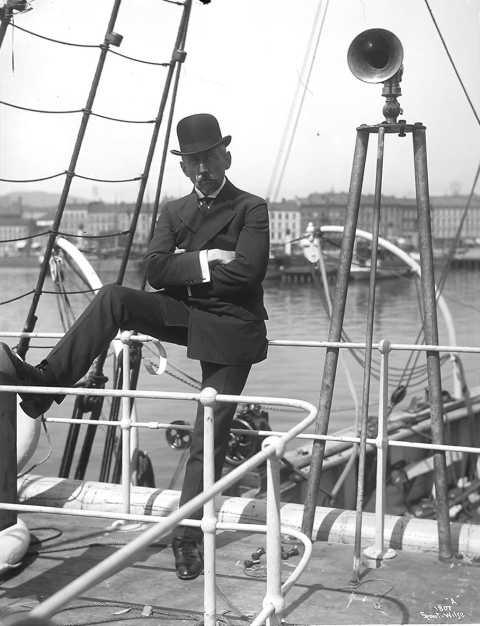 Amundsen shortly before departure, on the deck of the Fram. Photo by Anders Beer Wiltse. [3]
Shutting himself up in his cabin, Amundsen wrote the following letter:
"Herr Professor Fridtjof Nansen,
"It is not with a light heart that I send you these lines, but there is no way round, and therefore I might as well go straight to the point.
"When the news from Cook and later from Peary about their journeys to the North Pole arrived in the autumn of last year, I understood immediately that that was the death blow to my enterprise. I understood immediately that after this I could not count on the financial support I needed ....
"To give up my enterprise did not for one moment occur to me. The question for me became what I had to do in order to raise the necessary means. To acquire these without something special was out of the question. Something had to be done to rouse the interest of the public. In that way alone would it be possible to realize my plan. Only one problem remained in the polar regions that could be depended on to awaken the interest of the masses; the attainment of the South Pole. If I could carry that out, I knew that the means would be secured for the expedition I had originally planned.
"Yes, it is hard for me, Herr Professor, to tell you, but in September 1909, my decision to take part in the contest for the solution of this question was taken. Many a time I have been on the way to confide the whole matter in you, but always have turned back for fear that you would stop me. I have often wished that Scott could have learned of my decision, so that it would not seem as if I wanted to sneak down there without his knowledge in order to forestall him: but I have not dared to make any kind of announcement, for fear of being stopped. I shall in the meanwhile do everything possible to meet him down there and tell him my decision, and then he can act accordingly.
"So, since September last year, my mind has been made up, and I believe I may say we are well prepared. But at the same time I must point out that, had I succeeded in obtaining the funds still needed for the expedition I originally intended -- about 150,000 kroner -- I would have left out this extra excursion with pleasure; but there was no question of that.
"From Madeira we set our course Southwards for South Victoria Land. With 9 men it is my intention to be landed there, and then let Fram go out on an oceanographic cruise.... Where we will go ashore down there, I have not yet decided, but it is my intention not to dog the Englishmen's footsteps. They have naturally the first right. We must make do with what they discard.
"In February-March 1912, Fram will again come down to fetch us. We will then first go to Lyttelton in New Zealand to cable, and from there to San Francisco to continue my interrupted work with, as I hope, the equipment necessary for a voyage of this nature.
"I have asked Helland [Hansen], who for some time has known this plan, to deliver this letter, in the hope that possibly he will be in a position to put my case in a more favourable light than I myself am able.
"And when you pass judgment on me, Herr Professor, do not be too severe. I have taken the only path that seemed open, and now events will just have to take their course.
"Simultaneously with this letter, I am informing the King as well, but no one else. A few days after the receipt of this, my brother will arrange the announcement of the addition to the expedition's plan.
"Once more, I beg you, do not treat me too harshly. I am no humbug; necessity forced me.
"And so I beg your forgiveness for what I have done. May my coming work help to atone for that in which I have offended.
"With my most respectful greetings,
Roald Amundsen." [4]
Notes:
[1] L.E.G. Oates, [letter to his mother? date not given], quoted by Sue Limb and Patrick Cordingley in Captain Oates : Soldier and Explorer (London : Batsford, c1982), p.99.
[2] Cecil Meares, letter [to his father?], 22 August, 1910, quoted by David Crane in Scott of the Antarctic (New York : Knopf, c2005), p.388.
[3] GalleriNOR.
[4] Roald Amundsen, letter to Fridtjof Nansen, 22 August 1910, quoted by Roland Huntford in Scott and Amundsen (New York : Putnam, 1980, c1979), p.294-295.
March 18, 2010
Friday, 18 March 1910
Scott
Earlier in the year Scott had hired Cecil Meares as dog expert. Meares, the son of a major in the Royal Scots Fusiliers, was a wanderer and adventurer, an expert on eastern Siberia and Manchuria who spoke Russian, Chinese, and Hindustani, had made a number of journeys by dog including one of some two thousand miles across Siberia to Cape Chelyuskin on the Arctic Ocean, and had been recommended to Scott by someone at the Admiralty.
From Nikolayevsk in Siberia, Meares wrote, "I have been kept very busy collecting dogs, trying teams & picking out one or two dogs and making up a team & trying it on a run of 100 miles & throwing out the dogs which do not come up to the mark.... I expect to be back in Vladivostock [sic] by the middle of June where I will collect the ponies.... It is a very long contract indeed to choose all these animals & carry them down to Australia single handed." [1]
Meares eventually collected thirty-four dogs there in Nikolayevsk, and persuaded a Russian dog-driver, Dimtri Gerov, to join the expedition as his assistant; they then travelled to Vladivostok, where they selected the ponies. Per Scott's instruction, Meares purchased only white ponies, as on the Nimrod expedition Shackleton had noted that the dark ponies succumbed first. As white ponies were only a small percentage of those available, Meares, who did not claim to be an expert on horses, was severely limited in choice. Anton Omelchenko, a Russian jockey Meares hired, reported afterwards that the horse dealer left "with a plenty big smile". [2]
Notes:
[1] Cecil Meares, letter to his father, 18 March, 1910, quoted by David Crane in Scott of the Antarctic (New York : Knopf, c2005), p.387-388.
[2] Anton Omelchenko, in Frank Debenham, diary, 18 June, 1911, quoted by Roland Huntford in Scott and Amundsen (New York : Putnam, 1980, c1979), p.325.
Earlier in the year Scott had hired Cecil Meares as dog expert. Meares, the son of a major in the Royal Scots Fusiliers, was a wanderer and adventurer, an expert on eastern Siberia and Manchuria who spoke Russian, Chinese, and Hindustani, had made a number of journeys by dog including one of some two thousand miles across Siberia to Cape Chelyuskin on the Arctic Ocean, and had been recommended to Scott by someone at the Admiralty.
From Nikolayevsk in Siberia, Meares wrote, "I have been kept very busy collecting dogs, trying teams & picking out one or two dogs and making up a team & trying it on a run of 100 miles & throwing out the dogs which do not come up to the mark.... I expect to be back in Vladivostock [sic] by the middle of June where I will collect the ponies.... It is a very long contract indeed to choose all these animals & carry them down to Australia single handed." [1]
Meares eventually collected thirty-four dogs there in Nikolayevsk, and persuaded a Russian dog-driver, Dimtri Gerov, to join the expedition as his assistant; they then travelled to Vladivostok, where they selected the ponies. Per Scott's instruction, Meares purchased only white ponies, as on the Nimrod expedition Shackleton had noted that the dark ponies succumbed first. As white ponies were only a small percentage of those available, Meares, who did not claim to be an expert on horses, was severely limited in choice. Anton Omelchenko, a Russian jockey Meares hired, reported afterwards that the horse dealer left "with a plenty big smile". [2]
Notes:
[1] Cecil Meares, letter to his father, 18 March, 1910, quoted by David Crane in Scott of the Antarctic (New York : Knopf, c2005), p.387-388.
[2] Anton Omelchenko, in Frank Debenham, diary, 18 June, 1911, quoted by Roland Huntford in Scott and Amundsen (New York : Putnam, 1980, c1979), p.325.
Subscribe to:
Posts (Atom)


