Amundsen
Albert Armitage, who had been Scott's second-in-command on the Discovery expedition, wrote to Nansen, with "heartiest congratulations" on Amundsen's success. "It proves once more the value of practical experience & logical reasoning.... I fear that Scott, with his dislike for Ski, to say nothing else, will find great difficulty in reaching his goal.... I see that Amundsen intends making the Bering Sea passage across the North Pole, and I sincerely hope that he will be as fully successful as in the South." [1]
The Fram left Hobart for Buenos Aires to be refitted for the Arctic drift, set to begin in 1913.
Notes:
[1] Albert Armitage, letter to Fridtjof Nansen, 20 March, 1912, quoted by Roland Huntford in Scott and Amundsen (New York : Putnam, 1980, c1979), p.542.
Showing posts with label Fram. Show all posts
Showing posts with label Fram. Show all posts
March 20, 2012

March 8, 2012
Friday, 8 March 1912
Scott
"Worse and worse in morning," Scott wrote, "poor Oates' left foot can never last out, and time over foot gear something awful.... We did 4 1/2 miles this morning and are now 8 1/2 miles from the depot -- a ridiculously small distance to feel in difficulties, yet on this surface we know we cannot equal half our old marches, and that for that effort we expend nearly double the energy. The great question is, What shall we find at the depot? If the dogs have visited it we may get along a good distance, but if there is another short allowance of fuel, God help us indeed. We are in a very bad way, I fear, in any case." [1]
The weather at One Ton remained bad, with a "good day" at -10° F (-23 C), and blowing most of the time. Cherry wrote in his diary, "-28 when we turned in & must have been -40 at least last night. This morning -28 & wind 4. It is a very cold wait -- waiting & thinking. I was so sure I saw them coming last night I nearly started to walk to them." [2]
Amundsen
 Fram's crew upon arrival in Hobart. From left, in the back row, Hassel, Ludwig Hansen, Steller, Bjaaland, Kristensen, Rønne, Beck, Wisting, Halvorsen, Sundbeck; seated, Johansen, Prestrud, Amundsen, Nilsen, Gjertsen, Helmer Hanssen; in front, Lindstrøm, Stubberud, Karenius Olsen, A. Olsen. "Beattie's studios Hobart Tas." [3]
 Helmer Hanssen, Amundsen, and Lindstrøm.
 Hassel, Wisting, Amundsen, Bjaaland, and Helmer Hanssen. [4]
"Pole Attained Fourteenth-Seventeenth December 1911. All Well" ran headlines everywhere. "The whole world," said the New York Times, "has now been discovered." [5]
"On a day like this," exulted Aftenposten, a leading Christiania newspaper, "everything is changed.... It is more warmth and pride that we feel that we are all children of the same, happy country. Smiles are more frequent -- in bold mens' deeds we are richer and more united and happier. Ah yes -- at one blow, we are far forwards!" [6]
Helland-Hansen, though, wrote to Nansen that he could not understand "why people don't show more pleasure than they do." [7] Many Norwegians, it seemed, felt that Amundsen's accomplishment was a political mistake; one paper wrote, "We are glad that Roald Amundsen chose a new route to the South Pole, so that he avoided going directly in Scott's path. The English had the exclusive right to the route from McMurdo Sound. That was their opinion at any rate." [8] The Times, indeed, wrote a day later that the Norwegian expedition was "a mere dash for the Pole, designed to forestall the British expedition in the most spectacular, though not the most valuable part of the work." [9]
Notes:
[1] R.F. Scott, diary, 8 March, 1912, quoted in Scott's Last Expedition, v.1.
[2] Apsley Cherry-Garrard, diary, 8 March, 1912, Scott Polar Research Institute.
[3] Roald Amundsen Bildearkiv, Nasjonalbiblioteket.
[4] "Tasmanian views, Edward Searle's album of photographs of Australia, Antarctica and the Pacific, 1911-1915", National Library of Australia.
[5] New York Times, 8 March, 1912, quoted by Roland Huntford in Scott and Amundsen (New York : Putnam, 1980, c1979), p.546.
[6] Aftenposten, 9 March, 1912, quoted by Roland Huntford in Scott and Amundsen (New York : Putnam, 1980, c1979), p.547.
[7] Bjørn Helland-Hansen, letter to Fridtjof Nansen, [date not given], quoted by Roland Huntford in Scott and Amundsen (New York : Putnam, 1980, c1979), p.547.
[8] Norges Handels- og Sjøfartstidende, 9 March, 1912, quoted by Roland Huntford in Scott and Amundsen (New York : Putnam, 1980, c1979), p.547.
[9] The Times, 9 March, 1912, quoted by Roland Huntford in Scott and Amundsen (New York : Putnam, 1980, c1979), p.547.
"Worse and worse in morning," Scott wrote, "poor Oates' left foot can never last out, and time over foot gear something awful.... We did 4 1/2 miles this morning and are now 8 1/2 miles from the depot -- a ridiculously small distance to feel in difficulties, yet on this surface we know we cannot equal half our old marches, and that for that effort we expend nearly double the energy. The great question is, What shall we find at the depot? If the dogs have visited it we may get along a good distance, but if there is another short allowance of fuel, God help us indeed. We are in a very bad way, I fear, in any case." [1]
The weather at One Ton remained bad, with a "good day" at -10° F (-23 C), and blowing most of the time. Cherry wrote in his diary, "-28 when we turned in & must have been -40 at least last night. This morning -28 & wind 4. It is a very cold wait -- waiting & thinking. I was so sure I saw them coming last night I nearly started to walk to them." [2]
Amundsen
 Fram's crew upon arrival in Hobart. From left, in the back row, Hassel, Ludwig Hansen, Steller, Bjaaland, Kristensen, Rønne, Beck, Wisting, Halvorsen, Sundbeck; seated, Johansen, Prestrud, Amundsen, Nilsen, Gjertsen, Helmer Hanssen; in front, Lindstrøm, Stubberud, Karenius Olsen, A. Olsen. "Beattie's studios Hobart Tas." [3]
 Helmer Hanssen, Amundsen, and Lindstrøm.
  Hassel, Wisting, Amundsen, Bjaaland, and Helmer Hanssen. [4]
"Pole Attained Fourteenth-Seventeenth December 1911. All Well" ran headlines everywhere. "The whole world," said the New York Times, "has now been discovered." [5]
"On a day like this," exulted Aftenposten, a leading Christiania newspaper, "everything is changed.... It is more warmth and pride that we feel that we are all children of the same, happy country. Smiles are more frequent -- in bold mens' deeds we are richer and more united and happier. Ah yes -- at one blow, we are far forwards!" [6]
Helland-Hansen, though, wrote to Nansen that he could not understand "why people don't show more pleasure than they do." [7] Many Norwegians, it seemed, felt that Amundsen's accomplishment was a political mistake; one paper wrote, "We are glad that Roald Amundsen chose a new route to the South Pole, so that he avoided going directly in Scott's path. The English had the exclusive right to the route from McMurdo Sound. That was their opinion at any rate." [8] The Times, indeed, wrote a day later that the Norwegian expedition was "a mere dash for the Pole, designed to forestall the British expedition in the most spectacular, though not the most valuable part of the work." [9]
Notes:
[1] R.F. Scott, diary, 8 March, 1912, quoted in Scott's Last Expedition, v.1.
[2] Apsley Cherry-Garrard, diary, 8 March, 1912, Scott Polar Research Institute.
[3] Roald Amundsen Bildearkiv, Nasjonalbiblioteket.
[4] "Tasmanian views, Edward Searle's album of photographs of Australia, Antarctica and the Pacific, 1911-1915", National Library of Australia.
[5] New York Times, 8 March, 1912, quoted by Roland Huntford in Scott and Amundsen (New York : Putnam, 1980, c1979), p.546.
[6] Aftenposten, 9 March, 1912, quoted by Roland Huntford in Scott and Amundsen (New York : Putnam, 1980, c1979), p.547.
[7] Bjørn Helland-Hansen, letter to Fridtjof Nansen, [date not given], quoted by Roland Huntford in Scott and Amundsen (New York : Putnam, 1980, c1979), p.547.
[8] Norges Handels- og Sjøfartstidende, 9 March, 1912, quoted by Roland Huntford in Scott and Amundsen (New York : Putnam, 1980, c1979), p.547.
[9] The Times, 9 March, 1912, quoted by Roland Huntford in Scott and Amundsen (New York : Putnam, 1980, c1979), p.547.
March 7, 2012
Thursday, 7 March 1912
Scott
"This morning in 4 1/2 hours," wrote Scott, "we did just over 4 miles. We are 16 from our depot. If we only find the correct proportion of food there and this surface continues, we may get to the next depot [Mt. Hooper, 72 miles farther] but not to One Ton Camp. We hope against hope that the dogs have been to Mt. Hooper; then we might pull through. If there is a shortage of oil again we can have little hope. One feels that for poor Oates the crisis is near, but none of us are improving, though we are wonderfully fit considering the really excessive work we are doing." [1]
Amundsen
 "'The Fram' at Hobart, Tasmania, from South Pole, 1912." [2]
The Fram put in at Hobart, after having sighted land three days earlier and been held off by storm. The first thing that Amundsen asked about was news of the Terra Nova, and was cheered when he was told that she had not been heard of.
Having learned a hard lesson on the Northwest Passage, losing his newspaper scoop and the resulting funds to cover his debts, Amundsen himself did not even know with which newspaper his brother Leon had contracted, and the Fram remained at anchor outside Hobart and refused to identify herself. Amundsen, he wrote in his diary, went ashore alone and "got a room at the Orient Hotel -- Treated as a tramp -- my peaked cap and blue sweater -- given a miserable little room.... Visited the Consul.... Then I cabled to the King ... Nansen and Leon. The day passed quietly, except for reporters, who were insistent but without result." [3]
The next day, Amundsen "received a telegram from Leon, instructing me to cable my report to the Daily Chronicle, London. This was immediately done. After that, I kept very quiet. When I had gone to bed -- 10 p.m. -- the telegrams began to rain down -- the King's came first."
Notes:
[1] R.F. Scott, diary, 7 March, 1912, quoted in Scott's Last Expedition, v.1.
[2] "Tasmanian views, Edward Searle's album of photographs of Australia, Antarctica and the Pacific, 1911-1915", National Library of Australia.
[3] Roald Amundsen, diary, [date not given], quoted by Roland Huntford in The Amundsen Photographs (London : Hodder & Stoughton, c1987, p.142.
"This morning in 4 1/2 hours," wrote Scott, "we did just over 4 miles. We are 16 from our depot. If we only find the correct proportion of food there and this surface continues, we may get to the next depot [Mt. Hooper, 72 miles farther] but not to One Ton Camp. We hope against hope that the dogs have been to Mt. Hooper; then we might pull through. If there is a shortage of oil again we can have little hope. One feels that for poor Oates the crisis is near, but none of us are improving, though we are wonderfully fit considering the really excessive work we are doing." [1]
Amundsen
 "'The Fram' at Hobart, Tasmania, from South Pole, 1912." [2]
The Fram put in at Hobart, after having sighted land three days earlier and been held off by storm. The first thing that Amundsen asked about was news of the Terra Nova, and was cheered when he was told that she had not been heard of.
Having learned a hard lesson on the Northwest Passage, losing his newspaper scoop and the resulting funds to cover his debts, Amundsen himself did not even know with which newspaper his brother Leon had contracted, and the Fram remained at anchor outside Hobart and refused to identify herself. Amundsen, he wrote in his diary, went ashore alone and "got a room at the Orient Hotel -- Treated as a tramp -- my peaked cap and blue sweater -- given a miserable little room.... Visited the Consul.... Then I cabled to the King ... Nansen and Leon. The day passed quietly, except for reporters, who were insistent but without result." [3]
The next day, Amundsen "received a telegram from Leon, instructing me to cable my report to the Daily Chronicle, London. This was immediately done. After that, I kept very quiet. When I had gone to bed -- 10 p.m. -- the telegrams began to rain down -- the King's came first."
Notes:
[1] R.F. Scott, diary, 7 March, 1912, quoted in Scott's Last Expedition, v.1.
[2] "Tasmanian views, Edward Searle's album of photographs of Australia, Antarctica and the Pacific, 1911-1915", National Library of Australia.
[3] Roald Amundsen, diary, [date not given], quoted by Roland Huntford in The Amundsen Photographs (London : Hodder & Stoughton, c1987, p.142.
February 9, 2012
Friday, 9 February 1912
Scott
Lashly, Crean, and Lt. Evans reached the depot at One Ton. "Oh, what a God-send to get a change of food!" Lashly wrote with feeling. "We have taken enough food for 9 days, which if we still keep up our present rate of progress it ought to take us in to Hut Point. We cannot take too heavy a load, as there is only the two of us pulling now, and this our last port of call before we reach Hut Point, but things are not looking any too favourable for us, as our leader is gradually getting lower every day. It is almost impossible for him to get along, and we are still 120 miles from Hut Point." [1]
At Cape Evans, unloading of the Terra Nova began.
Amundsen
The Fram crossed the Antarctic Circle on her way to Hobart, "[creeping] forwards," Bjaaland wrote, "miserably slowly, headwinds and fog and rain and high seas on the beam." [2]
Amundsen spent hours every day in his cabin reading a year's worth of newspapers, preparing his telegrams and writing his story for the press, and writing the lecture he would give in the coming months. Nilsen translated this for him into English.
Johansen, miserable and disappointed, wrote to his wife, "When one is so far away and left to one's self in the great loneliness, one broods about one thing or the other... For my part, I can still be glad that I have not suffered any injury, but still possess my indomitable strength.... I did not get to the Pole. I naturally would have liked to.... The main thing is that ... we did good work [on King Edward VII Land]. But you know the great public asks who has been to the Pole. Well, I don't care. I dare to say that nevertheless I have also helped the Southern party to reach the Pole, even if I couldn't be on the final assault, and I know that I was appreciated by those with whom I worked.... Ah well, as things are, it has all turned out for the best." [3]
Notes:
[1] William Lashly, diary, 9 February, 1912, quoted by Apsley Cherry-Garrard in The Worst Journey in the World, ch.XII.
[2] Olav Bjaaland, diary, [date not given], quoted by Roland Huntford in Scott and Amundsen (New York : Putnam, 1980, c1979), p.530.
[3] Hjalmar Johansen, letter to his wife, [date not given], quoted by Roland Huntford in Scott and Amundsen (New York : Putnam, 1980, c1979), p.531.
Lashly, Crean, and Lt. Evans reached the depot at One Ton. "Oh, what a God-send to get a change of food!" Lashly wrote with feeling. "We have taken enough food for 9 days, which if we still keep up our present rate of progress it ought to take us in to Hut Point. We cannot take too heavy a load, as there is only the two of us pulling now, and this our last port of call before we reach Hut Point, but things are not looking any too favourable for us, as our leader is gradually getting lower every day. It is almost impossible for him to get along, and we are still 120 miles from Hut Point." [1]
At Cape Evans, unloading of the Terra Nova began.
Amundsen
The Fram crossed the Antarctic Circle on her way to Hobart, "[creeping] forwards," Bjaaland wrote, "miserably slowly, headwinds and fog and rain and high seas on the beam." [2]
Amundsen spent hours every day in his cabin reading a year's worth of newspapers, preparing his telegrams and writing his story for the press, and writing the lecture he would give in the coming months. Nilsen translated this for him into English.
Johansen, miserable and disappointed, wrote to his wife, "When one is so far away and left to one's self in the great loneliness, one broods about one thing or the other... For my part, I can still be glad that I have not suffered any injury, but still possess my indomitable strength.... I did not get to the Pole. I naturally would have liked to.... The main thing is that ... we did good work [on King Edward VII Land]. But you know the great public asks who has been to the Pole. Well, I don't care. I dare to say that nevertheless I have also helped the Southern party to reach the Pole, even if I couldn't be on the final assault, and I know that I was appreciated by those with whom I worked.... Ah well, as things are, it has all turned out for the best." [3]
Notes:
[1] William Lashly, diary, 9 February, 1912, quoted by Apsley Cherry-Garrard in The Worst Journey in the World, ch.XII.
[2] Olav Bjaaland, diary, [date not given], quoted by Roland Huntford in Scott and Amundsen (New York : Putnam, 1980, c1979), p.530.
[3] Hjalmar Johansen, letter to his wife, [date not given], quoted by Roland Huntford in Scott and Amundsen (New York : Putnam, 1980, c1979), p.531.
January 26, 2012
Friday, 26 January 1912
Scott
"Temp. -17°. Height 9700, must be high barometer," wrote Scott. "Started late, 8.50 -- for no reason, as I called the hands rather early. We must have fewer delays. There was a good stiff breeze and plenty of drift, but the tracks held. To our old blizzard camp of the 7th we got on well, 7 miles. But beyond the camp we found the tracks completely wiped out. We searched for some time, then marched on a short way and lunched, the weather gradually clearing, though the wind holding. Knowing there were two cairns at four mile intervals, we had little anxiety till we picked up the first far on our right, then steering right by a stroke of fortune, and Bowers' sharp eyes caught a glimpse of the second far on the left. Evidently we made a bad course outward at this part. There is not a sign of our tracks between these cairns, but the last, marking our night camp of the 6th, No. 59, is in the belt of hard sastrugi, and I was comforted to see signs of the track reappearing as we camped. I hope to goodness we can follow it to-morrow. We marched 16 miles (geo.) to-day, but made good only 15.4." [1]
Further north, Atkinson's party reached Hut Point, after a journey of 35 days. "Scott was to have sent back instructions for the dog party with us," Cherry wrote in his diary, "but these have, it would seem, been forgotten." [2]
Amundsen

Having been earlier driven out to sea by wind and ice, the Fram had seen the signal of the polar party's arrival, a swallow-tailed naval ensign flying from Cape Man's Head, and had put in to the Bay of Whales, blasting her horn. "There was great enthusiasm," Nilsen said later. "The first man on board was the Chief; I was so certain he had reached the goal that I never asked him. Not till an hour later, when we had discussed all kinds of other things, did I enquire 'Well, of course you have been at the South Pole?'" [3]
Much of the news that Nilsen brought was of how Amundsen's "detour" was viewed in the press at home and in England. "A number of people seem to be indignant over our activities down here -- a breach of 'etiquette'?" Amundsen had fumed in his diary the night before. "Are these people mad? Is the question of the Pole exclusively confided to Scott for solution? I don't give a hang for these idiots. Nansen, as usual, with his cool, clear understanding, has cooled emotions. Oh well, people are idiotic." [4]
Nilsen also told of Fram's stay in Buenos Aires, and his visit with Amundsen's benefactor Don Pedro Christophersen, for whose help and support Amundsen was still deeply grateful. "It is to the intervention of this man," he wrote in his diary, "that the third Fram expedition owes its continued existence. At home, all doors were shut -- with the exception of the King and Fridtjof Nansen. May the confidence that they have shown me not be disappointed! I admire the King for his manly behaviour. Likewise the other two gentlemen. When everyone turned their backs on me, they came towards me. The King was not afraid to give a contribution to the South Polar expedition [sic], even if parliament -- or the majority -- wanted Fram to be ordered home. But -- it didn't go the way those gentlemen wanted. Just wait a bit, we'll soon have a talk. Perhaps you will be pleasanter the next time you hear from Fram." [5]
But he still had to get through before Scott with the news. "Time is precious, and we've got to reach civilization before anyone else."
He planned to start loading the ship almost immediately and sail on the 31st, heading to Hobart and thence to Buenos Aires, "where I have to obtain temporary assistance for the drift".
Notes:
[1] R.F. Scott, diary, 26 January, 1912, quoted in Scott's Last Expedition, v.1.
[2] Apsley Cherry-Garrard, diary, [26? January, 1912], quoted in his The Worst Journey in the World, ch.XIII.
[3] Roald Amundsen Bildearkiv, Nasjonalbiblioteket.
[4] Thorvald Nilsen, "The Voyage of the Fram", in Roald Amundsen's The South Pole, ch.16.
[4] Roald Amundsen, diary, 26 January, 1912, quoted by Roland Huntford in Scott and Amundsen (New York : Putnam, 1980, c1979), p.327-328.
[5] Roald Amundsen, diary, 27 January, 1912, quoted by Roland Huntford in Race for the South Pole : the expedition diaries of Scott and Amundsen (London : Continuum, c2010), p.263. Amundsen's slip of the pen is significant, as of course King Haakon's support was for what he was told would be an Arctic drift, whereas Amundsen had already known that he was heading south.
"Temp. -17°. Height 9700, must be high barometer," wrote Scott. "Started late, 8.50 -- for no reason, as I called the hands rather early. We must have fewer delays. There was a good stiff breeze and plenty of drift, but the tracks held. To our old blizzard camp of the 7th we got on well, 7 miles. But beyond the camp we found the tracks completely wiped out. We searched for some time, then marched on a short way and lunched, the weather gradually clearing, though the wind holding. Knowing there were two cairns at four mile intervals, we had little anxiety till we picked up the first far on our right, then steering right by a stroke of fortune, and Bowers' sharp eyes caught a glimpse of the second far on the left. Evidently we made a bad course outward at this part. There is not a sign of our tracks between these cairns, but the last, marking our night camp of the 6th, No. 59, is in the belt of hard sastrugi, and I was comforted to see signs of the track reappearing as we camped. I hope to goodness we can follow it to-morrow. We marched 16 miles (geo.) to-day, but made good only 15.4." [1]
Further north, Atkinson's party reached Hut Point, after a journey of 35 days. "Scott was to have sent back instructions for the dog party with us," Cherry wrote in his diary, "but these have, it would seem, been forgotten." [2]
Amundsen

Fram at the ice-edge in the Bay of Whales, in an undated photograph. [3]
Having been earlier driven out to sea by wind and ice, the Fram had seen the signal of the polar party's arrival, a swallow-tailed naval ensign flying from Cape Man's Head, and had put in to the Bay of Whales, blasting her horn. "There was great enthusiasm," Nilsen said later. "The first man on board was the Chief; I was so certain he had reached the goal that I never asked him. Not till an hour later, when we had discussed all kinds of other things, did I enquire 'Well, of course you have been at the South Pole?'" [3]
Much of the news that Nilsen brought was of how Amundsen's "detour" was viewed in the press at home and in England. "A number of people seem to be indignant over our activities down here -- a breach of 'etiquette'?" Amundsen had fumed in his diary the night before. "Are these people mad? Is the question of the Pole exclusively confided to Scott for solution? I don't give a hang for these idiots. Nansen, as usual, with his cool, clear understanding, has cooled emotions. Oh well, people are idiotic." [4]
Nilsen also told of Fram's stay in Buenos Aires, and his visit with Amundsen's benefactor Don Pedro Christophersen, for whose help and support Amundsen was still deeply grateful. "It is to the intervention of this man," he wrote in his diary, "that the third Fram expedition owes its continued existence. At home, all doors were shut -- with the exception of the King and Fridtjof Nansen. May the confidence that they have shown me not be disappointed! I admire the King for his manly behaviour. Likewise the other two gentlemen. When everyone turned their backs on me, they came towards me. The King was not afraid to give a contribution to the South Polar expedition [sic], even if parliament -- or the majority -- wanted Fram to be ordered home. But -- it didn't go the way those gentlemen wanted. Just wait a bit, we'll soon have a talk. Perhaps you will be pleasanter the next time you hear from Fram." [5]
But he still had to get through before Scott with the news. "Time is precious, and we've got to reach civilization before anyone else."
He planned to start loading the ship almost immediately and sail on the 31st, heading to Hobart and thence to Buenos Aires, "where I have to obtain temporary assistance for the drift".
Notes:
[1] R.F. Scott, diary, 26 January, 1912, quoted in Scott's Last Expedition, v.1.
[2] Apsley Cherry-Garrard, diary, [26? January, 1912], quoted in his The Worst Journey in the World, ch.XIII.
[3] Roald Amundsen Bildearkiv, Nasjonalbiblioteket.
[4] Thorvald Nilsen, "The Voyage of the Fram", in Roald Amundsen's The South Pole, ch.16.
[4] Roald Amundsen, diary, 26 January, 1912, quoted by Roland Huntford in Scott and Amundsen (New York : Putnam, 1980, c1979), p.327-328.
[5] Roald Amundsen, diary, 27 January, 1912, quoted by Roland Huntford in Race for the South Pole : the expedition diaries of Scott and Amundsen (London : Continuum, c2010), p.263. Amundsen's slip of the pen is significant, as of course King Haakon's support was for what he was told would be an Arctic drift, whereas Amundsen had already known that he was heading south.
January 10, 2012
Wednesday, 10 January 1912
Scott
"T. -11°. Last depot 88° 29' S.; 159° 33' E.; Var. 180°. Terrible hard march in the morning," wrote Scott, "only covered 5.1 miles (geo.). Decided to leave depot at lunch camp. Built cairn and left one week's food together with sundry articles of clothing. We are down as close as we can go in the latter. We go forward with eighteen days' food. Yesterday I should have said certain to see us through, but now the surface is beyond words, and if it continues we shall have the greatest difficulty to keep our march long enough." [1]
Amundsen
 Antarctic skua, February/March 2008. Photo by Mirko Thiessen. [2]
Amundsen, back on familiar ground, grew aware again of the race between himself and the British, and became impatient and testy. "[He] tolerates no opposition," Bjaaland wrote. "Sharp dispute over my goggles. Is he annoyed that I'm not using the Roaldish snow goggles?" [3] Bjaaland had made a pair based on the Eskimo design with slits, whereas Amundsen preferred glasses with tinted lenses.
Amundsen decided to sprint, running fifteen or twenty miles, camping for eight hours, going on again, regardless of day or night. They saw the last of the mountains, "a wonderful sight," Bjaaland said, "like a home of the trolls, glittering with silver and crystal" -- and two skuas, the first living creatures they had seen for over two months. "Good day, good day, dear skua-crow," wrote Bjaaland. "How are you doing? .... You go back to Lindstrøm and tell him we'll be there in 20 days and clean up his hot cakes, beef and fruit, even if it's green plums." [4]
Fourteen miles out from Framheim, Prestrud noticed Johansen peering intently out to sea. "On my asking him what in the world he was looking at," Prestrud recalled, "he replied 'I could almost swear it was a ship, but of course it's only a wretched iceberg.' We were just agreed upon this, when suddenly Johansen stopped short and began a hurried search for his long glass. 'Are you going to look at the Fram?' I asked ironically. 'Yes, I am,' he said; and while he turned the telescope upon the doubtful object far out in Ross Sea, we two stood waiting for a few endless seconds. 'It's the Fram sure enough, as large as life!' was the welcome announcement that broke our suspense. I glanced at Stubberud and saw his face expanding into its most amiable smile." [5]
Notes:
[1] R.F. Scott, diary, 10 January, 1912, quoted in Scott's Last Expedition, v.1.
[2] Wikimedia Commons. The photograph used here is labelled Stercorarius chilensis; see Wikipedia on the "Brown skua" and e.g. Greg Lasley's page on the "Brown Skua (Catharacta antarctica)" for discussions of the taxonomy of Antarctic skuas.
[3] Olav Bjaaland, diary, 11 January 1912, quoted by Roland Huntford in Scott and Amundsen (New York : Putnam, 1980, c1979), p.506.
[4] Olav Bjaaland, diary, 11 January 1912, quoted by Roland Huntford in Scott and Amundsen (New York : Putnam, 1980, c1979), p.506.
[5] Kristian Prestrud, "The Eastern Sledge Journey", in Roald Amundsen's The South Pole, ch.15. Note that the date is given as 11th January 1912; see Hinks' note on dates in "The Observations of Amundsen and Scott at the South Pole" (The Geographical Journal, April 1944, p.169).
"T. -11°. Last depot 88° 29' S.; 159° 33' E.; Var. 180°. Terrible hard march in the morning," wrote Scott, "only covered 5.1 miles (geo.). Decided to leave depot at lunch camp. Built cairn and left one week's food together with sundry articles of clothing. We are down as close as we can go in the latter. We go forward with eighteen days' food. Yesterday I should have said certain to see us through, but now the surface is beyond words, and if it continues we shall have the greatest difficulty to keep our march long enough." [1]
Amundsen
 Antarctic skua, February/March 2008. Photo by Mirko Thiessen. [2]
Amundsen, back on familiar ground, grew aware again of the race between himself and the British, and became impatient and testy. "[He] tolerates no opposition," Bjaaland wrote. "Sharp dispute over my goggles. Is he annoyed that I'm not using the Roaldish snow goggles?" [3] Bjaaland had made a pair based on the Eskimo design with slits, whereas Amundsen preferred glasses with tinted lenses.
Amundsen decided to sprint, running fifteen or twenty miles, camping for eight hours, going on again, regardless of day or night. They saw the last of the mountains, "a wonderful sight," Bjaaland said, "like a home of the trolls, glittering with silver and crystal" -- and two skuas, the first living creatures they had seen for over two months. "Good day, good day, dear skua-crow," wrote Bjaaland. "How are you doing? .... You go back to Lindstrøm and tell him we'll be there in 20 days and clean up his hot cakes, beef and fruit, even if it's green plums." [4]
Fourteen miles out from Framheim, Prestrud noticed Johansen peering intently out to sea. "On my asking him what in the world he was looking at," Prestrud recalled, "he replied 'I could almost swear it was a ship, but of course it's only a wretched iceberg.' We were just agreed upon this, when suddenly Johansen stopped short and began a hurried search for his long glass. 'Are you going to look at the Fram?' I asked ironically. 'Yes, I am,' he said; and while he turned the telescope upon the doubtful object far out in Ross Sea, we two stood waiting for a few endless seconds. 'It's the Fram sure enough, as large as life!' was the welcome announcement that broke our suspense. I glanced at Stubberud and saw his face expanding into its most amiable smile." [5]
Notes:
[1] R.F. Scott, diary, 10 January, 1912, quoted in Scott's Last Expedition, v.1.
[2] Wikimedia Commons. The photograph used here is labelled Stercorarius chilensis; see Wikipedia on the "Brown skua" and e.g. Greg Lasley's page on the "Brown Skua (Catharacta antarctica)" for discussions of the taxonomy of Antarctic skuas.
[3] Olav Bjaaland, diary, 11 January 1912, quoted by Roland Huntford in Scott and Amundsen (New York : Putnam, 1980, c1979), p.506.
[4] Olav Bjaaland, diary, 11 January 1912, quoted by Roland Huntford in Scott and Amundsen (New York : Putnam, 1980, c1979), p.506.
[5] Kristian Prestrud, "The Eastern Sledge Journey", in Roald Amundsen's The South Pole, ch.15. Note that the date is given as 11th January 1912; see Hinks' note on dates in "The Observations of Amundsen and Scott at the South Pole" (The Geographical Journal, April 1944, p.169).
January 9, 2012
Tuesday, 9 January 1912
Scott
The weather lifted, and the party was able to move on. "RECORD," Scott cheered in his diary at 88° 25', having passed Shackleton's Furthest South, three years to the day earlier. "All is new ahead." [1]
Amundsen
"Same filthy weather," wrote Amundsen on the second day of a storm. "Snow, snow, snow. Snow and snow again. Will it never end." [2]
"Snowdrift and snowfall and I have had a bloody job going first," noted Bjaaland, but despite the drift so bad that they could hardly see, and a temperature of -8° that melted the drift and soaked the sledges, they managed sixteen miles. [3] "The dogs coped splendidly," Amundsen added.
The Fram arrived in the Bay of Whales.
Notes:
[1] R.F. Scott, diary, 9 January, 1912, quoted in Scott's Last Expedition, v.1.
[2] Roald Amundsen, diary, 10 January, 1912, quoted by Roland Huntford in Race for the South Pole : the expedition diaries of Scott and Amundsen (London : Continuum, c2010), p.234.
[3] Olav Bjaaland, diary, 10 January, 1912, quoted by Roland Huntford in Race for the South Pole : the expedition diaries of Scott and Amundsen (London : Continuum, c2010), p.235.
The weather lifted, and the party was able to move on. "RECORD," Scott cheered in his diary at 88° 25', having passed Shackleton's Furthest South, three years to the day earlier. "All is new ahead." [1]
Amundsen
"Same filthy weather," wrote Amundsen on the second day of a storm. "Snow, snow, snow. Snow and snow again. Will it never end." [2]
"Snowdrift and snowfall and I have had a bloody job going first," noted Bjaaland, but despite the drift so bad that they could hardly see, and a temperature of -8° that melted the drift and soaked the sledges, they managed sixteen miles. [3] "The dogs coped splendidly," Amundsen added.
The Fram arrived in the Bay of Whales.
Notes:
[1] R.F. Scott, diary, 9 January, 1912, quoted in Scott's Last Expedition, v.1.
[2] Roald Amundsen, diary, 10 January, 1912, quoted by Roland Huntford in Race for the South Pole : the expedition diaries of Scott and Amundsen (London : Continuum, c2010), p.234.
[3] Olav Bjaaland, diary, 10 January, 1912, quoted by Roland Huntford in Race for the South Pole : the expedition diaries of Scott and Amundsen (London : Continuum, c2010), p.235.
April 17, 2011
Monday, 17 April 1911
Amundsen
The only scientific work done by the men at Framheim was the routine meteorological observations. "Our plan is one, one and again one alone," Amundsen wrote in his diary, "to reach the pole. For that goal, I have decided to throw everything else aside. We shall do what we can without colliding with this plan. If we were to have a night watch, we would have to have a light burning the whole time. In one room, as we have, this would be worrying for most of us, and make us weak. What concerns me is that we all live properly in all respects during the winter. Sleep and eat well, so that we have full strength and are in good spirits when spring arrives to fight towards the goal which we must attain at any cost." [1]
The Fram arrived in Buenos Aires. Due to ill-feeling in Norway against Amundsen's behaviour, the Government had hesitated to ask the Storting for further grants, and the expedition was completely broke -- Nilsen did not even have the money to hire a tender to take him ashore, as all spare change had been confiscated at the Bay of Whales for soldering and sealing paraffin tanks.
Don Pedro Christophersen generously agreed to pay Amundsen's bills.
But, Nilsen wrote to Alexander Nansen, the expedition's business manager, "It was not fair to draw too big a draft on one man. [At] home they can naturally say that the expedition went South in all secrecy, and therefore it can manage as best it can. But what is one to do? Norway spends money now and then on vessels to represent the country. Is Fram not the best vessel that can be sent out? I won't pretend to say that there is anybody on board particularly qualified to represent the country, but who doesn't know Fram? Norway can scarcely be better known than by its flag flying the the world's greatest harbours from the gaff of the world's most famous ship."
"Every man from chief to cook has done, and will do everything for the expedition to reach its goal. It is therefore not exactly encouraging to hear in the first port of call that the country has washed its hands of us." [2]
Don Pedro payed for the refit Fram needed, and Nilsen left on 8th June as planned for his oceanographic cruise between South America and Southern Africa.
That part of the ocean was, as Fridtjof Nansen wrote to Nilsen, "so to say, all an unknown world, where previous expeditions have ... done little or nothing of significance. It would be splendid if Norwegians could also show themselves superior in this field. In addition, it will show clearly that the Fram expedition is not only a sporting stunt, as some say, but also a scientific enterprise worthy of respect." [3]
Notes:
[1] Roald Amundsen, diary, 18 April, 1911, quoted by Roland Huntford in Scott and Amundsen (New York : Putnam, 1980, c1979), p.380.
[2] Thorvald Nilsen, letter to Alexander Nansen, [date not given], quoted by Roland Huntford in Scott and Amundsen (New York : Putnam, 1980, c1979), p.376-377.
[3] Fridtjof Nansen, letter to Thorvald Nilsen, [date not given], quoted by Roland Huntford in Scott and Amundsen (New York : Putnam, 1980, c1979), p.377.
The only scientific work done by the men at Framheim was the routine meteorological observations. "Our plan is one, one and again one alone," Amundsen wrote in his diary, "to reach the pole. For that goal, I have decided to throw everything else aside. We shall do what we can without colliding with this plan. If we were to have a night watch, we would have to have a light burning the whole time. In one room, as we have, this would be worrying for most of us, and make us weak. What concerns me is that we all live properly in all respects during the winter. Sleep and eat well, so that we have full strength and are in good spirits when spring arrives to fight towards the goal which we must attain at any cost." [1]
The Fram arrived in Buenos Aires. Due to ill-feeling in Norway against Amundsen's behaviour, the Government had hesitated to ask the Storting for further grants, and the expedition was completely broke -- Nilsen did not even have the money to hire a tender to take him ashore, as all spare change had been confiscated at the Bay of Whales for soldering and sealing paraffin tanks.
Don Pedro Christophersen generously agreed to pay Amundsen's bills.
But, Nilsen wrote to Alexander Nansen, the expedition's business manager, "It was not fair to draw too big a draft on one man. [At] home they can naturally say that the expedition went South in all secrecy, and therefore it can manage as best it can. But what is one to do? Norway spends money now and then on vessels to represent the country. Is Fram not the best vessel that can be sent out? I won't pretend to say that there is anybody on board particularly qualified to represent the country, but who doesn't know Fram? Norway can scarcely be better known than by its flag flying the the world's greatest harbours from the gaff of the world's most famous ship."
"Every man from chief to cook has done, and will do everything for the expedition to reach its goal. It is therefore not exactly encouraging to hear in the first port of call that the country has washed its hands of us." [2]
Don Pedro payed for the refit Fram needed, and Nilsen left on 8th June as planned for his oceanographic cruise between South America and Southern Africa.
That part of the ocean was, as Fridtjof Nansen wrote to Nilsen, "so to say, all an unknown world, where previous expeditions have ... done little or nothing of significance. It would be splendid if Norwegians could also show themselves superior in this field. In addition, it will show clearly that the Fram expedition is not only a sporting stunt, as some say, but also a scientific enterprise worthy of respect." [3]
Notes:
[1] Roald Amundsen, diary, 18 April, 1911, quoted by Roland Huntford in Scott and Amundsen (New York : Putnam, 1980, c1979), p.380.
[2] Thorvald Nilsen, letter to Alexander Nansen, [date not given], quoted by Roland Huntford in Scott and Amundsen (New York : Putnam, 1980, c1979), p.376-377.
[3] Fridtjof Nansen, letter to Thorvald Nilsen, [date not given], quoted by Roland Huntford in Scott and Amundsen (New York : Putnam, 1980, c1979), p.377.
February 15, 2011
Wednesday, 15 February 1911
Amundsen
On arrival back at Framheim, Amundsen found that they had missed the departure of the Fram by twelve hours. "It made a melancholy, forlorn impression on us all. But the time will come, I hope, when we meet again with work well done." [1]
While they had been away, Stubberud and Bjaaland had dug a passage in the snow around the hut and roofed it in by an extension to the eaves. "Besides its protective function, it will also have great use as a store for all kinds of things. For example, here [Lindstrøm] can cut out shelves and have his fresh meat. The snow he cuts out he can use for fresh water.... Two things are achieved thereby. I. Always having reliably clean snow for water available -- and that is particularly difficult here, with so many puppies loose and mucking up the place. II. Not to be compelled to go under open skies to fetch snow. If we have a lot of bad weather, this will be of considerable importance." [2]
Wisting, in charge during Amundsen's absence, had also hauled one of Fram's boats several miles inland, as a life-boat in case the Barrier calved and the ice-hut drifted out to sea.
Amundsen was already planning the next depot-laying journey for a week hence, with everyone except Lindstrøm, who would stay behind to look after Framheim and the remaining dogs.
Notes:
[1] Roald Amundsen, diary, 16 February, 1911, quoted by Roland Huntford in Scott and Amundsen (New York : Putnam, 1980, c1979), p.349.
[2] Roald Amundsen, diary, 16 February, 1911, quoted by Roland Huntford in Scott and Amundsen (New York : Putnam, 1980, c1979), p.350.
On arrival back at Framheim, Amundsen found that they had missed the departure of the Fram by twelve hours. "It made a melancholy, forlorn impression on us all. But the time will come, I hope, when we meet again with work well done." [1]
While they had been away, Stubberud and Bjaaland had dug a passage in the snow around the hut and roofed it in by an extension to the eaves. "Besides its protective function, it will also have great use as a store for all kinds of things. For example, here [Lindstrøm] can cut out shelves and have his fresh meat. The snow he cuts out he can use for fresh water.... Two things are achieved thereby. I. Always having reliably clean snow for water available -- and that is particularly difficult here, with so many puppies loose and mucking up the place. II. Not to be compelled to go under open skies to fetch snow. If we have a lot of bad weather, this will be of considerable importance." [2]
Wisting, in charge during Amundsen's absence, had also hauled one of Fram's boats several miles inland, as a life-boat in case the Barrier calved and the ice-hut drifted out to sea.
Amundsen was already planning the next depot-laying journey for a week hence, with everyone except Lindstrøm, who would stay behind to look after Framheim and the remaining dogs.
Notes:
[1] Roald Amundsen, diary, 16 February, 1911, quoted by Roland Huntford in Scott and Amundsen (New York : Putnam, 1980, c1979), p.349.
[2] Roald Amundsen, diary, 16 February, 1911, quoted by Roland Huntford in Scott and Amundsen (New York : Putnam, 1980, c1979), p.350.
February 14, 2011
Tuesday, 14 February 1911
Scott
Gran and his pony again dropping behind, Scott consulted Oates as to what they might manage, "and he cheerfully proposed 15 miles [half again their usual distance] for the day! This piqued me somewhat and I marched till the sledge meter showed 6 1/2 miles." [1]
By that time Gran and Weary Willy were almost a mile behind. "What happened never became clear," Cherry wrote. "Poor Weary, it seems, was in difficulties in a snow-drift: the dogs of one team being very hungry took charge of their sledge and in a moment were on the horse, to all purposes a pack of ravenous wolves. Gran and Weary made a good fight and the dogs were driven off, but Weary came into camp without his sledge, covered with blood and looking very sick." [2]
"The incident is deplorable and the blame widespread," Scott wrote, but naming only himself "for not supervising these matters more effectively and for allowing W.W. to get so far behind."
Amundsen
The first depot-laying party returned to Framheim, a trip of about 160 nautical miles in five days.
"A fine performance of our dogs this, "Amundsen noted with satisfaction in his diary, "40 geographical miles yesterday -- of which 10 miles with heavy load and then 51 1/2 miles today -- I think they will hold their own with the ponies on the Barrier." [3]
Notes:
[1] R. F. Scott, diary, 14 February, 1911, quoted in Scott's Last Expedtition, v.1.
[2] Apsley Cherry-Garrard, The Worst Journey in the World, ch.5.
[3] Roald Amundsen, diary, 15 February, 1911, quoted by Roland Huntford in Scott and Amundsen (New York : Putnam, 1980, c1979), p.347.
Gran and his pony again dropping behind, Scott consulted Oates as to what they might manage, "and he cheerfully proposed 15 miles [half again their usual distance] for the day! This piqued me somewhat and I marched till the sledge meter showed 6 1/2 miles." [1]
By that time Gran and Weary Willy were almost a mile behind. "What happened never became clear," Cherry wrote. "Poor Weary, it seems, was in difficulties in a snow-drift: the dogs of one team being very hungry took charge of their sledge and in a moment were on the horse, to all purposes a pack of ravenous wolves. Gran and Weary made a good fight and the dogs were driven off, but Weary came into camp without his sledge, covered with blood and looking very sick." [2]
"The incident is deplorable and the blame widespread," Scott wrote, but naming only himself "for not supervising these matters more effectively and for allowing W.W. to get so far behind."
Amundsen
The first depot-laying party returned to Framheim, a trip of about 160 nautical miles in five days.
"A fine performance of our dogs this, "Amundsen noted with satisfaction in his diary, "40 geographical miles yesterday -- of which 10 miles with heavy load and then 51 1/2 miles today -- I think they will hold their own with the ponies on the Barrier." [3]
Notes:
[1] R. F. Scott, diary, 14 February, 1911, quoted in Scott's Last Expedtition, v.1.
[2] Apsley Cherry-Garrard, The Worst Journey in the World, ch.5.
[3] Roald Amundsen, diary, 15 February, 1911, quoted by Roland Huntford in Scott and Amundsen (New York : Putnam, 1980, c1979), p.347.
February 4, 2011
Saturday, 4 February 1911
 The Fram, from the Terra Nova. [1]
 Fram with the Terra Nova in the distance. [2]
A few hours before midnight, the Terra Nova put into the Bay of Whales.
Scott had always doubted the existence of this Bay, and Priestley was cheered to find that they had now "wonderfully upheld" Shackleton's observations. [3]
"[It was] satisfactory to find ... everybody backing up the Shackleton expedition," Priestley went on, "and I turned in ... feeling quite cheerful and believing that there would be a good chance of ... finding a home on the Barrier here -- our last hope of surveying King Edward's Land. However, Man proposes but God disposes and I was waked at one o'clock by Lillie with the astounding news that we had sighted a ship at anchor to the sea ice in the Bay. All was confusion on board for a few minutes, everybody rushing up on deck with cameras and clothes. It was no false alarm, there she was within a few hundred yards of us and what is more, those of us who had read Nansen's books recognized the Fram."
"An eruption of Erebus would fall flat after that," Bruce remarked. [4] "Curses loud & deep were heard everywhere, and we ran close by her & made fast to the floe ahead without them knowing." [5]
This astonishment is not particularly surprising, for although the British knew that Amundsen was in the Antarctic, they had no idea where, indeed, had assumed either Graham Land or the Weddell Sea.
The Norwegians were perhaps rather more alarmed than astonished.
"We had long expected her [the Terra Nova]," Gjertsen wrote in his diary, "to come into the bay when she went Eastwards with the party [for] King Edward's Land. Our watchman ... saw two men go ashore, put on skis, and, with reasonably good speed for foreigners, rush off up towards the barrier, following the dogs' tracks. 'Well,' thought the watchman, 'if they have any nefarious intentions, (one of our constant subjects of discussion was how the Englishmen would take our challenge) the dogs will manage that job, and get them to turn round all right. It'll be worse if they sneak up to Fram, where I'm alone on watch. Best to be ready for all eventualities.' After this profound monologue, he dashed into the charthouse, carefully loaded 9 bullets into our old Farman gun (which when at peace we used for hunting seals), dug out an old English grammar, and looked up, on page 11, 'How are you this morning' and similar expressions. Thus armed to the teeth, both physically and mentally, he crept out on watch again. He might have been waiting 1/2 an hour, partly occupied in checking sight and trigger, partly swotting items of grammar, when suddenly a shock went through him. The Englishmen were coming down again, with a course straight for Fram.... He looked carefully: No, they had no weapons; if so, it must be a revolver in a pocket -- Suddenly he remembered a verse from his childhood, 'Be brave when danger threatens, etc.' and immediately became very brave. He put down the gun and the grammar just under his coat, so that both could be retrieved in a hurry, raised himself and calmly awaited the Englishmen's movements." [6]
 Terra Nova to the left, and Fram. [7]
At six in the morning, Gjertsen continued, Amundsen and the others "came galloping down. Never before had it gone so swimmingly, and once down on the flat ice, they formed a line and there was a veritable race to reach the ship. The Englishmen [were] absolutely flabbergasted. No, they had never dreamt that dogs could run in that way before a sledge, and already they felt contempt for their dear ponies. Suddenly they were gripped by wild excitement, cheered, and waved their caps. Our drivers returned their greetings and cracked their whips." [8]
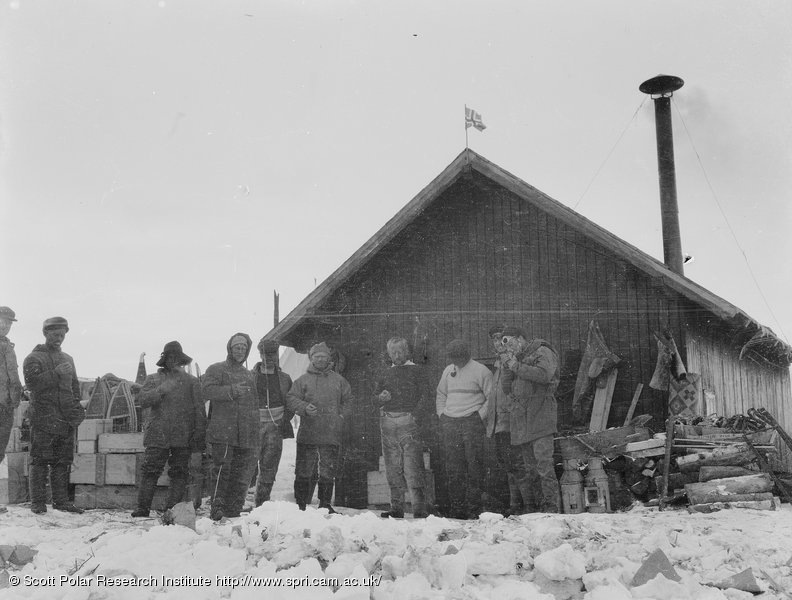 Campbell and his party at Framheim. At center, without a hat, is Amundsen, with Johansen at his right. Hassel is fourth from the left, with a fair beard. The man in the white jumper is probably Campbell. [9]
Campbell (who spoke Norwegian), Pennell, and Levick, the eastern party's surgeon, were invited to breakfast in the new hut, where Lindstrøm served them all hotcakes, and then they were given a tour of the Fram. "[Everyone] broke out in eulogies over how nice and comfortably we lived," Gjertsen said. "When they saw that every man had his own cabin, and everyone had a large common saloon, their eyes grew wide with astonishment. No, they had seen nothing like this before." Upon hearing how the officers' mess on the Terra Nova lay directly underneath the ponies, "one of Fram's crew was immediately seized by the deepest sympathy, and gave his melancholy informant ... a tot of aquavit to strengthen himself. The Englishman was wild with enthusiasm. Yes, it was 'a wonderful ship'."
Nilsen, after being shown over the Terra Nova in return, noted laconically, "I must confess it did not look very inviting." [10]
Johansen was not impressed either. "They should go to New Zealand immediately," he wrote in his diary. "They had a hard journey. Had been leaking and the bulwark was knocked in. But they were in good spirits and extremely courteous to us, though they nevertheless had not expected to meet us here. Something they repeatedly assured us." [11]
Amundsen told the British to land and make their base wherever they wanted, but, as Priestley put it, "we cannot according to etiquette trench on their country for winter quarters." [12] Campbell was deeply disappointed, having regarded the exploration of King Edward Land as "the thing of the whole expedition, " its only truly original work. [13] When Amundsen asked casually about the motor sledges, Campbell told him that one was "already on terra firma." He was referring, of course, to the one at the bottom of McMurdo Sound, but further information was neither asked for nor given. [14]
"It appears that ... Capt. Amundsen ... is going to have a run for the Pole so it will prove a very exciting affair," Dickason, one of the British seamen, wrote in his diary. "He has dogs for sledge work and all his men are good on ski." [15]
Notes:
[1] Alexander Turnbull Library, National Library of New Zealand. The catalogue record of this photograph identifies it as "The ship Terra Nova arriving at the Bay of Whales in 1910, to find the Norwegian expedition.... Photographed from 'Fram', the ship of Amundsen, by an unidentified photographer". It is clearly, however, the smoke-stackless, not to mention stocky and straight-sided, Fram.
[2] Roald Amundsen Bildearkiv, Nasjonalbiblioteket.
[3] Raymond Priestley, diary, [date not given], quoted by Roland Huntford in Scott and Amundsen (New York : Putnam, 1980, c1979), p.342.
[4] Wilfred Bruce, letter to Kathleen Scott, 27 February, 1911, quoted by Roland Huntford in Scott and Amundsen (New York : Putnam, 1980, c1979), p.342.
[5] Wilfred Bruce, letter to Kathleen Scott, 27 February, 1911, quoted by David Crane in Scott of the Antarctic (New York : Knopf, c2005), p.424.
[6] Lt. H.F. Gjertsen, diary, 4 February, 1911, quoted by Roland Huntford in Scott and Amundsen (New York : Putnam, 1980, c1979), p.341. The watchman was Beck, according to Gjertsen's account in ch.16 of The South Pole.
[7] Roald Amundsen Bildearkiv, Nasjonalbiblioteket.
[8] Lt. H.F. Gjertsen, diary, 4 February, 1911, quoted by Roland Huntford in Scott and Amundsen (New York : Putnam, 1980, c1979), p.341.
[9] Scott Polar Research Institute. The SPRI labels this photograph as being taken by Debenham, but he was in Victoria Land with Taylor, Wright, and P.O. Evans from January to March 1911; Levick probably took it, as he was quite interested in photography and had had lessons from Ponting.
[10] Thorvald Nilsen, diary, 4 February, 1911, quoted by Roland Huntford in Scott and Amundsen (New York : Putnam, 1980, c1979), p.344.
[11] Hjalmar Johansen, diary, 4 February 1911, published as Dagbok fra Sydpolen (Skien : Vågemot Miniforlag, 2007), p.6.
[12] Raymond Priestley, diary, 4 February, 1911, quoted by Roland Huntford in Scott and Amundsen (New York : Putnam, 1980, c1979), p.344.
[13] Victor Campbell [?], 27 February, 1911, quoted by David Crane in Scott of the Antarctic (New York : Knopf, c2005), p.424.
[14] Katherine Lambert, in The Longest Winter (Washington DC : Smithsonian, 2004, originally Hell with a Capital H, Pimlico, 2002) is the only writer yet found to state that the Norwegians did in fact find out that one of Scott's sledges had been lost: "Unfortunately, a member of the Eastern Party had let slip the fact that one of these machines was even then reposing on the floor of McMurdo Sound, a fact noted by Nilsen in his diary -- 'at 200 fathoms on the ice they had lost their best automobile.' Amundsen must have been profoundly relieved to hear this snippet of news" (p.53). Lambert does not give a citation for this or any of the diary quotes in this chapter.
[15] Harry Dickason, diary, 4 February 1911, quoted by Roland Huntford in Race for the South Pole : the expedition diaries of Scott and Amundsen (London : Continuum, c2010), p.18.
January 14, 2011
Saturday, 14 January 1911
Amundsen
 Unloading the Fram in the Bay of Whales, 14th January, 1911. [2]
At eleven o'clock in the morning, unloading of the Fram began. Eight dogs were hitched to a sledge loaded with 300 kilos (660 pounds) of supplies, and Amundsen was given the honour of driving.
"I glanced at the ship," he wrote later. "Yes; as I thought -- all our comrades were standing in a row, admiring the fine start. I am not quite sure that I did not hold my head rather high and look round with a certain air of triumph. If I did so, it was foolish of me. I ought to have waited; the defeat would have been easier to bear. For defeat it was, and a signal one. The dogs had spent half a year in lying about and eating and drinking, and had got the impression that they would never have anything else to do. Not one of them appeared to understand that a new era of toil had begun. After moving forward a few yards, they all sat down, as though at a word of command, and stared at each other. The most undisguised astonishment could be read in their faces. When at last we had succeeded, with another dose of the whip, in making them understand that we really asked them to work, instead of doing as they were told they flew at each other in a furious scrimmage. Heaven help me! what work we had with those eight dogs that day! If it was going to be like this on the way to the Pole, I calculated in the midst of the tumult that it would take exactly a year to get there, without counting the return journey. During all this confusion I stole another glance at the ship, but the sight that met me made me quickly withdraw my eyes again. They were simply shrieking with laughter, and loud shouts of the most infamous encouragement reached us." [3]
Anticipating the shuttle of stores between ship and hut, pennants on sticks had been prepared in advance, to be set out to mark the route.
Notes:
[1] Roald Amunsen Bildearkiv, Nasjonalbiblioteket.
[2] Roald Amundsen, The South Pole, ch.5.
 Unloading the Fram in the Bay of Whales, 14th January, 1911. [2]
At eleven o'clock in the morning, unloading of the Fram began. Eight dogs were hitched to a sledge loaded with 300 kilos (660 pounds) of supplies, and Amundsen was given the honour of driving.
"I glanced at the ship," he wrote later. "Yes; as I thought -- all our comrades were standing in a row, admiring the fine start. I am not quite sure that I did not hold my head rather high and look round with a certain air of triumph. If I did so, it was foolish of me. I ought to have waited; the defeat would have been easier to bear. For defeat it was, and a signal one. The dogs had spent half a year in lying about and eating and drinking, and had got the impression that they would never have anything else to do. Not one of them appeared to understand that a new era of toil had begun. After moving forward a few yards, they all sat down, as though at a word of command, and stared at each other. The most undisguised astonishment could be read in their faces. When at last we had succeeded, with another dose of the whip, in making them understand that we really asked them to work, instead of doing as they were told they flew at each other in a furious scrimmage. Heaven help me! what work we had with those eight dogs that day! If it was going to be like this on the way to the Pole, I calculated in the midst of the tumult that it would take exactly a year to get there, without counting the return journey. During all this confusion I stole another glance at the ship, but the sight that met me made me quickly withdraw my eyes again. They were simply shrieking with laughter, and loud shouts of the most infamous encouragement reached us." [3]
Anticipating the shuttle of stores between ship and hut, pennants on sticks had been prepared in advance, to be set out to mark the route.
Notes:
[1] Roald Amunsen Bildearkiv, Nasjonalbiblioteket.
[2] Roald Amundsen, The South Pole, ch.5.
January 6, 2011
Friday, 6 January 1911
Amundsen
 Ice in the Ross Sea. [1]
In one of the fasted passages to that date, the Fram came out into the open Ross Sea three and a half days after entering the ice pack. Thanks to her diesel motor, this was the first motor passage of the pack.
With characteristic respect for his predecessors, Amundsen wrote later of Sir James Ross, the first to reach the sea and ice shelf that now bear his name, "Few people of the present day are capable of rightly appreciating this heroic deed; this brilliant proof of human courage and energy. With two ponderous craft -- regular 'tubs' according to our ideas -- these men sailed right into the heart of the pack, which all previous polar explorers had regarded as certain death. It is not merely difficult to grasp this; it is simply impossible -- to us, who with a motion of the hand can set the screw going, and wriggle out of the first difficulty we encounter. These men were heroes -- heroes in the highest sense of the word." [2]
More immediately, he noted in his diary, "The swell is heavy and everything is familiar.... We are forging ahead under full sail and with the engine running as well, and doing 6-7 knots. If we carry on like this, the remaining 500 miles will soon be but a memory. We are all longing to start our work down there." [3]
Notes:
[1] Wikimedia Commons.
[2] Roald Amundsen, The South Pole, ch.1.
[3] Roald Amundsen, diary, [6 January, 1911?], quoted by Roland Huntford in The Amundsen Photographs (London : Hodder & Stoughton, c1987), p.72-73.
 Ice in the Ross Sea. [1]
In one of the fasted passages to that date, the Fram came out into the open Ross Sea three and a half days after entering the ice pack. Thanks to her diesel motor, this was the first motor passage of the pack.
With characteristic respect for his predecessors, Amundsen wrote later of Sir James Ross, the first to reach the sea and ice shelf that now bear his name, "Few people of the present day are capable of rightly appreciating this heroic deed; this brilliant proof of human courage and energy. With two ponderous craft -- regular 'tubs' according to our ideas -- these men sailed right into the heart of the pack, which all previous polar explorers had regarded as certain death. It is not merely difficult to grasp this; it is simply impossible -- to us, who with a motion of the hand can set the screw going, and wriggle out of the first difficulty we encounter. These men were heroes -- heroes in the highest sense of the word." [2]
More immediately, he noted in his diary, "The swell is heavy and everything is familiar.... We are forging ahead under full sail and with the engine running as well, and doing 6-7 knots. If we carry on like this, the remaining 500 miles will soon be but a memory. We are all longing to start our work down there." [3]
Notes:
[1] Wikimedia Commons.
[2] Roald Amundsen, The South Pole, ch.1.
[3] Roald Amundsen, diary, [6 January, 1911?], quoted by Roland Huntford in The Amundsen Photographs (London : Hodder & Stoughton, c1987), p.72-73.
January 3, 2011
Tuesday, 3 January 1911
Scott
 Cape Crozier precipices, photographed by Ponting on 3 January, 1911. [1]
"6 P.M. -- No good!! Alas! Cape Crozier with all its attractions is denied us," lamented Scott. [2] They had come to the Great Barrier five miles east of the Cape, but heavy swells prevented their landing a boat, and there was no access to the beach for unloading their equipment. "It would have taken weeks to land the ordinary stores, and heaven knows how we could have got the ponies and the motor sledges ashore." [3]
Cherry wrote later, "We could see the great pressure waves which had proved such an obstacle to travellers from the Discovery to the Emperor penguin rookery. The Knoll was clear, but the summit of Mount Terror was in the clouds. As for the Barrier we seemed to have known it all our lives, it was so exactly like what we had imagined it to be, and seen in the pictures and photographs." [4]
Amundsen
 Fram in the ice-pack, 1910. [5]
The Fram entered the pack ice at 175° 35'E longitude.
"The ice through which we have gone lies in streams with broad, open leads in between [with] a few eroded icebergs," Amundsen wrote in his diary. "An occasional seal has been seen here and there. In those cases, we stop and take it.... It had been a red letter day for all of us. For dinner we had steak -- the finest and tenderest meat.... The dogs have done just as well. For dinner they had each their huge piece of meat, about 2 kilos, together with a large piece of skin with blubber. To begin with, they did not really grasp the change from stockfish to fresh seal meat -- but it did not take them long.... I estimate that the ... heaviest seal we caught weighs about 500 kilos. Not many of those fellows will be needed to feed the dogs during the winter." [6]
Notes:
[1] Scott Polar Research Institute.
[2] R.F. Scott, diary, 3 January, 1911, quoted in Scott's Last Expedition, v.1.
[3] R.F. Scott, diary [date not given], quoted by David Crane in Scott of the Antarctic (New York : Knopf, c2005), p.401-402.
[4] Apsley Cherry-Garrard, The Worst Journey in the World, ch.4.
[5] Roald Amundsen Bildearkiv, Nasjonalbiblioteket.
[6] Roald Amundsen, diary, 3 January, 1911, quoted by Roland Huntford in The Amundsen Photographs (London : Hodder & Stoughton, c1987), p.72.
 Cape Crozier precipices, photographed by Ponting on 3 January, 1911. [1]
"6 P.M. -- No good!! Alas! Cape Crozier with all its attractions is denied us," lamented Scott. [2] They had come to the Great Barrier five miles east of the Cape, but heavy swells prevented their landing a boat, and there was no access to the beach for unloading their equipment. "It would have taken weeks to land the ordinary stores, and heaven knows how we could have got the ponies and the motor sledges ashore." [3]
Cherry wrote later, "We could see the great pressure waves which had proved such an obstacle to travellers from the Discovery to the Emperor penguin rookery. The Knoll was clear, but the summit of Mount Terror was in the clouds. As for the Barrier we seemed to have known it all our lives, it was so exactly like what we had imagined it to be, and seen in the pictures and photographs." [4]
Amundsen
 Fram in the ice-pack, 1910. [5]
The Fram entered the pack ice at 175° 35'E longitude.
"The ice through which we have gone lies in streams with broad, open leads in between [with] a few eroded icebergs," Amundsen wrote in his diary. "An occasional seal has been seen here and there. In those cases, we stop and take it.... It had been a red letter day for all of us. For dinner we had steak -- the finest and tenderest meat.... The dogs have done just as well. For dinner they had each their huge piece of meat, about 2 kilos, together with a large piece of skin with blubber. To begin with, they did not really grasp the change from stockfish to fresh seal meat -- but it did not take them long.... I estimate that the ... heaviest seal we caught weighs about 500 kilos. Not many of those fellows will be needed to feed the dogs during the winter." [6]
Notes:
[1] Scott Polar Research Institute.
[2] R.F. Scott, diary, 3 January, 1911, quoted in Scott's Last Expedition, v.1.
[3] R.F. Scott, diary [date not given], quoted by David Crane in Scott of the Antarctic (New York : Knopf, c2005), p.401-402.
[4] Apsley Cherry-Garrard, The Worst Journey in the World, ch.4.
[5] Roald Amundsen Bildearkiv, Nasjonalbiblioteket.
[6] Roald Amundsen, diary, 3 January, 1911, quoted by Roland Huntford in The Amundsen Photographs (London : Hodder & Stoughton, c1987), p.72.
January 2, 2011
Monday, 2 January 1911
Amundsen
The Fram crossed the Antarctic Circle, and found the water free of ice further south than anyone before had done. Amundsen's close study of the published records had led him to the conclusion that there was a passage at the point where the pack was slackest and narrowest, and that at that time of the year this point was probably a few degrees west of the 180th Meridian. Other than noting these conclusions, though, he let Beck take charge of their course.
"We have now found the sea free of ice further South than anyone else," Amundsen wrote in his diary. "But -- we will meet it in the end." [1]
Notes:
[1] Roald Amundsen, diary, 2 January, 1911, quoted by Roland Huntford in The Amundsen Photographs (London : Hodder & Stoughton, c1987), p.72.
The Fram crossed the Antarctic Circle, and found the water free of ice further south than anyone before had done. Amundsen's close study of the published records had led him to the conclusion that there was a passage at the point where the pack was slackest and narrowest, and that at that time of the year this point was probably a few degrees west of the 180th Meridian. Other than noting these conclusions, though, he let Beck take charge of their course.
"We have now found the sea free of ice further South than anyone else," Amundsen wrote in his diary. "But -- we will meet it in the end." [1]
Notes:
[1] Roald Amundsen, diary, 2 January, 1911, quoted by Roland Huntford in The Amundsen Photographs (London : Hodder & Stoughton, c1987), p.72.
January 1, 2011
Sunday, 1 January 1911
Amundsen
 Drift ice seen from the Fram, in an undated photo. [1]
At three in the morning, the officer of the watch sighted the first iceberg, with still more to come throughout the day.
Notes:
[1] Nasjonalbiblioteket. The glass plate has suffered heavy damage.
 Drift ice seen from the Fram, in an undated photo. [1]
At three in the morning, the officer of the watch sighted the first iceberg, with still more to come throughout the day.
Notes:
[1] Nasjonalbiblioteket. The glass plate has suffered heavy damage.
December 14, 2010
Wednesday, 14 December 1910
Scott
 A berg in the pack, with Debenham and Taylor on skis, photographed by Ponting, 20 December, 1910. [1]
The Terra Nova's progress through the ice was frustratingly slow but at the least it gave them a chance to leave the ship for a little while, and they took the opportunity to try out their skis -- or, as Griffith Taylor noted, "in current parlance (à la Gran) to go 'mit dee shee op'". [2] It was for many of them the very first time they had used skis.
"Gran is wonderfully good and gives instruction well," wrote Scott [3], although the men were not always particularly enthusiastic -- P.O. Evans, for one, referred to them as "planks". [4]
"It was hot and garments came off one by one -- the Soldier [Oates] and Atkinson were stripped to the waist eventually, and have been sliding round the floe for some time in that condition. Nearly everyone has been wearing goggles; the glare is very bad. Ponting tried to get a colour picture, but unfortunately the ice colours are too delicate for this."
Amundsen
 Fram in high seas, in an undated photograph. [5]
During a storm, the Fram tossed and rolled and bobbed, due to her round bottom and broad beam, built for the ice. The bridge, though, stayed dry, and sheltered the poor dogs, sometimes as many as fifty at a time. She might buck and toss, but the Fram never shipped a sea. It was, Amundsen wrote in his diary, "almost unbelievable. The one sea towers up more menacingly than the other, and one might expect it over one every moment. But no -- she gives a little twist, and the sea passes under .... Archer can be proud of Fram." [6]
Notes:
[1] Scott Polar Research Institute.
[2] T. Griffith Taylor, quoted by Diana Preston in A First Rate Tragedy (Boston : Houghton Mifflin, 1998, c1997), p.135. "Ski" in Norwegian is pronounced "shee".
[3] R.F. Scott, diary, 14 December, 1910, quoted in Scott's Last Expedition, v.1.
[4] Quoted by Diana Preston in A First Rate Tragedy (Boston : Houghton Mifflin, 1998, c1997), p.135.
[5] Roald Amundsen Bildearkiv, Nasjonalbiblioteket.
[6] Roald Amundsen, diary, 14 December 1910, quoted by Roland Huntford in Scott and Amundsen (New York : Putnam, 1980, c1979), p.311.
 A berg in the pack, with Debenham and Taylor on skis, photographed by Ponting, 20 December, 1910. [1]
The Terra Nova's progress through the ice was frustratingly slow but at the least it gave them a chance to leave the ship for a little while, and they took the opportunity to try out their skis -- or, as Griffith Taylor noted, "in current parlance (à la Gran) to go 'mit dee shee op'". [2] It was for many of them the very first time they had used skis.
"Gran is wonderfully good and gives instruction well," wrote Scott [3], although the men were not always particularly enthusiastic -- P.O. Evans, for one, referred to them as "planks". [4]
"It was hot and garments came off one by one -- the Soldier [Oates] and Atkinson were stripped to the waist eventually, and have been sliding round the floe for some time in that condition. Nearly everyone has been wearing goggles; the glare is very bad. Ponting tried to get a colour picture, but unfortunately the ice colours are too delicate for this."
Amundsen
 Fram in high seas, in an undated photograph. [5]
During a storm, the Fram tossed and rolled and bobbed, due to her round bottom and broad beam, built for the ice. The bridge, though, stayed dry, and sheltered the poor dogs, sometimes as many as fifty at a time. She might buck and toss, but the Fram never shipped a sea. It was, Amundsen wrote in his diary, "almost unbelievable. The one sea towers up more menacingly than the other, and one might expect it over one every moment. But no -- she gives a little twist, and the sea passes under .... Archer can be proud of Fram." [6]
Notes:
[1] Scott Polar Research Institute.
[2] T. Griffith Taylor, quoted by Diana Preston in A First Rate Tragedy (Boston : Houghton Mifflin, 1998, c1997), p.135. "Ski" in Norwegian is pronounced "shee".
[3] R.F. Scott, diary, 14 December, 1910, quoted in Scott's Last Expedition, v.1.
[4] Quoted by Diana Preston in A First Rate Tragedy (Boston : Houghton Mifflin, 1998, c1997), p.135.
[5] Roald Amundsen Bildearkiv, Nasjonalbiblioteket.
[6] Roald Amundsen, diary, 14 December 1910, quoted by Roland Huntford in Scott and Amundsen (New York : Putnam, 1980, c1979), p.311.
December 8, 2010
Thursday, 8 December 1910
Amundsen
 The crew (and dogs) on the deck of the Fram, in an undated photograph. Collectors are under the sails to catch fresh water; also visible are bundles of planks for the ice hut. [1]
The Fram passed the 100th meridian, approaching Australia.
 The crew (and dogs) on the deck of the Fram, in an undated photograph. Collectors are under the sails to catch fresh water; also visible are bundles of planks for the ice hut. [1]
The Fram passed the 100th meridian, approaching Australia.
November 11, 2010
Friday, 11 November 1910
Amundsen
 The Fram under sail, undated. [1]
The round-bottomed Fram, built for the pack ice, was notorious for rolling in the slightest swells. "[She] rolls day and night without respite," Johansen wrote in his diary. "At every meal, we have to lash our chairs to the deck ... not a moment's peace since we left Norway except for the 2-3 days at Madeira." [1]
Amundsen, though, was more phlegmatic. During a southwesterly storm, he wrote, "the sea rose up to a fairly noticeable height. Some [waves] reached the maximum on the scale -- 10 metres high. But -- how wonderfully [the Fram] takes them. As long as one is careful to keep her stern towards these bouncers, one would not know that one was at sea.... She lurches all right, but not a drop of water does she take on board." [2]
Notes:
[1] Roald Amundsen bildearkiv, Nasjonalbiblioteket.
[2] Hjalmar Johansen, diary [date not given], quoted by Roland Huntford in The Amundsen Photographs (London : Hodder & Stoughton, c1987), p.66.
[3] Roald Amundsen, diary, 10 November, 1910, quoted by Roland Huntford in The Amundsen Photographs (London : Hodder & Stoughton, c1987), p.66.
 The Fram under sail, undated. [1]
The round-bottomed Fram, built for the pack ice, was notorious for rolling in the slightest swells. "[She] rolls day and night without respite," Johansen wrote in his diary. "At every meal, we have to lash our chairs to the deck ... not a moment's peace since we left Norway except for the 2-3 days at Madeira." [1]
Amundsen, though, was more phlegmatic. During a southwesterly storm, he wrote, "the sea rose up to a fairly noticeable height. Some [waves] reached the maximum on the scale -- 10 metres high. But -- how wonderfully [the Fram] takes them. As long as one is careful to keep her stern towards these bouncers, one would not know that one was at sea.... She lurches all right, but not a drop of water does she take on board." [2]
Notes:
[1] Roald Amundsen bildearkiv, Nasjonalbiblioteket.
[2] Hjalmar Johansen, diary [date not given], quoted by Roland Huntford in The Amundsen Photographs (London : Hodder & Stoughton, c1987), p.66.
[3] Roald Amundsen, diary, 10 November, 1910, quoted by Roland Huntford in The Amundsen Photographs (London : Hodder & Stoughton, c1987), p.66.
October 16, 2010
Sunday, 16 October 1910
Amundsen
 Ilha da Trindade, date unknown [1]
According to noon observations on October 16, the Fram was in the vicinity of South Trinidad, off the east coast of Brazil. "It was our intention to go close under the island," Amundsen wrote, "and possibly to attempt a landing; but unfortunately the motor had to be stopped for cleaning, and this prevented our approaching it by daylight. We caught a glimpse of the land at dusk, which was, at all events, enough to check our chronometers." [2]
Notes:
[1] Source unknown.
[2] Roald Amundsen, The South Pole, ch.4.
 Ilha da Trindade, date unknown [1]
According to noon observations on October 16, the Fram was in the vicinity of South Trinidad, off the east coast of Brazil. "It was our intention to go close under the island," Amundsen wrote, "and possibly to attempt a landing; but unfortunately the motor had to be stopped for cleaning, and this prevented our approaching it by daylight. We caught a glimpse of the land at dusk, which was, at all events, enough to check our chronometers." [2]
Notes:
[1] Source unknown.
[2] Roald Amundsen, The South Pole, ch.4.
Subscribe to:
Posts (Atom)


