Showing posts with label Priestley. Show all posts

January 8, 2012

Monday, 8 January 1912

Scott

"Antarctic Sledging (One of Scott's party prepares for a night away from base)", a painting by Wilson from the Discovery expedition. [1]

The party was tent-bound, stopped by a Force 4-6 wind from the south. "T. -19.8°. Min. for night -25°," wrote Scott.

"It is quite impossible to speak too highly of my companions," he went on. "Each fulfils his office to the party; Wilson, first as doctor, ever on the lookout to alleviate the small pains and troubles incidental to the work, now as cook, quick, careful and dexterous, ever thinking of some fresh expedient to help the camp life; tough as steel on the traces, never wavering from start to finish." [1]

"Evans, a giant worker with a really remarkable headpiece. It is only now I realise how much has been due to him. Our ski shoes and crampons have been absolutely indispensable, and if the original ideas were not his, the details of manufacture and design and the good workmanship are his alone. He is responsible for every sledge, every sledge fitting, tents, sleeping-bags, harness, and when one cannot recall a single expression of dissatisfaction with any one of these items, it shows what an invaluable assistant he has been. Now, besides superintending the putting up of the tent, he thinks out and arranges the packing of the sledge; it is extraordinary how neatly and handily everything is stowed, and how much study has been given to preserving the suppleness and good running qualities of the machine. On the Barrier, before the ponies were killed, he was ever roaming round, correcting faults of stowage."

"Little Bowers remains a marvel -- he is thoroughly enjoying himself. I leave all the provision arrangement in his hands, and at all times he knows exactly how we stand, or how each returning party should fare. It has been a complicated business to redistribute stores at various stages of re-organisation, but not one single mistake has been made. In addition to the stores, he keeps the most thorough and conscientious meteorological record, and to this he now adds the duty of observer and photographer. Nothing comes amiss to him, and no work is too hard. It is a difficulty to get him into the tent; he seems quite oblivious of the cold, and he lies coiled in his bag writing and working out sights long after the others are asleep."

"Of these three it is a matter for thought and congratulation that each is sufficiently suited for his own work, but would not be capable of doing that of the others as well as it is done. Each is invaluable. Oates had his invaluable period with the ponies; now he is a foot slogger and goes hard the whole time, does his share of camp work, and stands the hardship as well as any of us. I would not like to be without him either. So our five people are perhaps as happily selected as it is possible to imagine."

Campbell's Northern Party was landed slightly further northeast of Evans Coves than planned, at a place they called Depot Moraine Camp, later called Hell's Gate. Priestley wrote later, "We had prepared a large depot at Cape Adare which was to have been landed with us here, but it was necessary to sledge all our gear about half a mile over sea ice before it would have been possible to depot it, and as Campbell did not wish to delay the ship, he decided to land only such spare food as could be taken in one journey by ourselves and a sledge party from the ship's crew. In the light of after events this proved to be a grave mistake." [3] Assuming that the ship would pick them up on 18th February as scheduled, Campbell did not feel justified in taking supplies marked down for the main party at Cape Evans.


Notes:

[1] Source unknown.
[2] R.F. Scott, diary, 8 January, 1912, quoted in Scott's Last Expedition, v.1.
[3] Raymond Priestley, quoted by Katherine Lambert in The Longest Winter (Washington DC : Smithsonian Books, c2004), p.110.

December 4, 2011

Monday, 4 December 1911

Scott

As the party neared the edge of the Barrier, Oates wrote in his diary, "Saw several enormous glaciers coming down between the mountains, and some of the chasms which stopped Shackleton. And now one is here one can realise what a wonderful journey his was and the daring which prompted him to strike up the glacier instead of following the coastline." [1]

"The dogs came up with us as we camped last night," Scott wrote, "and the man-haulers arrived this morning as we finished the pony wall. So we are all together again. The latter had great difficulty in following our tracks, and say they could not have steered a course without them. It is utterly impossible to push ahead in this weather, and one is at a complete loss to account for it. The barometer rose from 29.4 to 29.9 last night, a phenomenal rise. Evidently there is very great disturbance of atmospheric conditions. Well, one must stick it out, that is all, and hope for better things, but it makes me feel a little bitter to contrast such weather with that experienced by our predecessors." [2]

Scott had got from Priestley Frank Wild's diary of their polar journey, and based his own times, weights, and rations on that performance. Priestley recalled much later, "I've always thought of Shackleton acting as a ghostly pace-maker for Scott, and that diary having a considerable psychological effect." [3]

Bowers was "prognosticating good signs out of everything to cheer up Captain Scott, who naturally feels a bit down on his luck.... The Owner was in quite a paddy with the weather, and said we had not had a piece of good luck since we started." [4]

"We have only lost 5 or 6 miles on these two wretched days," Scott wrote, "but the disturbed condition of the weather makes me anxious with regard to the Glacier, where more than anywhere we shall need fine days. One has a horrid feeling that this is a real bad season. However, sufficient for the day is the evil thereof. We are practically through with the first stage of our journey. Looking from the last camp towards the S.S.E., where the farthest land can be seen, it seemed more than probable that a very high latitude could be reached on the Barrier, and if Amundsen journeying that way has a stroke of luck, he may well find his summit journey reduced to 100 miles or so. In any case it is a fascinating direction for next year's work if only fresh transport arrives." [5]

Bowers, though, wrote, "Amundsen has probably reached the Pole by now. I hope he has not, as I regard him as a sneaking, back-handed ruffian." [6]

Cherry's pony Michael was shot after they made evening camp.


Amundsen

"Have gone completely blind all day," wrote Amundsen. "Breeze from N. with thick drift, and greater, more constant snowfall than I have yet seen in these regions." Despite large sastrugi that capsized the sledges a number of times, "we have worked our way ahead by 20 nautical miles in this impenetrable weather, and at the moment are 10,200 ft. asl. [above sea level, 3109 m] by boiling point." [7]


Notes:

[1] L.E.G. Oates, diary, 4 December, 1911, quoted by Roland Huntford in Scott and Amundsen (New York : Putnam, 1980, c1979), p.428.
[2] R.F. Scott, diary, 4 December, 1911, quoted in Scott's Last Expedition : the Journals, v.1.
[3] Raymond Priestley, quoted by David Crane in Scott of the Antarctic (New York : Knopf, c2005), p.467.
[4] H.R. Bowers, diary, 4 December, 1911, quoted by Roland Huntford in Scott and Amundsen (New York : Putnam, 1980, c1979), p.462.
[5] R.F. Scott, diary, 4 December, 1911, quoted in Scott's Last Expedition : the Journals, v.1.
[6] H.R. Bowers, diary, [date not given], quoted by Roland Huntford in Scott and Amundsen (New York : Putnam, 1980, c1979), p.462.
[7] Roald Amundsen, diary, 5 December, 1911, quoted by Roland Huntford in Race for the South Pole : the expedition diaries of Scott and Amundsen (London : Continuum, c2010), p.164.

February 5, 2011

Sunday, 5 February 1911

Scott

A blizzard kept the depot party in camp. The dogs could curl up and sleep in the snow, but the ponies suffered terribly. The wind, Cherry wrote later, "is raging chaos. It is blowing a full gale: the air is full of falling snow, and the wind drives this along and adds to it the loose snow which is lying on the surface of the Barrier. Fight your way a few steps away from the tent, and it will be gone. Lose your sense of direction and there is nothing to guide you back." [1]

Campbell directed the Terra Nova back to McMurdo Sound with the news of Amundsen, amongst "heavy arguments in wardroom about the rights and wrongs of Amundsen's party and the chances of our being able to beat them. Their experience and number of dogs seem to leave us very little." [2]

"Well!," Priestley wrote in his diary that night, "we have left the Norwegians and our thoughts are full, too full of them at present. The impression they have left me with is that of a set of men of distinctive personality, and evidently inured to hardship, good goers and pleasant and good-humoured. All these qualities combine to make them very dangerous rivals, but even did one not want to, one cannot help liking them individually in spite of the rivalry." [3]


Amundsen

The day after the Terra Nova's visit, wrote Amundsen, "our hut was baptised and given the name 'Framheim' ["Home of Fram"]. The idea was Prestrud's. We had the ship's party, or as they are called, the pirates, for a house warming." [4] They had to visit in shifts, four to lunch and six to supper, as they could not all leave the ship at the same time.


Notes:

[1] Apsley Cherry-Garrard, The Worst Journey in the World, ch.5.
[2] Wilfred Bruce, diary, 5 February, 1911, quoted by Roland Huntford in Scott and Amundsen (New York : Putnam, 1980, c1979), p.360.
[3] Raymond Priestley, diary, [5 February, 1911], quoted by David Crane in Scott of the Antarctic (New York : Knopf, c2005), p.425.
[4] Roald Amundsen, diary, [date not given], quoted by Roland Huntford in The Amundsen Photographs (London : Hodder & Stoughton, c1987), p.85.

February 4, 2011

Saturday, 4 February 1911

The Fram, from the Terra Nova. [1]

Fram with the Terra Nova in the distance. [2]

A few hours before midnight, the Terra Nova put into the Bay of Whales.

Scott had always doubted the existence of this Bay, and Priestley was cheered to find that they had now "wonderfully upheld" Shackleton's observations. [3]

"[It was] satisfactory to find ... everybody backing up the Shackleton expedition," Priestley went on, "and I turned in ... feeling quite cheerful and believing that there would be a good chance of ... finding a home on the Barrier here -- our last hope of surveying King Edward's Land. However, Man proposes but God disposes and I was waked at one o'clock by Lillie with the astounding news that we had sighted a ship at anchor to the sea ice in the Bay. All was confusion on board for a few minutes, everybody rushing up on deck with cameras and clothes. It was no false alarm, there she was within a few hundred yards of us and what is more, those of us who had read Nansen's books recognized the Fram."

"An eruption of Erebus would fall flat after that," Bruce remarked. [4] "Curses loud & deep were heard everywhere, and we ran close by her & made fast to the floe ahead without them knowing." [5]

This astonishment is not particularly surprising, for although the British knew that Amundsen was in the Antarctic, they had no idea where, indeed, had assumed either Graham Land or the Weddell Sea.

The Norwegians were perhaps rather more alarmed than astonished.

"We had long expected her [the Terra Nova]," Gjertsen wrote in his diary, "to come into the bay when she went Eastwards with the party [for] King Edward's Land. Our watchman ... saw two men go ashore, put on skis, and, with reasonably good speed for foreigners, rush off up towards the barrier, following the dogs' tracks. 'Well,' thought the watchman, 'if they have any nefarious intentions, (one of our constant subjects of discussion was how the Englishmen would take our challenge) the dogs will manage that job, and get them to turn round all right. It'll be worse if they sneak up to Fram, where I'm alone on watch. Best to be ready for all eventualities.' After this profound monologue, he dashed into the charthouse, carefully loaded 9 bullets into our old Farman gun (which when at peace we used for hunting seals), dug out an old English grammar, and looked up, on page 11, 'How are you this morning' and similar expressions. Thus armed to the teeth, both physically and mentally, he crept out on watch again. He might have been waiting 1/2 an hour, partly occupied in checking sight and trigger, partly swotting items of grammar, when suddenly a shock went through him. The Englishmen were coming down again, with a course straight for Fram.... He looked carefully: No, they had no weapons; if so, it must be a revolver in a pocket -- Suddenly he remembered a verse from his childhood, 'Be brave when danger threatens, etc.' and immediately became very brave. He put down the gun and the grammar just under his coat, so that both could be retrieved in a hurry, raised himself and calmly awaited the Englishmen's movements." [6]


Terra Nova to the left, and Fram. [7]

At six in the morning, Gjertsen continued, Amundsen and the others "came galloping down. Never before had it gone so swimmingly, and once down on the flat ice, they formed a line and there was a veritable race to reach the ship. The Englishmen [were] absolutely flabbergasted. No, they had never dreamt that dogs could run in that way before a sledge, and already they felt contempt for their dear ponies. Suddenly they were gripped by wild excitement, cheered, and waved their caps. Our drivers returned their greetings and cracked their whips." [8]

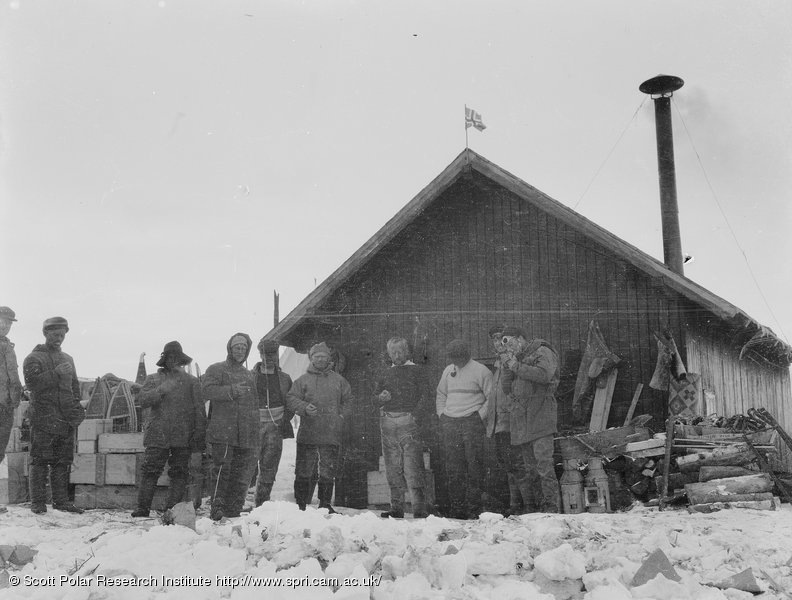
Campbell and his party at Framheim. At center, without a hat, is Amundsen, with Johansen at his right. Hassel is fourth from the left, with a fair beard. The man in the white jumper is probably Campbell. [9]

Campbell (who spoke Norwegian), Pennell, and Levick, the eastern party's surgeon, were invited to breakfast in the new hut, where Lindstrøm served them all hotcakes, and then they were given a tour of the Fram. "[Everyone] broke out in eulogies over how nice and comfortably we lived," Gjertsen said. "When they saw that every man had his own cabin, and everyone had a large common saloon, their eyes grew wide with astonishment. No, they had seen nothing like this before." Upon hearing how the officers' mess on the Terra Nova lay directly underneath the ponies, "one of Fram's crew was immediately seized by the deepest sympathy, and gave his melancholy informant ... a tot of aquavit to strengthen himself. The Englishman was wild with enthusiasm. Yes, it was 'a wonderful ship'."

Nilsen, after being shown over the Terra Nova in return, noted laconically, "I must confess it did not look very inviting." [10]

Johansen was not impressed either. "They should go to New Zealand immediately," he wrote in his diary. "They had a hard journey. Had been leaking and the bulwark was knocked in. But they were in good spirits and extremely courteous to us, though they nevertheless had not expected to meet us here. Something they repeatedly assured us." [11]

Amundsen told the British to land and make their base wherever they wanted, but, as Priestley put it, "we cannot according to etiquette trench on their country for winter quarters." [12] Campbell was deeply disappointed, having regarded the exploration of King Edward Land as "the thing of the whole expedition, " its only truly original work. [13] When Amundsen asked casually about the motor sledges, Campbell told him that one was "already on terra firma." He was referring, of course, to the one at the bottom of McMurdo Sound, but further information was neither asked for nor given. [14]

"It appears that ... Capt. Amundsen ... is going to have a run for the Pole so it will prove a very exciting affair," Dickason, one of the British seamen, wrote in his diary. "He has dogs for sledge work and all his men are good on ski." [15]


Notes:

[1] Alexander Turnbull Library, National Library of New Zealand. The catalogue record of this photograph identifies it as "The ship Terra Nova arriving at the Bay of Whales in 1910, to find the Norwegian expedition.... Photographed from 'Fram', the ship of Amundsen, by an unidentified photographer". It is clearly, however, the smoke-stackless, not to mention stocky and straight-sided, Fram.
[2] Roald Amundsen Bildearkiv, Nasjonalbiblioteket.
[3] Raymond Priestley, diary, [date not given], quoted by Roland Huntford in Scott and Amundsen (New York : Putnam, 1980, c1979), p.342.
[4] Wilfred Bruce, letter to Kathleen Scott, 27 February, 1911, quoted by Roland Huntford in Scott and Amundsen (New York : Putnam, 1980, c1979), p.342.
[5] Wilfred Bruce, letter to Kathleen Scott, 27 February, 1911, quoted by David Crane in Scott of the Antarctic (New York : Knopf, c2005), p.424.
[6] Lt. H.F. Gjertsen, diary, 4 February, 1911, quoted by Roland Huntford in Scott and Amundsen (New York : Putnam, 1980, c1979), p.341. The watchman was Beck, according to Gjertsen's account in ch.16 of The South Pole.
[7] Roald Amundsen Bildearkiv, Nasjonalbiblioteket.
[8] Lt. H.F. Gjertsen, diary, 4 February, 1911, quoted by Roland Huntford in Scott and Amundsen (New York : Putnam, 1980, c1979), p.341.
[9] Scott Polar Research Institute. The SPRI labels this photograph as being taken by Debenham, but he was in Victoria Land with Taylor, Wright, and P.O. Evans from January to March 1911; Levick probably took it, as he was quite interested in photography and had had lessons from Ponting.
[10] Thorvald Nilsen, diary, 4 February, 1911, quoted by Roland Huntford in Scott and Amundsen (New York : Putnam, 1980, c1979), p.344.
[11] Hjalmar Johansen, diary, 4 February 1911, published as Dagbok fra Sydpolen (Skien : Vågemot Miniforlag, 2007), p.6.
[12] Raymond Priestley, diary, 4 February, 1911, quoted by Roland Huntford in Scott and Amundsen (New York : Putnam, 1980, c1979), p.344.
[13] Victor Campbell [?], 27 February, 1911, quoted by David Crane in Scott of the Antarctic (New York : Knopf, c2005), p.424.
[14] Katherine Lambert, in The Longest Winter (Washington DC : Smithsonian, 2004, originally Hell with a Capital H, Pimlico, 2002) is the only writer yet found to state that the Norwegians did in fact find out that one of Scott's sledges had been lost: "Unfortunately, a member of the Eastern Party had let slip the fact that one of these machines was even then reposing on the floor of McMurdo Sound, a fact noted by Nilsen in his diary -- 'at 200 fathoms on the ice they had lost their best automobile.' Amundsen must have been profoundly relieved to hear this snippet of news" (p.53). Lambert does not give a citation for this or any of the diary quotes in this chapter.
[15] Harry Dickason, diary, 4 February 1911, quoted by Roland Huntford in Race for the South Pole : the expedition diaries of Scott and Amundsen (London : Continuum, c2010), p.18.

January 8, 2011

Sunday, 8 January 1911

Scott

"Men pulling a motor-sledge from the 'Terra Nova' on 8 January 1911. Taken by Herbert George Ponting in 1911, during the British Antarctic ('Terra Nova') Expedition (1910-1913)." [1]

The third of the motor sledges was lost when it fell through the thawing sea ice as it was being unloaded. "We realised that the ice was getting very rotten," Priestley wrote in his diary, but no-one wanted to disobey Scott's orders to hurry. The sledge had been lowered onto the ice when Williamson went through to his knees, "[the] car suddenly dipped, the ice gave way beneath her after end and she fell with all her weight vertically on the rope. The rope began cutting through the thin ice, and we were never able to hold her steady for a moment. Man after man was forced to leave the rope through his hands, and when only five of us were left she took charge at a gallop and is now resting on the bottom at a depth of 120 fathoms." Priestley himself, having gone back to the ship for a life-line and Day's goggles, fell through and was swept under by a strong current, bursting up again through the rotten ice "like a cork out of a champagne bottle." [2] "Day, here are your goggles," he said calmly. [3]

"A day of disaster," Scott wrote in his journal. [4]


Notes:

[1] National Library of New Zealand.
[2] Raymond Priestley, diary, 8 January, 1911, quoted by David Crane in Scott of the Antarctic (New York : Knopf, c2005), p.404.
[3] Apsley Cherry-Garrard, The Worst Journey in the World, ch.4.
[4] R.F. Scott, diary, 8 January, 1911, quoted in Scott's Last Expedition, v.1.

January 5, 2011

Thursday, 5 January 1911

Scott

"An iceberg and grotto. Photograph taken by Herbert George Ponting on 5 January 1911, during the British Antarctic ('Terra Nova') Expedition (1910-1913)." [1]

Priestley was unimpressed at the difference "between the way the work was carried out and the way when we were landing stores at Cape Royds.... [There are] too many officers superintending and the men never know when and where to go for orders.... [An] Expedition to make a complete success should be entirely away from any Navy ideas.... [In] this one particular give me Shackleton's expedition over and over again." [2]

Faced with the necessity of marking the route between ship and hut, empty paraffin tins were pressed into service.


Amundsen

"The Midnight Sun was visible for the first time today," wrote Amundsen. "It was a wonderful sight on this beautiful evening. It is almost calm; just a breath of wind from the S.E.... Who can describe the wonderful feeling of wellbeing that has enveloped us here in the calm waters among the ice, with plenty of fresh water -- or rather fresh ice -- and fine, fresh meat, after 4 months' unending, intolerable pitching and tossing? I believe that hardly anyone who has not experienced this, can properly understand to what degree we appreciate the change." [3]


Notes:

[1] National Library of New Zealand. The figures are Taylor and Wright; posing for Ponting quickly became known by the new verb "to pont".
[2] Raymond Priestley, letter from Cape Adare, undated, quoted by Roland Huntford in Scott and Amundsen (New York : Putnam, 1980, c1979), p.333.
[3] Roald Amundsen, diary, 5 January, 1911, quoted by Roland Huntford in The Amundsen Photographs (London : Hodder & Stoughton, c1987), p.72.

December 1, 2010

Thursday, 1 December 1910

Scott

Oates with some of the ponies on the Terra Nova, photographed by Herbert Ponting. (Note the damage that the ponies have done to the edge of their stalls by windsucking.) [1]

Even in calm weather, life aboard ship for the ponies must have been a trial. Scott described their situation in his diary: "Under the forecastle fifteen ponies close side by side, seven one side, eight the other, heads together and groom between -- swaying, swaying continually to the plunging, irregular motion. One takes a look through a hole in the bulkhead and sees a row of heads with sad, patient eyes come swinging up together from the starboard side, whilst those on the port swing back; then up come the port heads, whilst the starboard recede. It seems a terrible ordeal for these poor beasts to stand this day after day for weeks together...." [2]

The rest of the scientific staff had joined the ship in New Zealand -- Taylor, Raymond Priestley, and Frank Debenham.

Australian Frank Debenham received a BA in English and philosophy from the University of Sydney, and after a few years teaching in New South Wales returned to university to study geology under Sir Edgeworth David, who, on Shackleton's expedition had led the first ascent of Mt Erebus as well as the first party to reach the South Magnetic Pole (although there is now some doubt about its then-location).

Raymond Priestley, recruited by Scott in Sydney, had just completed his second year reading geology at University College, Bristol, when he joined Shackleton's Nimrod expedition as geologist, working with Edgeworth David and Douglas (later Sir Douglas) Mawson.


Amundsen

Amundsen announced the landing party: Prestrud, Johansen, Hassel, Lindstrøm, Helmer Hanssen, Wisting, Bjaaland, Stubberud, and himself.

Gjertsen wanted so badly to go ashore that he asked Amundsen if he could change places with Prestrud. Amundsen agreed if Prestrud did, but Prestrud did not want to change.

Amundsen increased the wages of those sailing back by half again, partly in consolation for the disappointment. He had, however, chosen his men, with a few exceptions, from those who had originally signed on for the whole Arctic drift.


Notes:

[1] Wikipedia.
[2] R.F. Scott, diary, 1 December, 1910, quoted in Scott's Last Expedition, v.1.

June 3, 2010

Friday, 3 June 1910

Scott

Debenham, Wright, Priestley, and Taylor (reading). Debenham and Priestley would meet the expedition in New Zealand and Australia, respectively. [1]

The Terra Nova arrived in Cardiff. Here they would be joined by more of the scientific staff.

T. Griffith Taylor, thirty, was an Australian geologist who received a Bachelor of Engineering in mining and metallurgy and had recently been elected a Fellow of the Geological Society. Encouraged by his Cambridge tutors and by his friend Douglas Mawson, recently returned from Shackleton's expedition, Taylor applied for the post of physiographer and geologist on Scott's expedition, and was accepted.

Charles S. Wright, nicknamed "Silas", was a twenty-three-year old Canadian physicist who had studied at the University of Toronto and won a postgraduate scholarship to Cambridge where he was now at the end of his two years research into cosmic rays. Impressed by Mawson, Wright had applied for Scott's expedition and been rejected.

Taylor then suggested to his friend that he should reapply to Scott in person; being academics and thus chronically short of funds, they decided to walk the fifty miles from Cambridge to London, with only a dozen hard-cooked eggs for sustenance. "Wright came through 'smiling'," Taylor later wrote of their ten-hour walk, "but my feet were so sore I could hardly stand the next day. My chief recollection is one of loathing for hard-boiled eggs, and of the relief with which I dropped three-quarters of our provisions in a secluded corner of King's Cross." [2]

After a brief interview, Scott changed his mind and Wright was engaged as expedition physicist, for the standard expedition rate of £4 per week for the first year. [3] It was still uncertain as to whether the expedition would remain for a second year.


Amundsen


The Fram off Uranienborg, June 1910. Amundsen stands in front with his dog. Photograph by Anders Beer Wilse. [4]

The Fram left Christiania and sailed down to anchor off Amundsen's home at Bundefjord. Verdens Gang, a Christiania newspaper, wrote that her "three yellow masts glistened in the sunlight, and ... the ship's black bulk stood out ... against the green ... forest-clad background.... Broad, sturdy and sober is she [and] a certain Sabbath peace hung over the vessel, as she lay there, at the edge of the gently rippled, slightly sombre fjord." [5]

Uranienborg, June 1910. Photograph by Anders Beer Wiltse. [6]

The "ice hut", June 1910. Photograph by Anders Beer Wiltse. [7]

The hut stood on the lawn at the water's edge for all to see, and was disassembled and stowed on board. "The more experienced among the members of the expedition," Amundsen wrote later, "were evidently absorbed in profound conjectures as to the meaning of this 'observation house,' as the newspapers had christened it. It may willingly be admitted that they had good reason for their speculations. By an observation house is usually meant a comparatively simple construction, sufficient to provide the necessary shelter from wind and weather. Our house, on the other hand, was a model of solidity, with three double walls, double roof and floor. Its arrangements included ten inviting bunks, a kitchen, and a table; the latter, moreover, had a brand-new American-cloth cover. 'I can understand that they want to keep themselves warm when they're making observations,' said Helmer Hanssen; 'but what they want with a cloth on the table I can’t make out.'" [8] Amundsen did not enlighten them.


Notes:

[1] "The TERRA NOVA Expedition 1910-13", south-pole.com.
[2] T. Griffith-Taylor, With Scott: the Silver Lining (London: Smith Elder, 1916), p.5, quoted by Adrian Raeside in Return to Antarctica: the Amazing Adventure of Sir Charles Wright on Robert Scott's Journey to the South Pole (Mississauga, Ont.: John Wiley, c2009), p.37-38.
[3] Wheeler, Sara, Cherry : a life of Apsley Cherry-Garrard (New York : Modern Library, 2003, c2001), p.66.
[4] GalleriNOR, Norsk Folkemuseum.
[5] Verdens Gang, 6 June 1910, quoted by Roland Huntford in Scott and Amundsen (New York : Putnam, 1980, c1979), p.287.
[6] GalleriNOR, Norsk Folkemuseum.
[7] GalleriNOR, Norsk Folkemuseum.
[8] Roald Amundsen, The South Pole, ch.3.