Scott
"Sunday night (February 12)," Cherry recalled, "we started from Bluff Depôt and did seven miles before lunch against a considerable drift and wind. It was pretty cold, and ten minutes after we left our lunch camp with the ponies it was blowing a full blizzard. The dog party had not started, so we camped and slept five in the four-man tent, and it was by no means uncomfortable. Probably this was the time when Scott first thought of taking a five-man party to the Pole." [1]
Gran noted, "We have not quite crossed the 79th parallel but are not much short of it. One thing is nevertheless certain, that I have now come farther south than Borchgrevink and am therefore the Norwegian who has been nearest the Pole -- provided, that is, Amundsen hasn't pushed farther south on the other side of the continent." [2] The depot party did not yet, of course, know that Amundsen was at the Bay of Whales.
Amundsen
"Today we have had a lot of loose snow," Amundsen wrote in his diary. "For us on skis it was the most magnificent going. How men & horses are going to get through in these conditions I cannot understand, not to mention an automobile. The Thermos flask is a splendid invention. We fill it every morning with boiling chocolate and drink it piping hot at noon. Not bad for the middle of the Barrier." [3]
Notes:
[1] Apsley Cherry-Garrard, The Worst Journey in the World, ch.5.
[2] Tryggve Gran, diary, 12 February, 1911, quoted in The Norwegian with Scott ([Greenwich] : National Maritime Museum, c1984), p.56.
[3] Roald Amundsen, diary, 13 February, 1911, quoted by Roland Huntford in Scott and Amundsen (New York : Putnam, 1980, c1979), p.347.
February 12, 2011

February 10, 2011
Friday, 10 February 1911
Amundsen
 The dogs being fed, on an unidentified sledge journey. [1]
The Norwegians soon learned the most effective order of running: first Prestrud on ski, then Helmer Hanssen with the lead dog team and steering compass, then Johansen with his team and a second compass, and lastly Amundsen with the third team, a spare compass, and the sledgemeter, a wheel attached to the back of the sledge that measured the distance that had been run.
Amundsen had learned in the Arctic that dogs preferred to have someone ahead of them to follow.
"[Amundsen] had trouble with his dog team," wrote Johansen, "in the end he had to take off his reindeer trousers and ski in shirt and underpants. The temperature was 12 degrees below zero. One can do this sort of thing here, where colds do not exist." By "shirt and underpants" he meant the Netsilik reindeer fur underclothes, which proved to be too warm. The boots, however, "of which so much was expected, turned out to be unusable in the cold. Both Prestrud and I got blisters from them. And at supper today I had to put on kamikks [Eskimo sealskin boots] instead." [2]
"The dogs pull magnificently, and the going on the barrier is ideal," Amundsen wrote. "Cannot understand what the English mean when they say that dogs cannot be used here." [3]
Notes:
[1] Roald Amundsen Bildearkiv, Nasjonalbiblioteket.
[2] Hjalmar Johansen, diary, 11 February, 1911, quoted by Roland Huntford in Scott and Amundsen (New York : Putnam, 1980, c1979), p.348.
[3] Roald Amundsen, diary, 11 February, 1911, quoted by Roland Huntford in Scott and Amundsen (New York : Putnam, 1980, c1979), p.347.
 The dogs being fed, on an unidentified sledge journey. [1]
The Norwegians soon learned the most effective order of running: first Prestrud on ski, then Helmer Hanssen with the lead dog team and steering compass, then Johansen with his team and a second compass, and lastly Amundsen with the third team, a spare compass, and the sledgemeter, a wheel attached to the back of the sledge that measured the distance that had been run.
Amundsen had learned in the Arctic that dogs preferred to have someone ahead of them to follow.
"[Amundsen] had trouble with his dog team," wrote Johansen, "in the end he had to take off his reindeer trousers and ski in shirt and underpants. The temperature was 12 degrees below zero. One can do this sort of thing here, where colds do not exist." By "shirt and underpants" he meant the Netsilik reindeer fur underclothes, which proved to be too warm. The boots, however, "of which so much was expected, turned out to be unusable in the cold. Both Prestrud and I got blisters from them. And at supper today I had to put on kamikks [Eskimo sealskin boots] instead." [2]
"The dogs pull magnificently, and the going on the barrier is ideal," Amundsen wrote. "Cannot understand what the English mean when they say that dogs cannot be used here." [3]
Notes:
[1] Roald Amundsen Bildearkiv, Nasjonalbiblioteket.
[2] Hjalmar Johansen, diary, 11 February, 1911, quoted by Roland Huntford in Scott and Amundsen (New York : Putnam, 1980, c1979), p.348.
[3] Roald Amundsen, diary, 11 February, 1911, quoted by Roland Huntford in Scott and Amundsen (New York : Putnam, 1980, c1979), p.347.
February 9, 2011
Thursday, 9 February 1911
Amundsen
Amundsen, Prestrud, Johansen, and Helmer Hanssen started out on the first of their depot-laying journeys, taking three sledges, eighteen dogs, and a half-ton of supplies. They hoped to reach 80°. Bjaaland, Hassel, Wisting, and Stubberud accompanied them as far as the Barrier to help get the sledges up the slope. "It was a hard push," Amundsen noted. [1]
Notes:
[1] Roald Amundsen, diary, [10 February 1911?], quoted by Roland Huntford in Scott and Amundsen (New York : Putnam, 1980, c1979), p.347.
Amundsen, Prestrud, Johansen, and Helmer Hanssen started out on the first of their depot-laying journeys, taking three sledges, eighteen dogs, and a half-ton of supplies. They hoped to reach 80°. Bjaaland, Hassel, Wisting, and Stubberud accompanied them as far as the Barrier to help get the sledges up the slope. "It was a hard push," Amundsen noted. [1]
Notes:
[1] Roald Amundsen, diary, [10 February 1911?], quoted by Roland Huntford in Scott and Amundsen (New York : Putnam, 1980, c1979), p.347.
February 8, 2011
Wednesday, 8 February 1911
Scott
 "Laying a depot. H. & P’s biscuits. Feb. 8th 1911", photographed by Ponting. [1]
After bad weather had kept them at Corner Camp from 4th to 7th February, the depot-laying party moved on. "The ponies were much shaken by the blizzard," Scott wrote in his diary. "One supposes they did not sleep -- all look listless and two or three are visibly thinner than before. But the worst case by far is Forde's little pony; he was reduced to a weight little exceeding 400 lbs. on his sledge and caved in altogether on the second part of the march. The load was reduced to 200 lbs., and finally Forde pulled this in, leading the pony. The poor thing is a miserable scarecrow and never ought to have been brought.... The dogs are in fine form -- the blizzard has only been a pleasant rest for them." [1]
Campbell and the Terra Nova arrived off Cape Evans with the news of Amundsen. He landed the two ponies he'd taken for the exploration of King Edward VII Land, as South Victoria Land was mountainous and unsuitable for ponies. They had to be swum ashore through the icy water.
In order to get the news to Scott as quickly as possible, Campbell took the ship up McMurdo Sound to Hut Point, before it headed off to put the now-renamed Northern Party ashore at, as it turned out, Cape Adare, where they would winter.
Notes:
[1] Scott Polar Research Institute.
[2] R.F. Scott, diary, 8 February, 1911, quoted in Scott's Last Expedition, v.1.
 "Laying a depot. H. & P’s biscuits. Feb. 8th 1911", photographed by Ponting. [1]
After bad weather had kept them at Corner Camp from 4th to 7th February, the depot-laying party moved on. "The ponies were much shaken by the blizzard," Scott wrote in his diary. "One supposes they did not sleep -- all look listless and two or three are visibly thinner than before. But the worst case by far is Forde's little pony; he was reduced to a weight little exceeding 400 lbs. on his sledge and caved in altogether on the second part of the march. The load was reduced to 200 lbs., and finally Forde pulled this in, leading the pony. The poor thing is a miserable scarecrow and never ought to have been brought.... The dogs are in fine form -- the blizzard has only been a pleasant rest for them." [1]
Campbell and the Terra Nova arrived off Cape Evans with the news of Amundsen. He landed the two ponies he'd taken for the exploration of King Edward VII Land, as South Victoria Land was mountainous and unsuitable for ponies. They had to be swum ashore through the icy water.
In order to get the news to Scott as quickly as possible, Campbell took the ship up McMurdo Sound to Hut Point, before it headed off to put the now-renamed Northern Party ashore at, as it turned out, Cape Adare, where they would winter.
Notes:
[1] Scott Polar Research Institute.
[2] R.F. Scott, diary, 8 February, 1911, quoted in Scott's Last Expedition, v.1.
February 6, 2011
Monday, 6 February 1911
Scott
The blizzard raged on. "The poor horses are having a hard time and are so frozen they can hardly eat," wrote Gran. [1]
Amundsen
 Framheim, February 1911. [2]
"We have now pitched 14 of the 16-man tents here," wrote Amundsen in his diary. "It looks like a little town." [3] Half of the tents were for the dogs to sleep in, and the rest were for storage of dog food and other supplies.
"Now there is so little to fetch on board, that there is only work for a few sledges a day. I have therefore decided to go south with 3 men -- Johansen, Prestrud and Helmer Hanssen -- to put out depots. The other 4 will stay here at the base and continue working." [4]
In a letter to Leon that would go with the Fram, Amundsen wrote, "It is true, I have raised wages by 50% for everyone who will remain aboard the ship. I do not know whether the expedition coffers can stand this but it will have to stand the test. You best understand what must be done and just arrange everything in the way you think best." He outlined his plans for laying depots for the journey to the Pole -- Leon was going to reveal these to the press -- then added, "Assuming Nansen is interested, then let him know this. I thought I might write to him from here, but I am so uncertain what he makes of it all that I have refrained. Send him my regards.... It seems to me, as things, now stand, that this contest might interest the world."
[5]
Notes:
[1] Tryggve Gran, diary, 6 February, 1911, quoted in The Norwegian With Scott : Tryggve Gran's Antarctic Diary 1910-1913 ([London] : National Maritime Museum, c1984), p.55.
[2] Roald Amundsen Bildearkiv, Nasjonalbiblioteket.
[3] Roald Amundsen, diary, 6 February, 1911, quoted by Roland Huntford in The Amundsen Photographs (London : Hodder & Stoughton, c1987), p.85.
[3] Roald Amundsen, diary, [date not given], quoted by Roland Huntford in The Amundsen Photographs (London : Hodder & Stoughton, c1987), p.86.
[4] Roald Amundsen, letter to Leon Amundsen, 7 February, 1911, quoted by Tor Bomann-Larsen in Roald Amundsen (Stroud, Gloucestershire : Sutton, c2006, c1995), p.91.
The blizzard raged on. "The poor horses are having a hard time and are so frozen they can hardly eat," wrote Gran. [1]
Amundsen
 Framheim, February 1911. [2]
"We have now pitched 14 of the 16-man tents here," wrote Amundsen in his diary. "It looks like a little town." [3] Half of the tents were for the dogs to sleep in, and the rest were for storage of dog food and other supplies.
"Now there is so little to fetch on board, that there is only work for a few sledges a day. I have therefore decided to go south with 3 men -- Johansen, Prestrud and Helmer Hanssen -- to put out depots. The other 4 will stay here at the base and continue working." [4]
In a letter to Leon that would go with the Fram, Amundsen wrote, "It is true, I have raised wages by 50% for everyone who will remain aboard the ship. I do not know whether the expedition coffers can stand this but it will have to stand the test. You best understand what must be done and just arrange everything in the way you think best." He outlined his plans for laying depots for the journey to the Pole -- Leon was going to reveal these to the press -- then added, "Assuming Nansen is interested, then let him know this. I thought I might write to him from here, but I am so uncertain what he makes of it all that I have refrained. Send him my regards.... It seems to me, as things, now stand, that this contest might interest the world."
[5]
Notes:
[1] Tryggve Gran, diary, 6 February, 1911, quoted in The Norwegian With Scott : Tryggve Gran's Antarctic Diary 1910-1913 ([London] : National Maritime Museum, c1984), p.55.
[2] Roald Amundsen Bildearkiv, Nasjonalbiblioteket.
[3] Roald Amundsen, diary, 6 February, 1911, quoted by Roland Huntford in The Amundsen Photographs (London : Hodder & Stoughton, c1987), p.85.
[3] Roald Amundsen, diary, [date not given], quoted by Roland Huntford in The Amundsen Photographs (London : Hodder & Stoughton, c1987), p.86.
[4] Roald Amundsen, letter to Leon Amundsen, 7 February, 1911, quoted by Tor Bomann-Larsen in Roald Amundsen (Stroud, Gloucestershire : Sutton, c2006, c1995), p.91.
February 5, 2011
Sunday, 5 February 1911
Scott
A blizzard kept the depot party in camp. The dogs could curl up and sleep in the snow, but the ponies suffered terribly. The wind, Cherry wrote later, "is raging chaos. It is blowing a full gale: the air is full of falling snow, and the wind drives this along and adds to it the loose snow which is lying on the surface of the Barrier. Fight your way a few steps away from the tent, and it will be gone. Lose your sense of direction and there is nothing to guide you back." [1]
Campbell directed the Terra Nova back to McMurdo Sound with the news of Amundsen, amongst "heavy arguments in wardroom about the rights and wrongs of Amundsen's party and the chances of our being able to beat them. Their experience and number of dogs seem to leave us very little." [2]
"Well!," Priestley wrote in his diary that night, "we have left the Norwegians and our thoughts are full, too full of them at present. The impression they have left me with is that of a set of men of distinctive personality, and evidently inured to hardship, good goers and pleasant and good-humoured. All these qualities combine to make them very dangerous rivals, but even did one not want to, one cannot help liking them individually in spite of the rivalry." [3]
Amundsen
The day after the Terra Nova's visit, wrote Amundsen, "our hut was baptised and given the name 'Framheim' ["Home of Fram"]. The idea was Prestrud's. We had the ship's party, or as they are called, the pirates, for a house warming." [4] They had to visit in shifts, four to lunch and six to supper, as they could not all leave the ship at the same time.
Notes:
[1] Apsley Cherry-Garrard, The Worst Journey in the World, ch.5.
[2] Wilfred Bruce, diary, 5 February, 1911, quoted by Roland Huntford in Scott and Amundsen (New York : Putnam, 1980, c1979), p.360.
[3] Raymond Priestley, diary, [5 February, 1911], quoted by David Crane in Scott of the Antarctic (New York : Knopf, c2005), p.425.
[4] Roald Amundsen, diary, [date not given], quoted by Roland Huntford in The Amundsen Photographs (London : Hodder & Stoughton, c1987), p.85.
A blizzard kept the depot party in camp. The dogs could curl up and sleep in the snow, but the ponies suffered terribly. The wind, Cherry wrote later, "is raging chaos. It is blowing a full gale: the air is full of falling snow, and the wind drives this along and adds to it the loose snow which is lying on the surface of the Barrier. Fight your way a few steps away from the tent, and it will be gone. Lose your sense of direction and there is nothing to guide you back." [1]
Campbell directed the Terra Nova back to McMurdo Sound with the news of Amundsen, amongst "heavy arguments in wardroom about the rights and wrongs of Amundsen's party and the chances of our being able to beat them. Their experience and number of dogs seem to leave us very little." [2]
"Well!," Priestley wrote in his diary that night, "we have left the Norwegians and our thoughts are full, too full of them at present. The impression they have left me with is that of a set of men of distinctive personality, and evidently inured to hardship, good goers and pleasant and good-humoured. All these qualities combine to make them very dangerous rivals, but even did one not want to, one cannot help liking them individually in spite of the rivalry." [3]
Amundsen
The day after the Terra Nova's visit, wrote Amundsen, "our hut was baptised and given the name 'Framheim' ["Home of Fram"]. The idea was Prestrud's. We had the ship's party, or as they are called, the pirates, for a house warming." [4] They had to visit in shifts, four to lunch and six to supper, as they could not all leave the ship at the same time.
Notes:
[1] Apsley Cherry-Garrard, The Worst Journey in the World, ch.5.
[2] Wilfred Bruce, diary, 5 February, 1911, quoted by Roland Huntford in Scott and Amundsen (New York : Putnam, 1980, c1979), p.360.
[3] Raymond Priestley, diary, [5 February, 1911], quoted by David Crane in Scott of the Antarctic (New York : Knopf, c2005), p.425.
[4] Roald Amundsen, diary, [date not given], quoted by Roland Huntford in The Amundsen Photographs (London : Hodder & Stoughton, c1987), p.85.
February 4, 2011
Saturday, 4 February 1911
 The Fram, from the Terra Nova. [1]
 Fram with the Terra Nova in the distance. [2]
A few hours before midnight, the Terra Nova put into the Bay of Whales.
Scott had always doubted the existence of this Bay, and Priestley was cheered to find that they had now "wonderfully upheld" Shackleton's observations. [3]
"[It was] satisfactory to find ... everybody backing up the Shackleton expedition," Priestley went on, "and I turned in ... feeling quite cheerful and believing that there would be a good chance of ... finding a home on the Barrier here -- our last hope of surveying King Edward's Land. However, Man proposes but God disposes and I was waked at one o'clock by Lillie with the astounding news that we had sighted a ship at anchor to the sea ice in the Bay. All was confusion on board for a few minutes, everybody rushing up on deck with cameras and clothes. It was no false alarm, there she was within a few hundred yards of us and what is more, those of us who had read Nansen's books recognized the Fram."
"An eruption of Erebus would fall flat after that," Bruce remarked. [4] "Curses loud & deep were heard everywhere, and we ran close by her & made fast to the floe ahead without them knowing." [5]
This astonishment is not particularly surprising, for although the British knew that Amundsen was in the Antarctic, they had no idea where, indeed, had assumed either Graham Land or the Weddell Sea.
The Norwegians were perhaps rather more alarmed than astonished.
"We had long expected her [the Terra Nova]," Gjertsen wrote in his diary, "to come into the bay when she went Eastwards with the party [for] King Edward's Land. Our watchman ... saw two men go ashore, put on skis, and, with reasonably good speed for foreigners, rush off up towards the barrier, following the dogs' tracks. 'Well,' thought the watchman, 'if they have any nefarious intentions, (one of our constant subjects of discussion was how the Englishmen would take our challenge) the dogs will manage that job, and get them to turn round all right. It'll be worse if they sneak up to Fram, where I'm alone on watch. Best to be ready for all eventualities.' After this profound monologue, he dashed into the charthouse, carefully loaded 9 bullets into our old Farman gun (which when at peace we used for hunting seals), dug out an old English grammar, and looked up, on page 11, 'How are you this morning' and similar expressions. Thus armed to the teeth, both physically and mentally, he crept out on watch again. He might have been waiting 1/2 an hour, partly occupied in checking sight and trigger, partly swotting items of grammar, when suddenly a shock went through him. The Englishmen were coming down again, with a course straight for Fram.... He looked carefully: No, they had no weapons; if so, it must be a revolver in a pocket -- Suddenly he remembered a verse from his childhood, 'Be brave when danger threatens, etc.' and immediately became very brave. He put down the gun and the grammar just under his coat, so that both could be retrieved in a hurry, raised himself and calmly awaited the Englishmen's movements." [6]
 Terra Nova to the left, and Fram. [7]
At six in the morning, Gjertsen continued, Amundsen and the others "came galloping down. Never before had it gone so swimmingly, and once down on the flat ice, they formed a line and there was a veritable race to reach the ship. The Englishmen [were] absolutely flabbergasted. No, they had never dreamt that dogs could run in that way before a sledge, and already they felt contempt for their dear ponies. Suddenly they were gripped by wild excitement, cheered, and waved their caps. Our drivers returned their greetings and cracked their whips." [8]
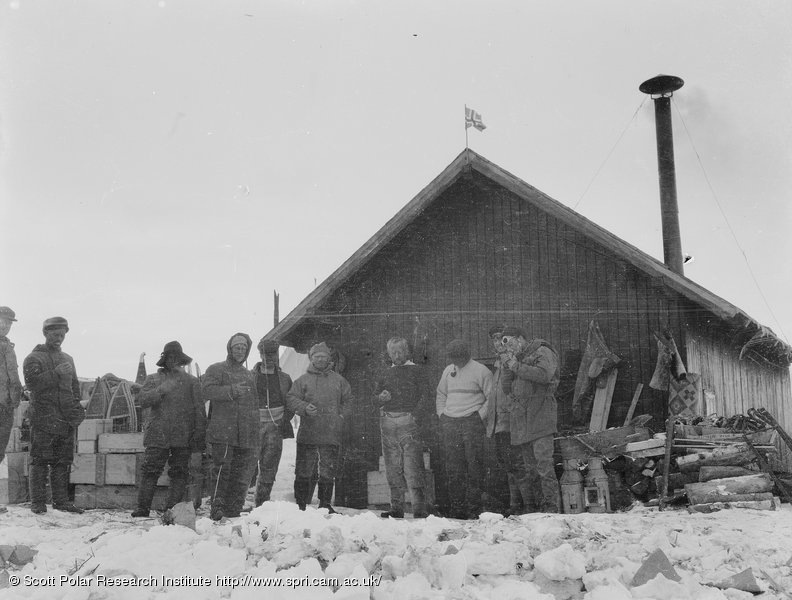 Campbell and his party at Framheim. At center, without a hat, is Amundsen, with Johansen at his right. Hassel is fourth from the left, with a fair beard. The man in the white jumper is probably Campbell. [9]
Campbell (who spoke Norwegian), Pennell, and Levick, the eastern party's surgeon, were invited to breakfast in the new hut, where Lindstrøm served them all hotcakes, and then they were given a tour of the Fram. "[Everyone] broke out in eulogies over how nice and comfortably we lived," Gjertsen said. "When they saw that every man had his own cabin, and everyone had a large common saloon, their eyes grew wide with astonishment. No, they had seen nothing like this before." Upon hearing how the officers' mess on the Terra Nova lay directly underneath the ponies, "one of Fram's crew was immediately seized by the deepest sympathy, and gave his melancholy informant ... a tot of aquavit to strengthen himself. The Englishman was wild with enthusiasm. Yes, it was 'a wonderful ship'."
Nilsen, after being shown over the Terra Nova in return, noted laconically, "I must confess it did not look very inviting." [10]
Johansen was not impressed either. "They should go to New Zealand immediately," he wrote in his diary. "They had a hard journey. Had been leaking and the bulwark was knocked in. But they were in good spirits and extremely courteous to us, though they nevertheless had not expected to meet us here. Something they repeatedly assured us." [11]
Amundsen told the British to land and make their base wherever they wanted, but, as Priestley put it, "we cannot according to etiquette trench on their country for winter quarters." [12] Campbell was deeply disappointed, having regarded the exploration of King Edward Land as "the thing of the whole expedition, " its only truly original work. [13] When Amundsen asked casually about the motor sledges, Campbell told him that one was "already on terra firma." He was referring, of course, to the one at the bottom of McMurdo Sound, but further information was neither asked for nor given. [14]
"It appears that ... Capt. Amundsen ... is going to have a run for the Pole so it will prove a very exciting affair," Dickason, one of the British seamen, wrote in his diary. "He has dogs for sledge work and all his men are good on ski." [15]
Notes:
[1] Alexander Turnbull Library, National Library of New Zealand. The catalogue record of this photograph identifies it as "The ship Terra Nova arriving at the Bay of Whales in 1910, to find the Norwegian expedition.... Photographed from 'Fram', the ship of Amundsen, by an unidentified photographer". It is clearly, however, the smoke-stackless, not to mention stocky and straight-sided, Fram.
[2] Roald Amundsen Bildearkiv, Nasjonalbiblioteket.
[3] Raymond Priestley, diary, [date not given], quoted by Roland Huntford in Scott and Amundsen (New York : Putnam, 1980, c1979), p.342.
[4] Wilfred Bruce, letter to Kathleen Scott, 27 February, 1911, quoted by Roland Huntford in Scott and Amundsen (New York : Putnam, 1980, c1979), p.342.
[5] Wilfred Bruce, letter to Kathleen Scott, 27 February, 1911, quoted by David Crane in Scott of the Antarctic (New York : Knopf, c2005), p.424.
[6] Lt. H.F. Gjertsen, diary, 4 February, 1911, quoted by Roland Huntford in Scott and Amundsen (New York : Putnam, 1980, c1979), p.341. The watchman was Beck, according to Gjertsen's account in ch.16 of The South Pole.
[7] Roald Amundsen Bildearkiv, Nasjonalbiblioteket.
[8] Lt. H.F. Gjertsen, diary, 4 February, 1911, quoted by Roland Huntford in Scott and Amundsen (New York : Putnam, 1980, c1979), p.341.
[9] Scott Polar Research Institute. The SPRI labels this photograph as being taken by Debenham, but he was in Victoria Land with Taylor, Wright, and P.O. Evans from January to March 1911; Levick probably took it, as he was quite interested in photography and had had lessons from Ponting.
[10] Thorvald Nilsen, diary, 4 February, 1911, quoted by Roland Huntford in Scott and Amundsen (New York : Putnam, 1980, c1979), p.344.
[11] Hjalmar Johansen, diary, 4 February 1911, published as Dagbok fra Sydpolen (Skien : Vågemot Miniforlag, 2007), p.6.
[12] Raymond Priestley, diary, 4 February, 1911, quoted by Roland Huntford in Scott and Amundsen (New York : Putnam, 1980, c1979), p.344.
[13] Victor Campbell [?], 27 February, 1911, quoted by David Crane in Scott of the Antarctic (New York : Knopf, c2005), p.424.
[14] Katherine Lambert, in The Longest Winter (Washington DC : Smithsonian, 2004, originally Hell with a Capital H, Pimlico, 2002) is the only writer yet found to state that the Norwegians did in fact find out that one of Scott's sledges had been lost: "Unfortunately, a member of the Eastern Party had let slip the fact that one of these machines was even then reposing on the floor of McMurdo Sound, a fact noted by Nilsen in his diary -- 'at 200 fathoms on the ice they had lost their best automobile.' Amundsen must have been profoundly relieved to hear this snippet of news" (p.53). Lambert does not give a citation for this or any of the diary quotes in this chapter.
[15] Harry Dickason, diary, 4 February 1911, quoted by Roland Huntford in Race for the South Pole : the expedition diaries of Scott and Amundsen (London : Continuum, c2010), p.18.
February 3, 2011
Friday, 3 February 1911
Scott
They shifted from day to night marching, in hopes of a better surface for the ponies, to no avail. "Then came the triumph of the snow-shoe again," wrote Scott. "If we had more of these shoes we could certainly put them on seven out of eight of our ponies ... as certainly the ponies so shod would draw their loads over the soft snow patches without any difficulty. It is trying to feel that so great a help to our work has been left behind at the station." [1]
Oates, sharing a tent with Gran and Keohane, wrote to his mother, "The surface of the barrier is very bad for travelling as the summer sun has melted the crust on the snow to a certain extent and the ponies break through almost to their knees.... These poor ponies are having a perfectly wretched time they have their summer coats on and this wind which is blowing now is bitterly cold for them I don't know how they will get on atal [sic], the dogs have bucked up a lot but don't drag much of a load. These reindeer sleeping bags are beastly smelly things but wonderfully warm in fact you could not get any sleep without one. I am very fit indeed it is marvellous how little one feels the cold I suppose it is owing to always being out in it. I have had no snow blindness yet as most people have and I hardly wear goggles atal the reason of this is I think that my eyes are sunk fairly well into my head and so don't get affected so quickly. This is a wonderful country and a great delight to travel in but one can hardly call it travelling for pleasure with 8 ponies to look after and if you take off your mitts you lose the use of your hands almost at once." [2]
Notes:
[1] R.F. Scott, diary, 3 February, 1911, quoted in Scott's Last Expedition, v.1.
[2] L.E.G. Oates, letter to Caroline Oates, [date not given], quoted by Sue Limb and Patrick Cordingley in Captain Oates : Soldier and Explorer (London : Batsford, c1982), p.112.
They shifted from day to night marching, in hopes of a better surface for the ponies, to no avail. "Then came the triumph of the snow-shoe again," wrote Scott. "If we had more of these shoes we could certainly put them on seven out of eight of our ponies ... as certainly the ponies so shod would draw their loads over the soft snow patches without any difficulty. It is trying to feel that so great a help to our work has been left behind at the station." [1]
Oates, sharing a tent with Gran and Keohane, wrote to his mother, "The surface of the barrier is very bad for travelling as the summer sun has melted the crust on the snow to a certain extent and the ponies break through almost to their knees.... These poor ponies are having a perfectly wretched time they have their summer coats on and this wind which is blowing now is bitterly cold for them I don't know how they will get on atal [sic], the dogs have bucked up a lot but don't drag much of a load. These reindeer sleeping bags are beastly smelly things but wonderfully warm in fact you could not get any sleep without one. I am very fit indeed it is marvellous how little one feels the cold I suppose it is owing to always being out in it. I have had no snow blindness yet as most people have and I hardly wear goggles atal the reason of this is I think that my eyes are sunk fairly well into my head and so don't get affected so quickly. This is a wonderful country and a great delight to travel in but one can hardly call it travelling for pleasure with 8 ponies to look after and if you take off your mitts you lose the use of your hands almost at once." [2]
Notes:
[1] R.F. Scott, diary, 3 February, 1911, quoted in Scott's Last Expedition, v.1.
[2] L.E.G. Oates, letter to Caroline Oates, [date not given], quoted by Sue Limb and Patrick Cordingley in Captain Oates : Soldier and Explorer (London : Batsford, c1982), p.112.
Subscribe to:
Posts (Atom)

