June 7, 2010

Tuesday, 7 June 1910

Amundsen

Fram on her way to the Antarctic, 10 June 1910. Photograph by Anders Beer Wiltse. [1]

"Sailed at midnight," Amundsen wrote in his diary. "Quietly and calmly we stand out of the Christiania Fjord. Soon the land will have disappeared from view and Fram will have begun her third voyage. God grant it will be to our credit." [2]

Most of he crew of the Fram, 1910. Back, from left: sailmaker Martin Rønne, engineer Knut Sundbeck, seaman and ice pilot Andreas Beck, carpenter Jørgen Stubberud. Middle row, from left: seaman and ice pilot Ludwig Hansen, ship's cook Karenius Olsen, second officer Lt. Kristian Prestrud, first mate Lt. Frederick Gjertsen, deck-hand and later third engineer H. Kristensen, cook Adolf Lindstrøm. Front, from left: dog-driver Sverre Hassel, Oskar Wisting, carpenter Olav Bjaaland, ice pilot and dog-driver Helmer Hanssen. [3]

They would spend a month on a preliminary cruise in the North Atlantic, taking oceanographical readings for Nansen. They would also, of course, be testing the Fram's new diesel motor and the men.

The 7th of June was, significantly, Norwegian Independence Day, marking the peaceful separation of the country from Swedish rule in 1905, the first time that Norway had been fully independent in over five hundred years.

The night before, Amundsen had revealed to Gjertsen and Prestrud that they were going south. "When asked whether they wished to take part in the new plan," he wrote laconically, "they both answered at once in the affirmative, and that settled it." [4]


Notes:

[1] Roald Amundsen Bildearkiv, Nasjonalbiblioteket.
[2] Roald Amundsen, diary, 8 June 1910, quoted by Roland Huntford in Scott and Amundsen (New York : Putnam, 1980, c1979), p.287-288.
[3] Nasjonalbiblioteket.
[4] Roald Amundsen, The South Pole, ch.3.

June 3, 2010

Friday, 3 June 1910

Scott

Debenham, Wright, Priestley, and Taylor (reading). Debenham and Priestley would meet the expedition in New Zealand and Australia, respectively. [1]

The Terra Nova arrived in Cardiff. Here they would be joined by more of the scientific staff.

T. Griffith Taylor, thirty, was an Australian geologist who received a Bachelor of Engineering in mining and metallurgy and had recently been elected a Fellow of the Geological Society. Encouraged by his Cambridge tutors and by his friend Douglas Mawson, recently returned from Shackleton's expedition, Taylor applied for the post of physiographer and geologist on Scott's expedition, and was accepted.

Charles S. Wright, nicknamed "Silas", was a twenty-three-year old Canadian physicist who had studied at the University of Toronto and won a postgraduate scholarship to Cambridge where he was now at the end of his two years research into cosmic rays. Impressed by Mawson, Wright had applied for Scott's expedition and been rejected.

Taylor then suggested to his friend that he should reapply to Scott in person; being academics and thus chronically short of funds, they decided to walk the fifty miles from Cambridge to London, with only a dozen hard-cooked eggs for sustenance. "Wright came through 'smiling'," Taylor later wrote of their ten-hour walk, "but my feet were so sore I could hardly stand the next day. My chief recollection is one of loathing for hard-boiled eggs, and of the relief with which I dropped three-quarters of our provisions in a secluded corner of King's Cross." [2]

After a brief interview, Scott changed his mind and Wright was engaged as expedition physicist, for the standard expedition rate of £4 per week for the first year. [3] It was still uncertain as to whether the expedition would remain for a second year.


Amundsen


The Fram off Uranienborg, June 1910. Amundsen stands in front with his dog. Photograph by Anders Beer Wilse. [4]

The Fram left Christiania and sailed down to anchor off Amundsen's home at Bundefjord. Verdens Gang, a Christiania newspaper, wrote that her "three yellow masts glistened in the sunlight, and ... the ship's black bulk stood out ... against the green ... forest-clad background.... Broad, sturdy and sober is she [and] a certain Sabbath peace hung over the vessel, as she lay there, at the edge of the gently rippled, slightly sombre fjord." [5]

Uranienborg, June 1910. Photograph by Anders Beer Wiltse. [6]

The "ice hut", June 1910. Photograph by Anders Beer Wiltse. [7]

The hut stood on the lawn at the water's edge for all to see, and was disassembled and stowed on board. "The more experienced among the members of the expedition," Amundsen wrote later, "were evidently absorbed in profound conjectures as to the meaning of this 'observation house,' as the newspapers had christened it. It may willingly be admitted that they had good reason for their speculations. By an observation house is usually meant a comparatively simple construction, sufficient to provide the necessary shelter from wind and weather. Our house, on the other hand, was a model of solidity, with three double walls, double roof and floor. Its arrangements included ten inviting bunks, a kitchen, and a table; the latter, moreover, had a brand-new American-cloth cover. 'I can understand that they want to keep themselves warm when they're making observations,' said Helmer Hanssen; 'but what they want with a cloth on the table I can’t make out.'" [8] Amundsen did not enlighten them.


Notes:

[1] "The TERRA NOVA Expedition 1910-13", south-pole.com.
[2] T. Griffith-Taylor, With Scott: the Silver Lining (London: Smith Elder, 1916), p.5, quoted by Adrian Raeside in Return to Antarctica: the Amazing Adventure of Sir Charles Wright on Robert Scott's Journey to the South Pole (Mississauga, Ont.: John Wiley, c2009), p.37-38.
[3] Wheeler, Sara, Cherry : a life of Apsley Cherry-Garrard (New York : Modern Library, 2003, c2001), p.66.
[4] GalleriNOR, Norsk Folkemuseum.
[5] Verdens Gang, 6 June 1910, quoted by Roland Huntford in Scott and Amundsen (New York : Putnam, 1980, c1979), p.287.
[6] GalleriNOR, Norsk Folkemuseum.
[7] GalleriNOR, Norsk Folkemuseum.
[8] Roald Amundsen, The South Pole, ch.3.

June 2, 2010

Thursday, 2 June 1910

Amundsen

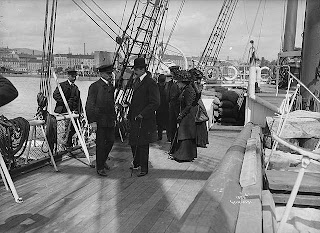
Amundsen speaks with King Haakon before the Fram's departure. Behind the King, Queen Maud stands with Nansen (partly obscured) and a group of visitors. Thorvald Nilsen stands outboard behind Amundsen. Photo: Anders Beer Wilse. [1]

King Haakon and Queen Maud visited the Fram on the Christiania waterfront. "We were warned in advance of Their Majesties' arrival," Amundsen wrote, "and we tried as best we could to bring a little order into the chaos on board. I am not sure whether we had much luck." [2]

Stowing the ship had taken over a month, for not only would there be no opportunity to take on stores on the journey, as the Terra Nova would have, but Fram's stores had to be loaded in such a way that once she reached the ice, each item was available in the correct order.


Notes:

[1] GalleriNOR, Norske Folkemuseum.
[2] Roald Amundsen, quoted by Roland Huntford in The Amundsen Photographs (London : Hodder & Stoughton, c1987), p.49.

June 1, 2010

Wednesday, 1 June 1910

Scott

The Terra Nova in Cardiff. [1]

Canadian explorer Robert Bartlett, who had been with Peary in 1908-09, attended the farewell luncheon at the RGS on 31st May, and, by special invitation, was at the docks to see the Terra Nova depart London for Cardiff the next day.

"Two things especially struck me about what I saw," Bartlett later wrote, "the attitude of the country and the kind of equipment ... there were gold lace and cocked hats and dignitaries enough to run a Navy. I couldn't help comparing all this formality with the shoddy, almost sneering attitude of the American public towards Peary's brave efforts.... The basis of all Peary's work was application of Eskimo methods .... In contrast to this, the British worked out their own theories. [They] proved on paper that it wasn't worth while to use dogs .... I thought of these things as I looked at the fine woollen clothing, the specially designed (in England) ... other gear. None of it looked like the Eskimo stuff that we were used to." [1]

Scott was not aboard; he stayed behind for last-minute fund-raising and final arrangements, leaving Teddy Evans in charge of the ship. Six of the staff were aboard -- Atkinson, Wright, Taylor, Gran, Oates, and Cherry -- the others were to join the ship in New Zealand and Australia.


Notes:

[1] Source unknown.
[2] Captain Robert Bartlett, The Log of Bob Bartlett, p.224, quoted by Roland Huntford in Scott and Amundsen (New York : Putnam, 1980, c1979), p.283.

May 31, 2010

May 1910

Scott

The first sight of Oates at the Victoria Street offices gave the expedition members something of a surprise. "We had pictured a smartly-turned-out young cavalry officer with hair nicely brushed up and neat moustache," Teddy Evans wrote later. "Our future companion turned up with a bowler characteristically on the back of his head and a very worn Aquascutum buttoned up closely round his neck, hiding his collar, and showing a strong, clean-shaven, weather-beaten face with kindly brown eyes indicative of his fine personality. 'I'm Oates,' he said." [1]

At the West India Docks a few days later, it was the same story. "We could none of us make out who or what he was when he came on board," Tom Crean remembered, "we never for a moment thought he was an officer for they were usually so smart! We made up our minds he was a farmer, he was always so nice and friendly, just like one of ourselves, but oh! he was a gentleman, quite a gentleman, and always a gentleman!" [2]

Frank Debenham later said that Oates's appearance was generally that of "a stableman with unusual good manners". [3]

Oates proved to be so useful as the Terra Nova was being fitted out, that Evans and Campbell asked that he be enrolled as a midshipman and stay onboard rather than go to Siberia with Meares to select the dogs and ponies. Scott agreed.


Notes:

[1] E.R.G.R. Evans, "My Recollections of a Gallant Comrade," The Strand Magazine, December 1913, quoted by Sue Limb and Patrick Cordingley in Captain Oates : Soldier and Explorer (London : Batsford, 1982), p.94-95.
[2] Tom Crean, quoted by Sue Limb and Patrick Cordingley in Captain Oates : Soldier and Explorer (London : Batsford, 1982), p.95.
[3] Frank Debenham, in The Quiet Land (1992), quoted by Diana Preston in A First Rate Tragedy (Boston : Houghton Mifflin, 1998, c1997), p.108.

May 1910

Scott

"Terra Nova, Tromsö, Norway, 1905", a watercolour by Russell W. Porter. [1]

The Terra Nova, although lately put into service as a relief ship for both the Jackson-Harmsworth Arctic expedition and Scott's own Discovery, was still equipped for her original use as a whaler, and was now in London's West India docks being refitted for the Antarctic: blubber-tanks removed, hold cleansed, bilges sluiced, hull reinforced with seven feet of sturdy oak.

Lt. Evans recorded "a multitude of necessities -- canvas for sail-making, fireworks for signalling, whale-boats and whaling-gear, flags, logs, paint, tar, carpenter's stores, blacksmith's outfit -- bought, borrowed or 'aquired'. We then 'had her barque-rigged'.... A large, well-insulated ice house was erected on the upper deck which held 150 carcasses of frozen mutton, and owing to the position of the cold chamber, free as it was from the vicinity of iron, we mounted here our standard compass and Lloyd Creek pedestal for magnetic work.... A new stove was put in the galley, a lamp-room and paraffin store built, and store rooms, instrument, and chronometer rooms were added.... Twenty-four bunks were fitted around the saloon accommodation ... laboratories ... constructed on [the] poop, while two large magazines and a clothing store were zinc-lined to keep them damp free." [2]


Notes:

[1] Papers of Russell W. Porter, 1893-1949 (XRWP), The National Archives and Records Administration. Porter was astronomer and artist for the American Ziegler/Fiala expedition to the Arctic in 1903-1905. The Terra Nova collected the stranded expedition in Franz Josef Land and brought them back to Tromsø.
[2] E.R.G.R. Evans, South with Scott, pp.27-29, quoted by David Crane in Scott of the Antarctic (New York : Knopf, c2005), p.364.

May 17, 2010

Tuesday, 17 May 1910

Scott

Gran joined the Terra Nova at the West India Docks. "Men tore about like busy ants," he wrote later, "Sailors were crawling over rigging and spars." Belowdecks, he added, "chaos also reigned." [1]

First mate Victor Campbell was already aboard. Campbell, an Old Etonian who had retired from a naval career at twenty-seven to live part of the year on a salmon river near Sandefjord in Norway, knew Gran from when they had met skiing at a Norwegian mountain hotel. Campbell's knowledge of ski was one of the reasons he had volunteered for Scott's expedition; he was to lead the party that was to explore King Edward VII Land. "He had a very nasty temper," Gran recalled, "& the nickname 'the wicked mate' was a right one. But he was a very good sailor." [2]


Notes:

[1] Tryggve Gran, Slik var Det, pp.75-76, quoted by Roland Huntford in Scott and Amundsen (New York : Putnam, 1980, c1979), p.280.
[2] Tryggve Gran, personal communication with Roland Huntford, quoted by Huntford in Scott and Amundsen (New York : Putnam, 1980, c1979), p.281.

April 25, 2010

Monday, 25 April 1910

Scott

"Cherry", photographed later on the expedition by Ponting, 30 August, 1911. [1]

Apsley Cherry-Garrard had been so inspired by Edward Wilson, whom he had met in 1908 at the home of Cherry-Garrard's cousin, Reginald Smith, the publisher of Scott's The Voyage of the 'Discovery' and a friend of Wilson's, that he submitted an application for Scott's new expedition as one of the "subscribing volunteers".

A shy, bespectacled young man of twenty-four, Cherry-Garrard had at Oxford rowed for his college and read Classics before switching in his second year to Modern History, and squeaked through with a third-class degree despite the burdens of burying both his father and his grandfather in the space of a few months and inheriting a large estate with its attendant responsibilities. Although deeply sensitive to his duties as head of the family and landowner, he found the life of a country squire unappealing, and took to travel as a means to satisfy a longing for adventure.

When he heard on 21st April that his application to join the expedition was turned down, he offered his donation of £1,000 regardless.

Four days later, Wilson wrote to him that "Captain Scott wants to see you again and have a talk over things with you before giving you a final answer. Can you manage to be at the office, 36 Victoria Street, on Wednesday forenoon, say at 11 o'clock?"

"I have received your cheque and I am withholding it," Wilson went on, "as Captain Scott wishes you to see him first. He says he must satisfy himself by a talk with you that there is no misunderstanding on the subject before coming to a determination, otherwise he feels you might both be in something of a false position. I believe he is right, and the time has come when you and he must understand one another. I can tell you one thing however, and that is that he very much appreciates the motive which induced you to send your subscription independently of your chance of being taken. That is an action which appeals to him, not because of the money for which he cares very little, except impersonally, insofar as it helps the Expedition to be a success, but because he knows what to expect of a man who felt it was the right thing to do."

"I know Scott intimately, as you know. I have known him now for ten years, and I believe in him so firmly that I am often sorry when he lays himself open to misunderstanding. I am sure that you will come to know him and believe in him as I do, and none the less because he is sometimes difficult. However you will soon see for yourself."

"Come prepared to be examined medically in the event of your being accepted, as we have arranged to overhaul everyone at the office that day." [1]

Scott was so impressed by Cherry-Garrard's gesture that he eventually agreed to accept him, and the young man was duly appointed assistant zoologist.


Amundsen

The Fram departed the dockyards at Horten for Christiania.


Notes:

[1] Scott Polar Research Institute.
[2] E.A. Wilson, letter to Apsley Cherry-Garrard, 25 April, 1910, quoted by Sara Wheeler in Cherry : a Life of Apsley Cherry-Garrard (New York : Modern Library, 2003, c2001), p.59-60.