June 2, 2010

Thursday, 2 June 1910

Amundsen

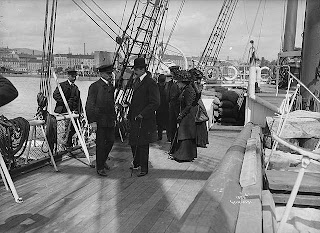
Amundsen speaks with King Haakon before the Fram's departure. Behind the King, Queen Maud stands with Nansen (partly obscured) and a group of visitors. Thorvald Nilsen stands outboard behind Amundsen. Photo: Anders Beer Wilse. [1]

King Haakon and Queen Maud visited the Fram on the Christiania waterfront. "We were warned in advance of Their Majesties' arrival," Amundsen wrote, "and we tried as best we could to bring a little order into the chaos on board. I am not sure whether we had much luck." [2]

Stowing the ship had taken over a month, for not only would there be no opportunity to take on stores on the journey, as the Terra Nova would have, but Fram's stores had to be loaded in such a way that once she reached the ice, each item was available in the correct order.


Notes:

[1] GalleriNOR, Norske Folkemuseum.
[2] Roald Amundsen, quoted by Roland Huntford in The Amundsen Photographs (London : Hodder & Stoughton, c1987), p.49.

June 1, 2010

Wednesday, 1 June 1910

Scott

The Terra Nova in Cardiff. [1]

Canadian explorer Robert Bartlett, who had been with Peary in 1908-09, attended the farewell luncheon at the RGS on 31st May, and, by special invitation, was at the docks to see the Terra Nova depart London for Cardiff the next day.

"Two things especially struck me about what I saw," Bartlett later wrote, "the attitude of the country and the kind of equipment ... there were gold lace and cocked hats and dignitaries enough to run a Navy. I couldn't help comparing all this formality with the shoddy, almost sneering attitude of the American public towards Peary's brave efforts.... The basis of all Peary's work was application of Eskimo methods .... In contrast to this, the British worked out their own theories. [They] proved on paper that it wasn't worth while to use dogs .... I thought of these things as I looked at the fine woollen clothing, the specially designed (in England) ... other gear. None of it looked like the Eskimo stuff that we were used to." [1]

Scott was not aboard; he stayed behind for last-minute fund-raising and final arrangements, leaving Teddy Evans in charge of the ship. Six of the staff were aboard -- Atkinson, Wright, Taylor, Gran, Oates, and Cherry -- the others were to join the ship in New Zealand and Australia.


Notes:

[1] Source unknown.
[2] Captain Robert Bartlett, The Log of Bob Bartlett, p.224, quoted by Roland Huntford in Scott and Amundsen (New York : Putnam, 1980, c1979), p.283.

May 31, 2010

May 1910

Scott

The first sight of Oates at the Victoria Street offices gave the expedition members something of a surprise. "We had pictured a smartly-turned-out young cavalry officer with hair nicely brushed up and neat moustache," Teddy Evans wrote later. "Our future companion turned up with a bowler characteristically on the back of his head and a very worn Aquascutum buttoned up closely round his neck, hiding his collar, and showing a strong, clean-shaven, weather-beaten face with kindly brown eyes indicative of his fine personality. 'I'm Oates,' he said." [1]

At the West India Docks a few days later, it was the same story. "We could none of us make out who or what he was when he came on board," Tom Crean remembered, "we never for a moment thought he was an officer for they were usually so smart! We made up our minds he was a farmer, he was always so nice and friendly, just like one of ourselves, but oh! he was a gentleman, quite a gentleman, and always a gentleman!" [2]

Frank Debenham later said that Oates's appearance was generally that of "a stableman with unusual good manners". [3]

Oates proved to be so useful as the Terra Nova was being fitted out, that Evans and Campbell asked that he be enrolled as a midshipman and stay onboard rather than go to Siberia with Meares to select the dogs and ponies. Scott agreed.


Notes:

[1] E.R.G.R. Evans, "My Recollections of a Gallant Comrade," The Strand Magazine, December 1913, quoted by Sue Limb and Patrick Cordingley in Captain Oates : Soldier and Explorer (London : Batsford, 1982), p.94-95.
[2] Tom Crean, quoted by Sue Limb and Patrick Cordingley in Captain Oates : Soldier and Explorer (London : Batsford, 1982), p.95.
[3] Frank Debenham, in The Quiet Land (1992), quoted by Diana Preston in A First Rate Tragedy (Boston : Houghton Mifflin, 1998, c1997), p.108.

May 1910

Scott

"Terra Nova, Tromsö, Norway, 1905", a watercolour by Russell W. Porter. [1]

The Terra Nova, although lately put into service as a relief ship for both the Jackson-Harmsworth Arctic expedition and Scott's own Discovery, was still equipped for her original use as a whaler, and was now in London's West India docks being refitted for the Antarctic: blubber-tanks removed, hold cleansed, bilges sluiced, hull reinforced with seven feet of sturdy oak.

Lt. Evans recorded "a multitude of necessities -- canvas for sail-making, fireworks for signalling, whale-boats and whaling-gear, flags, logs, paint, tar, carpenter's stores, blacksmith's outfit -- bought, borrowed or 'aquired'. We then 'had her barque-rigged'.... A large, well-insulated ice house was erected on the upper deck which held 150 carcasses of frozen mutton, and owing to the position of the cold chamber, free as it was from the vicinity of iron, we mounted here our standard compass and Lloyd Creek pedestal for magnetic work.... A new stove was put in the galley, a lamp-room and paraffin store built, and store rooms, instrument, and chronometer rooms were added.... Twenty-four bunks were fitted around the saloon accommodation ... laboratories ... constructed on [the] poop, while two large magazines and a clothing store were zinc-lined to keep them damp free." [2]


Notes:

[1] Papers of Russell W. Porter, 1893-1949 (XRWP), The National Archives and Records Administration. Porter was astronomer and artist for the American Ziegler/Fiala expedition to the Arctic in 1903-1905. The Terra Nova collected the stranded expedition in Franz Josef Land and brought them back to Tromsø.
[2] E.R.G.R. Evans, South with Scott, pp.27-29, quoted by David Crane in Scott of the Antarctic (New York : Knopf, c2005), p.364.

May 17, 2010

Tuesday, 17 May 1910

Scott

Gran joined the Terra Nova at the West India Docks. "Men tore about like busy ants," he wrote later, "Sailors were crawling over rigging and spars." Belowdecks, he added, "chaos also reigned." [1]

First mate Victor Campbell was already aboard. Campbell, an Old Etonian who had retired from a naval career at twenty-seven to live part of the year on a salmon river near Sandefjord in Norway, knew Gran from when they had met skiing at a Norwegian mountain hotel. Campbell's knowledge of ski was one of the reasons he had volunteered for Scott's expedition; he was to lead the party that was to explore King Edward VII Land. "He had a very nasty temper," Gran recalled, "& the nickname 'the wicked mate' was a right one. But he was a very good sailor." [2]


Notes:

[1] Tryggve Gran, Slik var Det, pp.75-76, quoted by Roland Huntford in Scott and Amundsen (New York : Putnam, 1980, c1979), p.280.
[2] Tryggve Gran, personal communication with Roland Huntford, quoted by Huntford in Scott and Amundsen (New York : Putnam, 1980, c1979), p.281.

April 25, 2010

Monday, 25 April 1910

Scott

"Cherry", photographed later on the expedition by Ponting, 30 August, 1911. [1]

Apsley Cherry-Garrard had been so inspired by Edward Wilson, whom he had met in 1908 at the home of Cherry-Garrard's cousin, Reginald Smith, the publisher of Scott's The Voyage of the 'Discovery' and a friend of Wilson's, that he submitted an application for Scott's new expedition as one of the "subscribing volunteers".

A shy, bespectacled young man of twenty-four, Cherry-Garrard had at Oxford rowed for his college and read Classics before switching in his second year to Modern History, and squeaked through with a third-class degree despite the burdens of burying both his father and his grandfather in the space of a few months and inheriting a large estate with its attendant responsibilities. Although deeply sensitive to his duties as head of the family and landowner, he found the life of a country squire unappealing, and took to travel as a means to satisfy a longing for adventure.

When he heard on 21st April that his application to join the expedition was turned down, he offered his donation of £1,000 regardless.

Four days later, Wilson wrote to him that "Captain Scott wants to see you again and have a talk over things with you before giving you a final answer. Can you manage to be at the office, 36 Victoria Street, on Wednesday forenoon, say at 11 o'clock?"

"I have received your cheque and I am withholding it," Wilson went on, "as Captain Scott wishes you to see him first. He says he must satisfy himself by a talk with you that there is no misunderstanding on the subject before coming to a determination, otherwise he feels you might both be in something of a false position. I believe he is right, and the time has come when you and he must understand one another. I can tell you one thing however, and that is that he very much appreciates the motive which induced you to send your subscription independently of your chance of being taken. That is an action which appeals to him, not because of the money for which he cares very little, except impersonally, insofar as it helps the Expedition to be a success, but because he knows what to expect of a man who felt it was the right thing to do."

"I know Scott intimately, as you know. I have known him now for ten years, and I believe in him so firmly that I am often sorry when he lays himself open to misunderstanding. I am sure that you will come to know him and believe in him as I do, and none the less because he is sometimes difficult. However you will soon see for yourself."

"Come prepared to be examined medically in the event of your being accepted, as we have arranged to overhaul everyone at the office that day." [1]

Scott was so impressed by Cherry-Garrard's gesture that he eventually agreed to accept him, and the young man was duly appointed assistant zoologist.


Amundsen

The Fram departed the dockyards at Horten for Christiania.


Notes:

[1] Scott Polar Research Institute.
[2] E.A. Wilson, letter to Apsley Cherry-Garrard, 25 April, 1910, quoted by Sara Wheeler in Cherry : a Life of Apsley Cherry-Garrard (New York : Modern Library, 2003, c2001), p.59-60.
March 21, 2010

Monday, 21 March 1910

Scott

The officers of the 1901-1904 British Antarctic Expedition aboard the Discovery. From left: Edward Wilson, Ernest Shackleton, Albert Armitage, Michael Barne, Reginald Koettlitz, Reginald Skelton, Capt. Robert Scott, Charles Royds, Louis Bernacchi, Hartley Ferrar, Thomas V. Hodgson. [1]

Skelton had assumed that the rank of second-in-command would be his, but the hiring of Lt. Evans put paid to that, as, although Skelton himself was willing to go in any capacity, Evans was unable to accept the notion of a commander of senior rank serving under him.

"I should be delighted to have you on the Expedition," Scott wrote to Skelton, "but it would be folly for me to indulge in a personal predilection and this may lead to friction -- I hope you see my position -- Evans would of course assent if I put my foot down but I don't think I ought to do that, for yielding on his part should be voluntary." [2]

Skelton, not only having sailed with Scott on the Discovery, but having developed the motor sledges for the new expedition, was understandably bitter about being jettisoned in favour of the inexperienced Evans. "If the dispensing with my services is so easy, I think it might have been put so 3 years ago when you [first] wrote ... to me about the motor sledge." [3]

"My dear chap, you are bound to feel sore over this matter and I cannot expect you will quite appreciate my motives. I am very grieved that it should be so.... I have the highest regard for your capabilities, your integrity, & your loyalty to myself," Scott wrote, adding at last, "I'm sorry awfully sorry." [4]


Notes:

[1] Wikimedia Commons.
[2] R.F. Scott, letter to Reginald Skelton, 21 March, 1910, quoted by David Crane in Scott of the Antarctic (New York : Knopf, c2005), p.361.
[3] Reginald Skelton, letter to R.F. Scott, 7 April, 1910, quoted by Roland Huntford in Scott and Amundsen (New York : Putnam, 1980, c1979), p.279.
[4] R.F. Scott, letter to Reginald Skelton, 3 April, 1910, quoted by David Crane in Scott of the Antarctic (New York : Knopf, c2005), p.362.

March 18, 2010

Friday, 18 March 1910

Scott

Earlier in the year Scott had hired Cecil Meares as dog expert. Meares, the son of a major in the Royal Scots Fusiliers, was a wanderer and adventurer, an expert on eastern Siberia and Manchuria who spoke Russian, Chinese, and Hindustani, had made a number of journeys by dog including one of some two thousand miles across Siberia to Cape Chelyuskin on the Arctic Ocean, and had been recommended to Scott by someone at the Admiralty.

From Nikolayevsk in Siberia, Meares wrote, "I have been kept very busy collecting dogs, trying teams & picking out one or two dogs and making up a team & trying it on a run of 100 miles & throwing out the dogs which do not come up to the mark.... I expect to be back in Vladivostock [sic] by the middle of June where I will collect the ponies.... It is a very long contract indeed to choose all these animals & carry them down to Australia single handed." [1]

Meares eventually collected thirty-four dogs there in Nikolayevsk, and persuaded a Russian dog-driver, Dimtri Gerov, to join the expedition as his assistant; they then travelled to Vladivostok, where they selected the ponies. Per Scott's instruction, Meares purchased only white ponies, as on the Nimrod expedition Shackleton had noted that the dark ponies succumbed first. As white ponies were only a small percentage of those available, Meares, who did not claim to be an expert on horses, was severely limited in choice. Anton Omelchenko, a Russian jockey Meares hired, reported afterwards that the horse dealer left "with a plenty big smile". [2]


Notes:

[1] Cecil Meares, letter to his father, 18 March, 1910, quoted by David Crane in Scott of the Antarctic (New York : Knopf, c2005), p.387-388.
[2] Anton Omelchenko, in Frank Debenham, diary, 18 June, 1911, quoted by Roland Huntford in Scott and Amundsen (New York : Putnam, 1980, c1979), p.325.